

Executive Summary
As cyber threats continue to evolve, organizations must proactively identify and eliminate security weaknesses before attackers can exploit them. Two of the most important cybersecurity practices are vulnerability assessments and penetration testing. Although these terms are often used interchangeably, they serve different purposes within an organization’s security strategy. Together, they form the foundation of effective vapt testing, helping businesses strengthen security, improve compliance, and reduce cyber risks.
- Vulnerability assessments identify potential security weaknesses
- Penetration testing validates exploitable vulnerabilities
- Both practices improve enterprise cyber resilience
- Proactive security reduces business and compliance risks
Introduction
Cyberattacks are becoming increasingly sophisticated, targeting organizations of all sizes across industries. Businesses rely on digital infrastructure, cloud environments, APIs, and connected applications that require continuous security monitoring.
Identifying vulnerabilities before cybercriminals do is critical for protecting sensitive data and ensuring business continuity. This is where vulnerability assessments and penetration testing play a vital role.
While both aim to improve security, they differ significantly in methodology, objectives, and outcomes. Understanding these differences enables organizations to implement a comprehensive cybersecurity strategy.
Looking to identify vulnerabilities before attackers do? Talk with our cybersecurity experts to build a proactive and resilient security strategy.

What is Vulnerability Assessment?
A vulnerability assessment is the systematic process of identifying, classifying, and prioritizing security weaknesses across an organization’s IT infrastructure.
Its primary objective is to detect known vulnerabilities before they can be exploited.
A typical assessment evaluates:
- Networks
- Servers
- Applications
- Cloud environments
- Endpoints
- Databases
Many organizations leverage vulnerability assessment services to perform regular scans, identify risks, and maintain continuous visibility into their security posture.
What is Penetration Testing?
Penetration testing is a simulated cyberattack performed by ethical security professionals to determine whether identified vulnerabilities can actually be exploited.
Unlike automated assessments, penetration testing evaluates real-world attack scenarios by attempting to gain unauthorized access to systems and applications.
Professional penetration testing services help organizations:
- Validate security controls
- Test incident response capabilities
- Identify attack paths
- Evaluate business impact
- Improve overall cyber resilience
Vulnerability Assessment vs Penetration Testing
Purpose
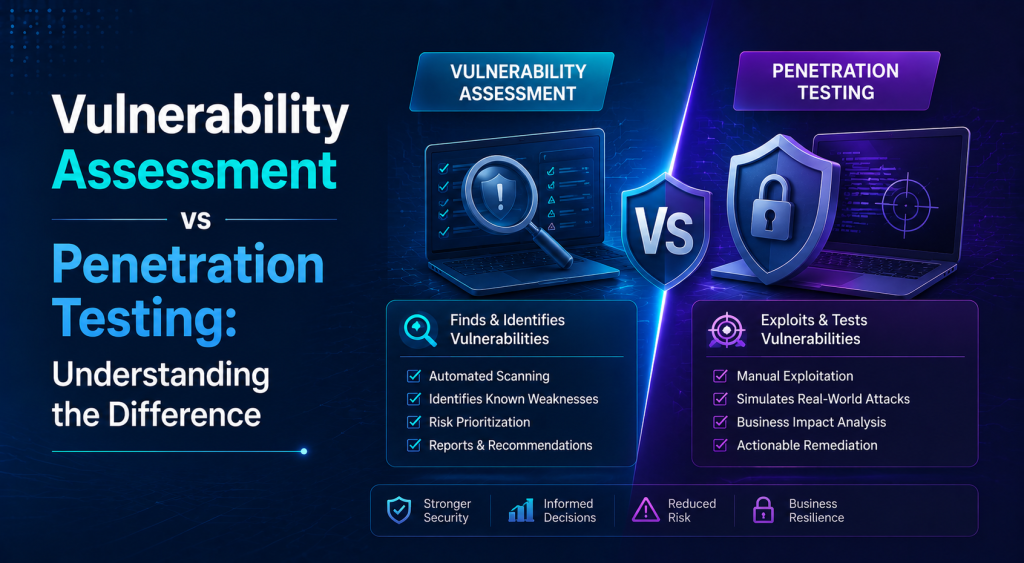
A vulnerability assessment identifies security weaknesses across systems and applications.
Penetration testing goes a step further by attempting to exploit those weaknesses to determine actual business risk.
Approach
Vulnerability assessments primarily rely on automated tools and predefined security checks.
Penetration testing combines automated tools with manual testing techniques performed by experienced ethical hackers.
Frequency
Vulnerability assessments are typically performed regularly as part of ongoing security monitoring.
Penetration testing is generally conducted periodically or after major infrastructure changes, application deployments, or compliance requirements.
Outcome
A vulnerability assessment provides a prioritized list of identified vulnerabilities.
Penetration testing delivers detailed findings showing how vulnerabilities could be exploited and the potential impact on the organization.
Why Organizations Need Both
Many businesses assume one security assessment is sufficient. However, vulnerability assessments and penetration testing complement one another.
Together, they help organizations:
- Identify hidden security gaps
- Validate existing security controls
- Reduce cyber risks
- Improve compliance readiness
- Strengthen incident response planning
A combined approach through vapt testing provides comprehensive visibility into enterprise security.
Benefits of Cybersecurity Assessment
A comprehensive cybersecurity assessment enables organizations to understand their overall security maturity and identify areas requiring improvement.
Key benefits include:
Improved Risk Visibility
Organizations gain a clear understanding of vulnerabilities across their digital infrastructure.
Better Compliance
Regular security assessments help support regulatory standards such as ISO 27001, PCI DSS, HIPAA, and GDPR.
Reduced Attack Surface
Identifying and remediating vulnerabilities minimizes opportunities for cybercriminals.
Enhanced Business Continuity
Proactive security testing reduces the likelihood of costly cyber incidents and operational disruptions.
Best Practices for Enterprise Security Testing
Organizations should adopt a layered security strategy that includes:
Continuous Vulnerability Scanning
Regular scans ensure newly discovered vulnerabilities are identified quickly.
Periodic Penetration Testing
Ethical hacking exercises validate the effectiveness of existing security controls.
Risk-Based Remediation
Prioritize vulnerabilities based on business impact rather than technical severity alone.
Security Awareness
Employee education complements technical security measures by reducing human-related risks.
Future of Security Testing
Cybersecurity testing continues to evolve with advancements in:
- AI-powered threat detection
- Continuous security validation
- Cloud-native security testing
- Zero Trust architectures
- Automated attack simulation
Organizations adopting proactive security testing strategies will be better prepared to defend against emerging cyber threats.
Conclusion
Vulnerability assessments and penetration testing are both essential components of a mature cybersecurity strategy. While vulnerability assessments identify weaknesses, penetration testing demonstrates how attackers could exploit them in real-world scenarios.
By combining both approaches, organizations gain a comprehensive understanding of their security posture, reduce cyber risks, and strengthen resilience against evolving threats. Investing in regular security assessments enables businesses to protect critical assets while supporting long-term digital transformation.
Strengthen your security posture with INT.’s comprehensive VAPT, risk assessment, and enterprise cybersecurity solutions. Let’s Connect.
FAQs
1. What is the difference between a vulnerability assessment and penetration testing?
A vulnerability assessment identifies security weaknesses, while penetration testing attempts to exploit those weaknesses to evaluate actual business risk.
2. What is VAPT testing?
VAPT testing combines vulnerability assessment and penetration testing to identify, validate, and prioritize security risks across enterprise systems.
3. Why are penetration testing services important?
Penetration testing services simulate real cyberattacks to identify exploitable vulnerabilities and evaluate the effectiveness of security controls.
4. What are vulnerability assessment services?
Vulnerability assessment services identify and prioritize security weaknesses across applications, networks, cloud environments, and IT infrastructure.
5. How often should organizations perform cybersecurity assessments?
Organizations should conduct vulnerability assessments regularly and perform penetration testing periodically or after major infrastructure or application changes.