
Executive Summary
Enterprises generate data across CRM, ERP, e-commerce, finance, supply chain, customer service, and other business applications. When these systems maintain different versions of the same customer, product, supplier, or location data, inconsistencies can affect reporting, operations, customer experiences, and decision-making.
Master data management provides a structured approach to creating and maintaining trusted, consistent records for critical business entities. With effective governance and integration, MDM can establish a reliable data foundation for enterprise applications, analytics, automation, and AI.
- MDM creates consistent records for critical business entities.
- It helps reduce duplicate, fragmented, and conflicting information.
- Data governance defines ownership, quality standards, and policies.
- Trusted master data improves reporting and operational decisions.
- MDM provides a stronger foundation for enterprise analytics and AI initiatives.
Introduction
Consider a large enterprise using separate platforms for sales, billing, customer support, marketing, and operations.
A single customer might appear differently across these systems. One application may contain an outdated address, another may use a different customer name, and a third may contain duplicate records.
Which version should employees trust?
The problem becomes significantly larger when enterprises manage millions of records across customers, products, suppliers, employees, assets, and locations.
MDM addresses this challenge by creating processes and technology frameworks that help organizations establish consistent and trusted master data across their technology ecosystem.
What Is Master Data Management?
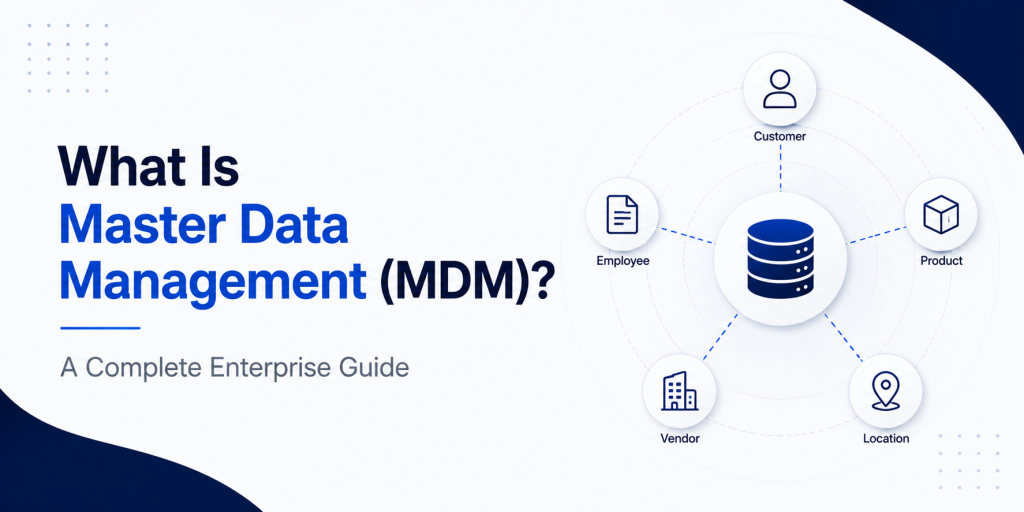
Master data management is a combination of processes, governance, technology, and standards used to create and maintain consistent, accurate, and authoritative records for critical business entities. These entities commonly include customers, products, suppliers, employees, locations, and assets that are shared across multiple enterprise systems.
The trusted representation of an entity is often referred to as a golden record.
What Is Master Data?
Master data represents relatively stable business entities that are repeatedly used across systems and processes.
Common master data domains include:
Customer Data
Names, contact details, customer identifiers, account relationships, and other core customer information.
Product Data
Product IDs, descriptions, categories, specifications, and other standardized attributes.
Supplier Data
Supplier identities, locations, classifications, and approved business information.
Location Data
Branches, offices, warehouses, stores, service locations, and geographical hierarchies.
Employee Data
Core employee identifiers and organizational information where applicable.
Master data differs from transactional data. A customer record is master data, while an individual purchase made by that customer is transactional data.
How Does Master Data Management Work?
A typical MDM process can be represented as:
Source Systems → Data Integration → Standardization → Matching & Deduplication → Validation → Golden Record → Governance → Enterprise Distribution
1. Collect Data
Information is brought together from systems such as:
- CRM
- ERP
- E-commerce platforms
- Finance systems
- Supply chain applications
- Customer service platforms
- Legacy systems
2. Standardize Data
Records are transformed into consistent formats. For example, naming conventions, addresses, product categories, and identifiers may be standardized.
3. Match and Deduplicate
MDM identifies records that potentially represent the same entity and resolves duplicates according to predefined rules.
4. Validate Information
Records are checked against data-quality rules to identify incomplete, invalid, or inconsistent information.
5. Create a Golden Record
Validated information is combined according to defined survivorship rules to establish an authoritative representation of an entity.
6. Govern the Data
Ownership, access, quality requirements, approval workflows, and lifecycle policies are applied.
7. Distribute Trusted Data
Approved master data can then be synchronized with relevant enterprise applications and analytical platforms.
Why Is Master Data Management Important?
Improves Data Quality
MDM can reduce duplicate, inconsistent, incomplete, and outdated information across systems.
Creates a Consistent Enterprise View
Teams can work from common definitions and trusted records rather than maintaining conflicting versions of important business entities.
Supports Better Customer Experiences
Accurate customer information can help sales, marketing, service, and digital platforms deliver more consistent interactions.
Improves Operational Efficiency
Employees spend less time manually reconciling information between disconnected applications.
Strengthens Decision-Making
Reliable master data gives business intelligence and reporting platforms a more trustworthy foundation.
What Are Master Data Management Solutions?
Master data management solutions provide capabilities for creating, governing, synchronizing, and monitoring master records across enterprise environments.
Typical capabilities include:
- Data integration
- Data cleansing
- Matching and deduplication
- Golden-record creation
- Data-quality management
- Hierarchy management
- Workflow management
- Data stewardship
- Governance controls
- Audit trails
- APIs and system integration
The appropriate architecture depends on an organization’s data landscape, business objectives, governance maturity, and existing technology stack.
Master Data Management vs Enterprise Data Management
Although related, MDM and enterprise data management are not identical.
| Area | Master Data Management | Enterprise Data Management |
| Primary Focus | Critical business entities | Enterprise-wide data |
| Typical Data | Customer, product, supplier, location | Master, transactional, analytical and other data |
| Main Goal | Create trusted master records | Manage data throughout the enterprise |
| Golden Record | Core capability | May incorporate MDM |
| Governance | Focused on master domains | Broader enterprise governance |
| Scope | Specific data domains | Organization-wide |
MDM can therefore be viewed as an important component of a broader enterprise data strategy.
What Is the Role of Data Governance in MDM?
Technology alone cannot establish trustworthy master data.
Organizations also need clear governance defining:
- Who owns each data domain?
- Who can create or modify records?
- What constitutes a valid record?
- Which source takes precedence?
- How are duplicates resolved?
- How is data quality measured?
- How long should information be retained?
Data Stewards
Data stewards help maintain quality and resolve issues that cannot be handled automatically.
Owners of the Data
Business data owners establish accountability for specific domains and approve important policies.
Together, technology, governance, and stewardship help maintain data quality over time.
How Does MDM Support Analytics and AI?
The relationship between Analytics and AI and MDM is becoming increasingly important.
AI models and analytical systems depend heavily on the quality of the information they receive. If duplicate, inconsistent, or incorrectly classified customer or product records exist, they can make downstream outputs unreliable.
MDM can support:
Better Business Intelligence
Standardized dimensions can improve consistency across dashboards and reports.
Customer 360
Combining trusted customer identities across systems helps organizations build more complete customer profiles.
AI Readiness
Well-governed master data provides AI applications with more consistent business context.
Personalization
Accurate customer and product information can improve recommendation and engagement systems.
Predictive Analytics
Trusted entity information provides a stronger foundation for models analyzing churn, risk, demand, or customer behavior.
MDM does not guarantee accurate AI outcomes, but it can significantly strengthen the underlying data foundation.
What Are Common MDM Use Cases?
Banking and Financial Services
Banks can establish consistent customer, account-related, product, and organizational reference information across complex technology environments.
Insurance
Insurers can improve consistency across policyholder, intermediary, product, provider, and other core data domains.
Life Sciences
Life sciences organizations may manage trusted records across products, HCPs, institutions, suppliers, and other regulated data environments.
Retail
Retailers can standardize customer, product, supplier, store, and inventory-related master information across physical and digital channels.
These use cases make MDM relevant across INT.’s strategic markets: Banking and Financial Services, Insurance, Life Sciences, and Retail & Diverse.
What Are the Challenges of MDM Implementation?
Data Silos
Business units may maintain separate systems with conflicting information.
Legacy Systems
Older platforms can make data extraction and synchronization more difficult.
Unclear Ownership
MDM initiatives often struggle when responsibility for data quality is undefined.
Poor Data Quality
Years of duplicate or inconsistent records may require significant cleansing before establishing golden records.
Organizational Adoption
Teams may resist changing existing data-management processes or giving up locally maintained definitions.
How Can Enterprises Implement MDM Successfully?
Step 1: Define Business Objectives
Identify measurable problems MDM should solve, such as duplicate customer records or inconsistent product information.
Step 2: Select Priority Data Domains
Organizations do not necessarily need to master everything at once. Begin with high-value domains.
Step 3: Assess Existing Data
Evaluate completeness, accuracy, duplication, consistency, and source systems.
Step 4: Establish Governance
Define data owners, stewards, quality rules, access policies, and accountability.
Step 5: Design the MDM Architecture
Determine how information will be integrated, mastered, governed, and distributed.
Step 6: Create Matching and Survivorship Rules
Define how duplicate records are identified and which values become authoritative.
Step 7: Integrate Enterprise Systems
Connect MDM with relevant operational, analytical, and digital platforms.
Step 8: Monitor Data Quality
Continuously track duplicates, completeness, consistency, and other quality metrics.
Conclusion
Master data management helps enterprises establish a consistent and trustworthy foundation for critical business information.
By integrating fragmented records, standardizing information, resolving duplicates, establishing golden records, and applying strong governance, MDM can improve operational efficiency and decision-making across the organization.
Its importance is also increasing as enterprises invest in advanced analytics and AI. Intelligent systems are only as dependable as the data foundations supporting them.
Organizations that treat MDM as a combination of technology, governance, processes, and business ownership—not simply another software implementation- will be better positioned to build scalable and reliable data ecosystems.
Build a trusted enterprise data foundation with INT.’s data engineering, analytics, AI, and digital transformation capabilities. Let’s Connect.
FAQs
1. What is master data management?
MDM is the process of creating and maintaining consistent, accurate, and governed records for critical business entities across multiple enterprise systems.
2. What is a golden record in MDM?
Organizations create a golden record as an authoritative representation of a business entity by combining and resolving information from relevant sources.
3. What is the difference between MDM and enterprise data management?
MDM focuses primarily on critical master entities, while enterprise data management covers the broader management of data across an organization.
4. How does MDM support AI and analytics?
MDM provides cleaner and more consistent business entities, helping improve the quality of data used by BI, predictive analytics, and AI applications.
5. What are common master data domains?
Common domains include customers, products, suppliers, employees, locations, and assets.