

Executive Summary
Enterprise technology environments are becoming increasingly complex as organizations accelerate digital transformation, adopt AI-driven operations, and modernize legacy infrastructure. To remain competitive, businesses must build a resilient technology foundation that supports agility, scalability, security, and innovation. In 2026, leading enterprises are focusing on four critical pillars of IT excellence: Intelligent Infrastructure Management, Performance Optimization, DevOps Excellence, and Cloud Transformation. Together, these capabilities enable organizations to improve operational efficiency, enhance customer experiences, and drive sustainable business growth.
- Intelligent infrastructure improves operational visibility
- Performance optimization enhances system reliability and efficiency
- DevOps accelerates software delivery and innovation
- Cloud transformation provides scalability and business agility
Introduction
Modern enterprises depend on technology to power customer experiences, operational processes, and business growth. However, fragmented infrastructure, legacy systems, performance bottlenecks, and slow development cycles can limit innovation and competitiveness.
To overcome these challenges, organizations need an integrated approach to IT modernization. Enterprise leaders are increasingly investing in infrastructure intelligence, cloud adoption, automation, and performance
Talk with our experts to design a scalable, resilient, and high-performing enterprise technology strategy, engineering to create future-ready technology ecosystems.

These investments form the foundation of Enterprise IT Excellence.
Pillar 1: Intelligent Infrastructure Management (iiM)
Infrastructure is the backbone of every digital enterprise. As environments become more distributed and data-intensive, organizations need intelligent systems that provide continuous visibility and control.
Intelligent Infrastructure Management helps enterprises:
- Monitor infrastructure health in real time
- Improve resource utilization
- Detect anomalies proactively
- Reduce operational downtime
- Strengthen business continuity
By leveraging automation, analytics, and AI-driven monitoring, organizations can move from reactive operations to proactive infrastructure management.
A strong infrastructure foundation also supports emerging technologies such as AI, analytics, and cloud native systems.
Pillar 2: Performance Optimization
Digital experiences depend heavily on system speed, responsiveness, and reliability. Even minor performance issues can impact customer satisfaction, employee productivity, and business outcomes.
Effective performance optimization helps organizations:
- Reduce latency and downtime
- Improve application responsiveness
- Optimize infrastructure utilization
- Enhance user experiences
- Increase operational efficiency
Modern enterprises increasingly rely on advanced monitoring and analytics to identify bottlenecks before they impact business operations.
A strategic approach to application performance optimization ensures that critical enterprise systems continue to perform efficiently as workloads scale and business demands evolve.
Pillar 3: DevOps Excellence
Speed and agility have become essential competitive advantages. Traditional development and operations models often create silos that slow innovation and increase operational complexity.
Devops for business enables organizations to bridge these gaps through automation, collaboration, and continuous delivery practices.
Key benefits include:
- Faster software releases
- Improved development efficiency
- Reduced deployment risks
- Better collaboration between teams
- Accelerated innovation cycles
Organizations that embrace DevOps can respond more quickly to market changes while maintaining quality and operational stability.
DevOps also plays a critical role in supporting cloud-native development and enterprise modernization initiatives.
Pillar 4: Cloud Consulting and Migration
Cloud adoption is no longer simply a technology initiative—it is a business transformation strategy. Enterprises require scalable, flexible, and cost-efficient environments capable of supporting innovation at scale.
Professional cloud consulting services help organizations develop cloud strategies aligned with business goals, operational requirements, and future growth plans.
Key focus areas include:
- Cloud readiness assessments
- Architecture planning
- Security and governance frameworks
- Infrastructure modernization
- Cloud optimization strategies
At the same time, effective cloud migration services enable businesses to move workloads, applications, and data seamlessly while minimizing disruption and risk.
Cloud transformation empowers enterprises to:
- Scale operations faster
- Improve business agility
- Support remote and hybrid work
- Accelerate innovation
- Optimize infrastructure costs
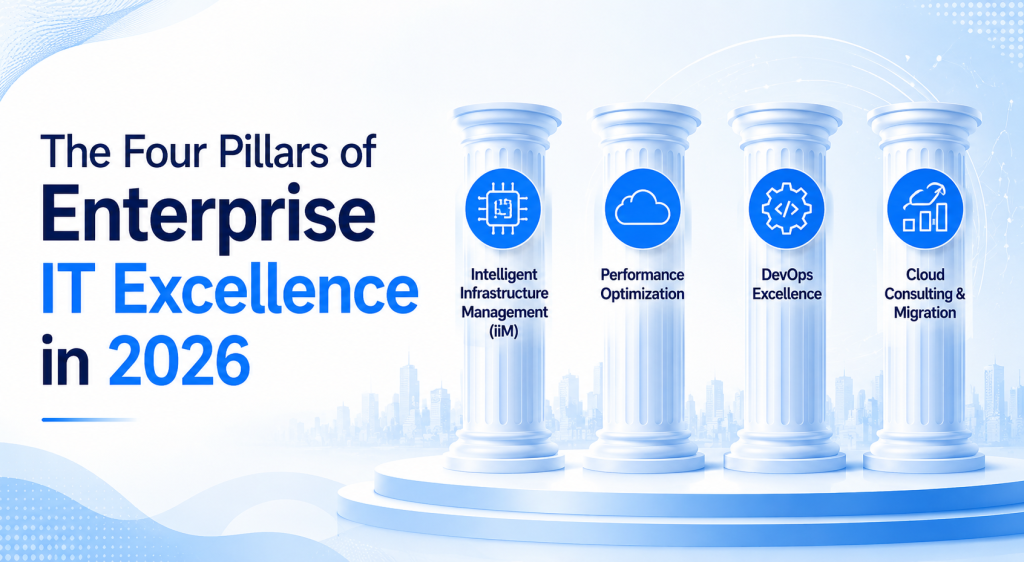
How the Four Pillars Work Together
While each pillar delivers value independently, the greatest impact occurs when they work together as part of a unified IT strategy.
For example:
- Intelligent infrastructure provides visibility and operational intelligence.
- Performance optimization ensures systems operate efficiently.
- DevOps accelerates innovation and delivery.
- Cloud transformation provides the scalable foundation for growth.
Together, these capabilities create a resilient, agile, and future-ready enterprise technology ecosystem.
Why Enterprise IT Excellence Matters in 2026
Organizations that invest in these four pillars gain:
- Greater operational efficiency
- Improved customer experiences
- Faster innovation cycles
- Enhanced business resilience
- Better scalability and flexibility
- Stronger competitive positioning
As AI, automation, and digital transformation continue reshaping industries, a modern IT foundation will become increasingly critical to business success.
Conclusion
Enterprise IT excellence is no longer defined by infrastructure alone. It requires a balanced strategy that combines intelligent infrastructure management, performance optimization, DevOps excellence, and cloud transformation.
Organizations that successfully integrate these four pillars can build scalable, resilient, and high-performing technology ecosystems capable of supporting innovation and long-term growth. In 2026, these capabilities will serve as the foundation for future-ready enterprises across every industry.
Build a future-ready enterprise with INT.’s expertise in intelligent infrastructure, cloud transformation, DevOps, and performance engineering. Let’s Connect.
FAQs
1. What are the four pillars of Enterprise IT Excellence?
The four pillars are Intelligent Infrastructure Management, Performance Optimization, DevOps Excellence, and Cloud Consulting & Migration.
2. Why is performance optimization important for enterprises?
Performance optimization improves system reliability, user experiences, operational efficiency, and overall business productivity.
3. How does DevOps support business growth?
DevOps accelerates software delivery, improves collaboration, reduces deployment risks, and enables faster innovation cycles.
4. What role does cloud transformation play in enterprise IT?
Cloud transformation provides scalability, flexibility, cost efficiency, and a foundation for digital innovation and modernization.
5. Why is intelligent infrastructure management important?
It enables proactive monitoring, operational visibility, improved resource utilization, and stronger business continuity.