

Executive Summary
In today’s fast-changing business environment, reacting to challenges after they occur is no longer enough. Organizations need the ability to anticipate market shifts, customer behavior, and operational risks before they impact business outcomes. By leveraging AI, advanced analytics, and predictive performance analytics, enterprises can transition from reactive decision-making to proactive strategies that improve agility, efficiency, and long-term growth. In 2026, predictive business strategies have become a competitive necessity for organizations pursuing digital transformation.
- Predictive analytics enables proactive business decisions.
- AI helps organizations identify opportunities and risks earlier.
- Data-driven forecasting improves operational efficiency.
- Predictive strategies strengthen business resilience and growth.
Introduction
Businesses generate enormous volumes of data every day through customer interactions, business operations, connected devices, and digital platforms. While historical reports explain what has already happened, they rarely provide the insights needed to prepare for future challenges.
Predictive business strategies use artificial intelligence and advanced analytics to forecast trends, identify potential risks, and recommend actions before problems arise. Instead of responding to disruptions after they occur, organizations can make informed decisions that improve performance, reduce uncertainty, and create new opportunities for innovation.
This shift from reactive to predictive operations is becoming a defining characteristic of successful enterprises. Ready to move from reactive operations to predictive business strategies? Talk with our experts to build an intelligent analytics ecosystem that accelerates growth and innovation.

Reactive vs Predictive Business Strategies
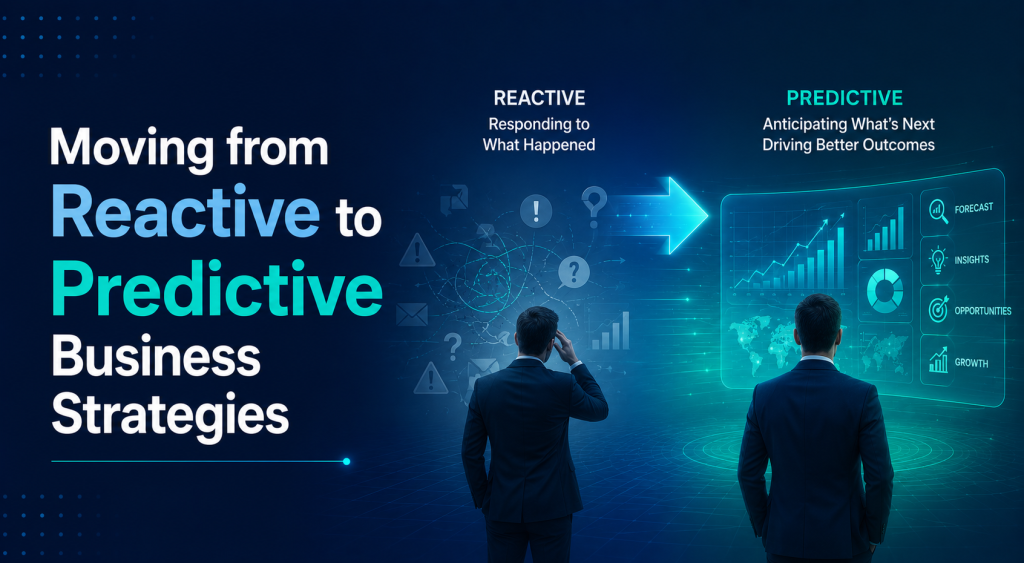
Reactive strategies focus on solving problems after they occur. Businesses typically respond to declining sales, system failures, customer complaints, or operational disruptions only when they become visible.
Predictive strategies, on the other hand, analyze historical and real-time data to anticipate future events. This enables organizations to take preventive actions, optimize resources, and improve decision-making before challenges affect business performance.
The result is a more agile, resilient, and competitive organization.
The Role of Predictive Analytics
Modern enterprises increasingly rely on predictive performance analytics to identify trends and improve strategic planning.
Predictive analytics helps organizations:
- Forecast customer demand
- Detect operational risks
- Improve financial planning
- Optimize resource allocation
- Support data-driven decision-making
These insights allow leaders to make proactive decisions based on likely future outcomes rather than historical observations alone.
Improving Operational Performance
Organizations that embrace predictive performance gain greater visibility into their operations.
Key benefits include:
- Early identification of performance bottlenecks
- Reduced operational downtime
- Improved workforce productivity
- Better asset utilization
- Faster response to changing business conditions
Proactive performance management enables businesses to operate more efficiently while reducing unnecessary costs.
Importance of Data Analytics
Successful predictive strategies depend on high-quality data analytics.
By collecting and analyzing information from multiple business systems, organizations can:
- Identify customer behavior patterns
- Monitor operational trends
- Detect anomalies
- Improve forecasting accuracy
- Generate actionable business insights
Reliable analytics forms the foundation for intelligent business planning and continuous improvement.
Role of Data Analytics Services
Many organizations partner with providers offering data analytics services to accelerate their predictive analytics initiatives.
These services help businesses:
- Integrate enterprise data sources
- Build predictive models
- Develop interactive dashboards
- Improve data governance
- Implement AI-powered analytics solutions
Working with experienced analytics partners enables organizations to transform raw data into strategic business intelligence.
Challenges to Overcome
Transitioning to predictive business strategies requires organizations to address several challenges:
- Data quality and consistency
- Legacy technology integration
- Skills and analytics expertise
- Data privacy and compliance
- Organizational change management
Developing a clear analytics roadmap and investing in the right technologies are essential for long-term success.
Future of Predictive Business Strategies
The future of business strategy will increasingly rely on:
- AI-driven forecasting
- Real-time business intelligence
- Predictive decision intelligence
- Intelligent automation
- Autonomous business operations
Organizations that adopt predictive capabilities today will be better equipped to respond to market changes, improve customer experiences, and maintain a competitive advantage.
Conclusion
Reactive decision-making is no longer sufficient in an increasingly dynamic business landscape. Predictive business strategies empower organizations to anticipate challenges, optimize operations, and make informed decisions based on future insights rather than past events.
By combining AI, predictive analytics, and enterprise data, businesses can improve resilience, increase operational efficiency, and unlock sustainable growth in the digital economy.
Turn your enterprise data into predictive insights with INT.’s AI and analytics solutions designed to drive smarter business decisions. Let’s Connect.
FAQs
1. What is a predictive business strategy?
A predictive business strategy uses AI and analytics to forecast future trends, identify risks, and support proactive decision-making.
2. How does predictive analytics improve business performance?
It enables organizations to anticipate challenges, optimize operations, improve forecasting accuracy, and make better strategic decisions.
3. What is predictive performance analytics?
Predictive performance analytics uses historical and real-time data to forecast operational outcomes and identify opportunities for performance improvement.
4. Why is data analytics important for predictive strategies?
Data analytics provides the insights needed to identify trends, understand business performance, and build accurate predictive models.
5. How do data analytics services help businesses?
They help organizations integrate data, implement predictive models, improve reporting, and generate actionable insights that support business growth.