


Executive Summary
As enterprises accelerate digital transformation, selecting the right application development strategy has become a critical business decision. While low-code platforms enable rapid application delivery with minimal coding, custom development offers greater flexibility, scalability, and control for complex business requirements. Choosing the right approach depends on an organization’s goals, technical needs, and long-term growth plans. In 2026, businesses are increasingly evaluating whether a low code development platform or custom app development is better suited to support enterprise-scale innovation.
- Low-code accelerates application delivery
- Custom development offers greater flexibility and scalability
- Enterprise application strategies should align with long-term business goals
- The right approach depends on complexity, security, and future growth
Introduction
Modern enterprises are under constant pressure to deliver digital solutions faster while maintaining security, scalability, and operational efficiency. As customer expectations evolve and competition intensifies, organizations need application strategies that support continuous innovation.
This has led many businesses to compare low-code platforms with traditional development approaches. While low-code solutions promise faster deployment and reduced development effort, custom-built applications provide the flexibility required for complex enterprise ecosystems.
Understanding the strengths and limitations of each approach enables organizations to make informed technology investments that support long-term success.
What is Low-Code Development?
A low-code platform allows developers and business users to create applications using visual interfaces, drag-and-drop components, and prebuilt modules instead of extensive manual coding.
Low-code platforms help organizations:
- Accelerate application delivery
- Reduce development time
- Simplify workflow automation
- Enable rapid prototyping
- Improve collaboration between IT and business teams
These platforms are ideal for applications with standard business processes and relatively straightforward functionality.
What is Custom App Development?
Custom app development involves designing and building applications specifically tailored to an organization’s unique business processes, operational requirements, and long-term objectives.
Unlike off-the-shelf or low-code solutions, custom applications provide complete control over architecture, functionality, integrations, security, and user experience.
Businesses investing in custom app development gain applications that evolve alongside their operations without being restricted by platform limitations.
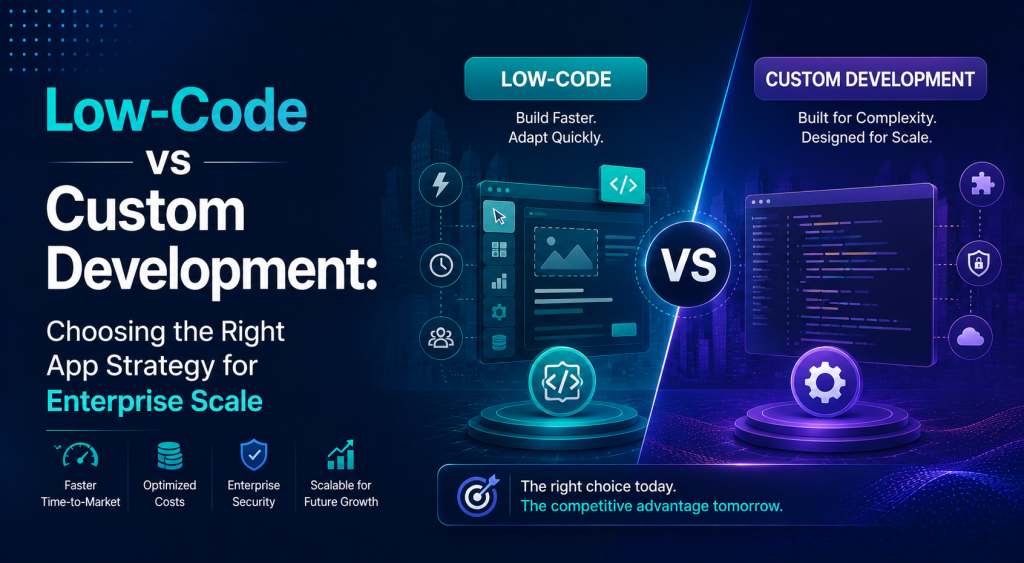
Low-Code vs Custom Development
Development Speed
Low-code platforms significantly reduce development timelines through reusable components and visual development tools.
Custom development requires more planning, coding, and testing but produces highly tailored solutions.
Flexibility and Customization
Low-code applications work well for standardized workflows but may become restrictive as business complexity grows.
Custom-built applications allow organizations to create highly specialized features, workflows, and integrations that support unique business requirements.
Scalability
As organizations expand, applications must support increasing workloads, users, and integrations.
Custom solutions provide stronger scalability and performance for enterprise environments, making them ideal for enterprise application development initiatives.
Integration Capabilities
Enterprise applications often need to connect with ERP systems, CRM platforms, cloud environments, AI solutions, and third-party services.
Custom applications provide greater flexibility for building secure and seamless integrations across enterprise ecosystems.
Security and Compliance
Industries such as banking, insurance, healthcare, and retail require strict regulatory compliance and advanced security controls.
Custom-built applications provide greater control over security architecture, governance, and compliance requirements.
When Should Enterprises Choose Low-Code?
A low-code approach is suitable when organizations need:
Rapid Application Delivery
Businesses can launch internal tools and simple business applications quickly.
Workflow Automation
Low-code platforms are effective for digitizing repetitive business processes.
Department-Level Applications
Teams can build operational dashboards, approval workflows, and internal applications with minimal development effort.
When Should Enterprises Choose Custom Development?
Organizations should consider custom application development services when applications require:
Complex Business Logic
Enterprise operations often involve specialized workflows that standard platforms cannot easily support.
High Scalability
Applications supporting thousands of users or mission-critical operations require scalable architectures.
Advanced Integrations
Custom applications connect seamlessly with multiple enterprise systems while maintaining flexibility and performance.
Long-Term Digital Transformation
Custom development provides the foundation for continuous innovation and evolving business needs.
Choosing the Right Strategy
Rather than viewing low-code and custom development as competing approaches, many enterprises successfully combine both.
Organizations often use:
- Low-code platforms for internal productivity applications
- Custom development for customer-facing platforms
- Hybrid strategies for balancing speed and flexibility
The right decision depends on business complexity, budget, scalability requirements, and long-term technology strategy.
Future of Enterprise Application Development
Enterprise application strategies will increasingly focus on:
- AI-assisted software development
- Cloud-native architectures
- Composable applications
- API-first ecosystems
- Intelligent automation
Organizations adopting flexible development strategies today will be better positioned to innovate, scale, and respond to evolving market demands.
Conclusion
Both low-code and custom development offer unique advantages for modern enterprises. While low-code platforms enable rapid delivery and faster innovation, custom applications provide the flexibility, scalability, and control required for complex enterprise environments.
Businesses should evaluate their operational requirements, long-term objectives, and technical complexity before selecting an application strategy. By choosing the right development approach, organizations can accelerate digital transformation while building resilient and future-ready digital ecosystems.
Accelerate digital transformation with INT.’s custom application development expertise, delivering scalable, secure, and future-ready enterprise solutions. Let’s Connect.
FAQs
1. What is the difference between low-code and custom development?
Low-code uses visual development tools for faster application creation, while custom development builds fully tailored applications through traditional programming.
2. When should businesses choose custom app development?
Businesses should choose custom app development when they require complex workflows, advanced integrations, scalability, stronger security, and long-term flexibility.
3. What are custom application development services?
Custom application development services involve designing, developing, integrating, and maintaining applications built specifically for an organization’s unique business requirements.
4. Is a low-code development platform suitable for enterprises?
Yes, low-code platforms are suitable for internal applications and workflow automation, but complex enterprise systems often require custom development.
5. Why is enterprise application development important?
Enterprise application development enables organizations to build scalable, secure, and integrated solutions that improve operational efficiency and support business growth.