

Executive Summary
Business intelligence has evolved from simply reporting historical data to generating actionable insights that help organizations anticipate future outcomes. Predictive analytics is at the center of this transformation, enabling enterprises to forecast trends, identify opportunities, and mitigate risks before they occur. By combining historical data, machine learning, and advanced analytics, organizations can improve decision-making and gain a competitive advantage. In 2026, enterprises leveraging predictive analytics within their business intelligence systems are better positioned to drive growth, improve efficiency, and strengthen strategic planning.
- Predictive analytics enables proactive decision-making
- Business intelligence becomes more actionable and forward-looking
- Data-driven forecasting improves operational efficiency
- Organizations gain better visibility into future business outcomes
Introduction
Modern enterprises generate vast amounts of data from customers, operations, applications, and digital platforms. While traditional business intelligence systems help organizations understand what happened in the past, today’s business environment requires businesses to anticipate what will happen next.
This is where predictive analytics becomes critical. By analyzing historical and real-time information, predictive models help enterprises identify patterns, forecast outcomes, and make informed strategic decisions.
Organizations integrating predictive analytics into their intelligence frameworks can improve agility, reduce uncertainty, and unlock greater value from their data investments.
Looking to transform enterprise data into actionable future insights? Talk with our experts to build scalable predictive analytics and business intelligence ecosystems.

What is Predictive Analytics?
Predictive analytics is the practice of using statistical models, machine learning algorithms, and historical information to forecast future events and outcomes.
Predictive analytics helps organizations:
- Forecast market trends
- Identify customer behavior patterns
- Predict operational risks
- Improve resource planning
- Support strategic decision-making
When combined with modern business intelligence platforms, predictive analytics transforms raw information into actionable foresight.
What are Business Intelligence Systems?
Business intelligence systems are platforms and technologies that collect, process, analyze, and visualize enterprise information to support decision-making.
These systems help organizations:
- Monitor performance metrics
- Generate operational reports
- Analyze business trends
- Improve strategic planning
- Enhance organizational visibility
Modern business analytics strategies increasingly rely on predictive capabilities to move beyond descriptive reporting.
Why Predictive Analytics Matters in Business Intelligence
Moving Beyond Historical Reporting
Traditional BI platforms focus primarily on past performance.
Predictive analytics helps organizations:
- Forecast future outcomes
- Anticipate customer demands
- Identify emerging risks
- Improve business planning
This enables more proactive and strategic decision-making.
Improving Accuracy of Business Decisions
Predictive models use historical and real-time information to generate data-driven recommendations.
Organizations can make better decisions related to:
- Sales forecasting
- Inventory management
- Customer engagement
- Operational planning
This reduces uncertainty and improves business outcomes.
How Data Analytics Powers Predictive Intelligence
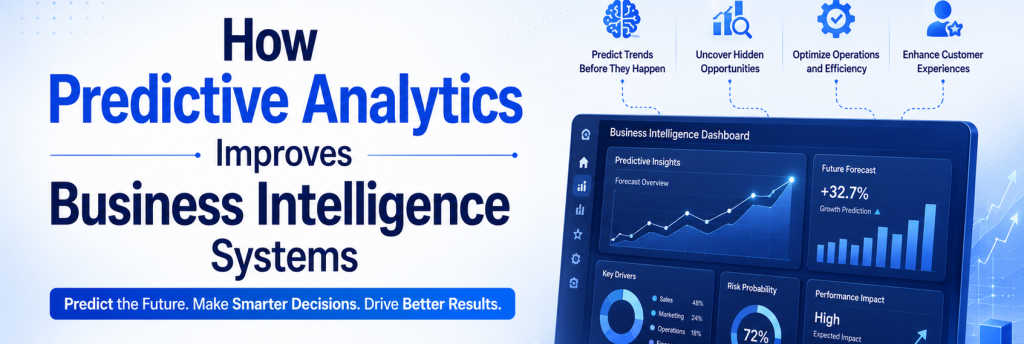
Predictive systems depend heavily on accurate and scalable data analytics frameworks.
Modern analytics ecosystems help organizations:
- Process large volumes of information
- Identify hidden patterns
- Generate predictive models
- Improve forecasting accuracy
Without strong data analytics capabilities, predictive intelligence initiatives may struggle to deliver reliable insights.
Key Benefits of Predictive Analytics in Business Intelligence
Enhanced Customer Insights
Predictive models help businesses understand customer preferences, behaviors, and future purchasing patterns.
Benefits include:
- Personalized experiences
- Better customer retention
- Improved marketing effectiveness
- Increased customer satisfaction
Better Risk Management
Organizations can identify operational, financial, and market risks before they become significant business challenges.
Improved Operational Efficiency
Predictive intelligence helps optimize:
- Resource allocation
- Workforce planning
- Supply chain operations
- Inventory management
This improves productivity and reduces operational waste.
Stronger Strategic Planning
Predictive analytics enables organizations to align decisions with future opportunities and market trends.
Role of AI and Machine Learning
Artificial intelligence and machine learning significantly enhance predictive analytics capabilities.
AI-driven systems help organizations:
- Analyze complex datasets
- Detect anomalies automatically
- Generate real-time predictions
- Improve model accuracy continuously
Modern business analytics platforms increasingly integrate AI to deliver intelligent forecasting and decision support.
Importance of Data Analytics Services
As predictive ecosystems become more sophisticated, enterprises increasingly rely on specialized data analytics services to design, implement, and optimize predictive intelligence frameworks.
These services help organizations:
- Build scalable analytics infrastructures
- Develop predictive models
- Improve data quality and governance
- Accelerate analytics adoption
Professional data analytics services enable enterprises to maximize the value of their business intelligence investments.
Challenges Enterprises Must Address
Data Quality Issues
Predictive models require accurate, complete, and consistent information to generate reliable forecasts.
Integration Complexity
Organizations often struggle to integrate predictive systems with existing BI platforms and legacy infrastructure.
Skills and Expertise Gaps
Advanced predictive analytics requires expertise in data science, AI, and enterprise analytics.
Governance and Compliance
Businesses must ensure predictive systems align with data privacy, security, and regulatory requirements.
A strategic approach helps organizations overcome these challenges effectively.
Future of Predictive Analytics in Business Intelligence
The future of predictive intelligence will increasingly focus on:
- AI-powered forecasting
- Autonomous analytics platforms
- Real-time predictive decision-making
- Intelligent business planning
- Hyper-personalized customer insights
Organizations investing in predictive intelligence today will gain stronger agility, resilience, and competitive advantage in the future.
Conclusion
Predictive analytics is transforming business intelligence systems from reactive reporting tools into proactive decision-making platforms. By combining advanced analytics, AI, and forecasting capabilities, organizations can anticipate future outcomes, improve operational efficiency, and make smarter strategic decisions.
As enterprises continue accelerating digital transformation in 2026, predictive intelligence will become a key driver of business growth, innovation, and competitive advantage.
Unlock the power of predictive intelligence with INT.’s advanced analytics, AI, and business intelligence solutions. Let’s Connect.
FAQs
1. What is predictive analytics in business intelligence?
Predictive analytics uses historical data, AI, and statistical models to forecast future outcomes and improve enterprise decision-making within business intelligence systems.
2. How does predictive analytics improve business intelligence?
Predictive analytics transforms business intelligence from historical reporting into proactive forecasting, helping organizations anticipate trends, opportunities, and potential risks effectively.
3. Why is data analytics important for predictive intelligence?
Data analytics provides the foundation for predictive models by collecting, processing, and analyzing information needed to generate accurate business forecasts.
4. What are the benefits of predictive analytics for enterprises?
Benefits include improved forecasting, better customer insights, stronger risk management, enhanced operational efficiency, and more informed strategic decision-making capabilities.5. How do data analytics services support predictive analytics initiatives?
Data analytics services help organizations build scalable infrastructures, develop predictive models, improve data governance, and maximize business intelligence outcomes effectively.