
Executive Summary
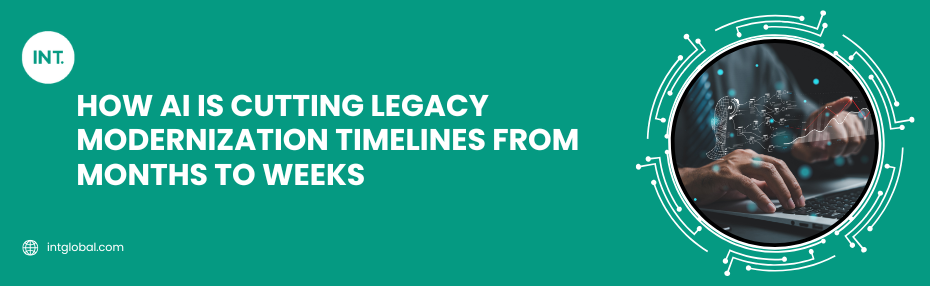
Legacy systems continue to support critical business operations across industries, but they often slow innovation, increase maintenance costs, and limit scalability. Traditionally, modernization projects required months or even years of planning, code migration, testing, and deployment. Today, artificial intelligence is transforming this process by automating repetitive tasks, identifying modernization opportunities, and accelerating decision-making. Organizations investing in Application Modernization are using AI to shorten project timelines, reduce risks, and modernize legacy systems more efficiently than ever before.
- AI accelerates application assessment and migration
- Automation reduces manual coding and testing efforts
- Faster modernization minimizes business disruption
- Intelligent modernization improves scalability and agility
Introduction
Many enterprises still rely on legacy applications that power mission-critical operations. While these systems remain valuable, they often struggle to integrate with modern technologies, support cloud environments, or meet evolving customer expectations.
Modernizing legacy applications has traditionally been a complex, time-consuming process involving extensive code reviews, dependency analysis, infrastructure upgrades, and testing. As organizations face increasing pressure to innovate, AI is emerging as a powerful accelerator for modernization initiatives.
By automating key phases of modernization, AI enables businesses to move from outdated systems to modern architectures in weeks instead of months. Ready to transform legacy applications into future-ready digital platforms? Talk with our experts to build a smarter modernization roadmap.

What is AI-Driven Application Modernization?
Application Modernization involves transforming existing applications to improve performance, scalability, security, and compatibility with modern technologies.
AI enhances modernization by helping organizations:
- Analyze legacy code automatically
- Identify modernization opportunities
- Recommend optimal migration strategies
- Generate code suggestions
- Automate testing and validation
This intelligent approach reduces manual effort while improving project accuracy and speed.
Why Traditional Legacy Modernization Takes So Long
Several factors contribute to lengthy modernization projects:
Complex Legacy Systems
Older applications often contain millions of lines of code with undocumented dependencies and outdated technologies.
Manual Code Analysis
Developers spend significant time understanding legacy code before planning modernization efforts.
Extensive Testing
Application migration requires comprehensive testing to ensure functionality, security, and business continuity.
Integration Challenges
Legacy applications often connect with multiple enterprise systems, making modernization more complex.
These challenges have traditionally extended project timelines and increased implementation risks.
How AI Accelerates Legacy Modernization
Intelligent Code Analysis
AI rapidly scans legacy codebases to identify dependencies, redundant components, and modernization opportunities.
This significantly reduces the time spent on manual application assessments.
Automated Code Transformation
AI-powered tools can recommend or generate modern code structures, helping development teams accelerate legacy application modernization initiatives while maintaining application functionality.
Faster Testing and Validation
AI automates test case generation, identifies defects, and validates application behavior across multiple environments.
This shortens testing cycles and improves deployment confidence.
Predictive Project Planning
AI analyzes application complexity and infrastructure requirements to recommend modernization strategies that minimize risks and optimize timelines.
Benefits of AI-Powered Modernization
Organizations adopting AI-driven modernization achieve several advantages:
Reduced Project Timelines
Automation significantly decreases the time required for assessment, migration, testing, and deployment.
Lower Costs
Reduced manual effort and faster project completion help control modernization expenses.
Improved Accuracy
AI minimizes human errors during code analysis and migration.
Better Business Continuity
Incremental modernization reduces downtime and minimizes disruption to critical business operations.
Many organizations partner with providers offering application modernization services to combine AI capabilities with technical expertise for faster and more successful outcomes.

AI and Legacy System Modernization
Modern enterprises are increasingly using AI to support legacy system modernization by enabling gradual, low-risk transformation rather than large-scale replacement projects.
AI assists with:
- Cloud migration planning
- API generation
- Documentation creation
- Dependency mapping
- Performance optimization
These capabilities help organizations modernize critical systems while preserving business continuity.
Future of AI in Application Modernization
The future of modernization will increasingly focus on:
- AI-assisted code refactoring
- Autonomous testing
- Intelligent migration planning
- Cloud-native transformation
- Continuous modernization through automation
Organizations that embrace AI-driven modernization today will be better equipped to adapt to evolving technologies and changing business requirements.
Conclusion
Legacy modernization no longer needs to be a lengthy and resource-intensive process. By leveraging artificial intelligence, organizations can automate code analysis, accelerate migration, reduce testing effort, and significantly shorten project timelines.
As digital transformation continues to reshape industries, AI-powered modernization offers a faster, smarter, and more cost-effective path toward building scalable, secure, and future-ready enterprise applications.
Accelerate your modernization journey with INT.’s AI-powered application modernization solutions that reduce risk and deliver faster business outcomes. Let’s Connect.
FAQs
1. What is application modernization?
Application modernization involves updating legacy applications to improve scalability, performance, security, and compatibility with modern technologies.
2. How does AI accelerate legacy modernization?
AI automates code analysis, migration planning, testing, documentation, and code transformation, reducing project timelines and improving efficiency.
3. What is legacy application modernization?
Legacy application modernization is the process of upgrading outdated applications to support modern business requirements and digital technologies.
4. Why are application modernization services important?
Application modernization services provide the expertise, tools, and methodologies needed to reduce modernization risks and accelerate transformation.
5. What are the benefits of legacy system modernization?
Legacy system modernization improves business agility, reduces maintenance costs, strengthens security, enhances scalability, and supports long-term digital transformation.