

Executive Summary
Data analytics is a critical enabler of data-driven decision making, helping enterprises transform raw data into actionable insights. Organizations today generate vast amounts of data, but without proper analysis, this data cannot deliver value. By leveraging advanced analytics techniques, businesses can identify trends, predict outcomes, and make informed decisions. This approach improves efficiency, reduces risks, and enhances competitiveness. Enterprises that adopt analytics-driven strategies can respond quickly to market changes and optimize performance across operations, customer experience, and growth initiatives.
- Converts data into actionable insights
- Improves decision-making accuracy
- Enhances operational efficiency
- Supports business growth and innovation
Introduction
In an increasingly digital world, organizations rely on accurate and timely information to make strategic decisions. Traditional decision-making methods, often based on intuition or limited data, are no longer sufficient.
Modern enterprises are adopting data analytics to gain deeper insights into their operations, customers, and market trends. This shift is enabling businesses to make smarter, faster, and more informed decisions
Turn complex data into confident business decisions with advanced analytics solutions. Talk to our expert.

What is Data-Driven Decision Making?
Data-driven decision making refers to the process of using data analysis and insights to guide business strategies and actions.
It involves:
- Collecting and analyzing data from multiple sources
- Identifying patterns and trends
- Using insights to support decision-making
- Continuously optimizing strategies based on data
This approach ensures that decisions are based on evidence rather than assumptions.
Role of Data Analytics in Decision Making
Data analytics plays a central role in enabling organizations to extract meaningful insights from data.
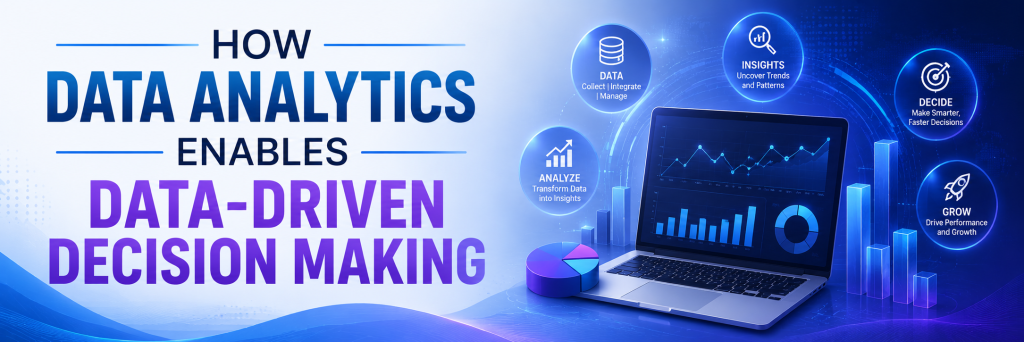
Data Collection and Integration
Analytics systems gather data from various sources, ensuring a unified view of business operations.
Insight Generation
Advanced techniques in business analytics help organizations uncover trends, correlations, and opportunities.
Real-Time Decision Support
Analytics tools provide real-time insights, allowing businesses to respond quickly to changes.
Predictive Capabilities
Organizations can forecast future trends and outcomes, enabling proactive decision-making.
Benefits of Data-Driven Decision Making
Improved Accuracy
Decisions based on data are more reliable and reduce the risk of errors.
Faster Decision-Making
Real-time analytics enables quicker responses to market changes and operational challenges.
Enhanced Efficiency
Data insights help optimize processes and improve resource utilization.
Competitive Advantage
Organizations that leverage data effectively can identify opportunities and stay ahead of competitors.
Leveraging Data Analytics Services
To fully realize the benefits of analytics, enterprises must adopt advanced data analytics services that integrate data management, analysis, and visualization.
These services enable organizations to:
- Build scalable data platforms
- Generate actionable insights
- Improve data quality and governance
- Support enterprise-wide decision-making
A strategic approach ensures that businesses can maximize the value of their data investments.
Challenges in Implementing Data-Driven Strategies
Despite its advantages, organizations face challenges such as:
- Data silos and integration issues
- Poor data quality
- Lack of skilled professionals
- Resistance to change
Addressing these challenges is essential for successful implementation.
How Enterprises Can Implement Data-Driven Decision Making
To adopt data-driven strategies effectively, organizations should:
- Define clear business objectives
- Invest in scalable analytics infrastructure
- Ensure data quality and governance
- Train teams to use analytics tools
- Partner with experienced service providers
A structured approach ensures long-term success and measurable outcomes.
Conclusion
Data analytics is a powerful enabler of data-driven decision making, helping enterprises transform data into actionable insights. By leveraging advanced analytics, organizations can improve accuracy, efficiency, and overall performance.
As businesses continue to evolve, adopting data-driven strategies will be essential for staying competitive and achieving sustainable growth. Enterprises that invest in analytics today will be better positioned to make smarter decisions and drive long-term success.
Unlock real-time insights that drive growth, efficiency, and smarter enterprise strategies. Let’s Connect
FAQs
Data-driven decision making uses data analysis and insights to guide business strategies, helping organizations make informed, accurate, and effective decisions across operations and planning processes.
Data analytics supports decision making by analyzing data, identifying trends, generating insights, and providing real-time information that helps organizations make faster and more accurate decisions.
Benefits include improved accuracy, faster decision-making, better efficiency, reduced risks, and enhanced ability to identify opportunities and drive business growth effectively.
Challenges include data quality issues, integration of multiple data sources, lack of skilled professionals, and resistance to adopting data-driven approaches within organizations.