

Executive Summary
Content has become one of the most valuable business assets in the digital era. As enterprises manage growing volumes of digital content across websites, applications, and multiple customer touchpoints, traditional content management approaches are no longer sufficient. An ai powered cms combines artificial intelligence with a modern content management system to automate content creation, improve personalization, and streamline publishing workflows. In 2026, organizations are increasingly adopting AI-driven CMS platforms to improve operational efficiency, enhance customer experiences, and accelerate digital transformation.
- AI automates content creation and management workflows
- Intelligent personalization improves customer engagement
- AI-driven insights enhance content performance
- Modern CMS platforms support scalable digital experiences
Introduction
Managing enterprise content has become increasingly complex as organizations publish information across websites, mobile applications, customer portals, and digital marketing channels. Businesses must ensure that content remains relevant, accurate, personalized, and easily accessible while maintaining consistency across every touchpoint.
Traditional content management systems often require significant manual effort, making it difficult to manage large-scale digital operations efficiently. Artificial intelligence is changing this landscape by introducing intelligent automation into content management processes.
Today, enterprises are leveraging AI to optimize content creation, improve search capabilities, automate workflows, and deliver personalized digital experiences at scale.
Looking to modernize your content management ecosystem with intelligent automation? Talk with our experts to build a future-ready AI-powered CMS tailored to your business needs.
What is an AI-Powered CMS?
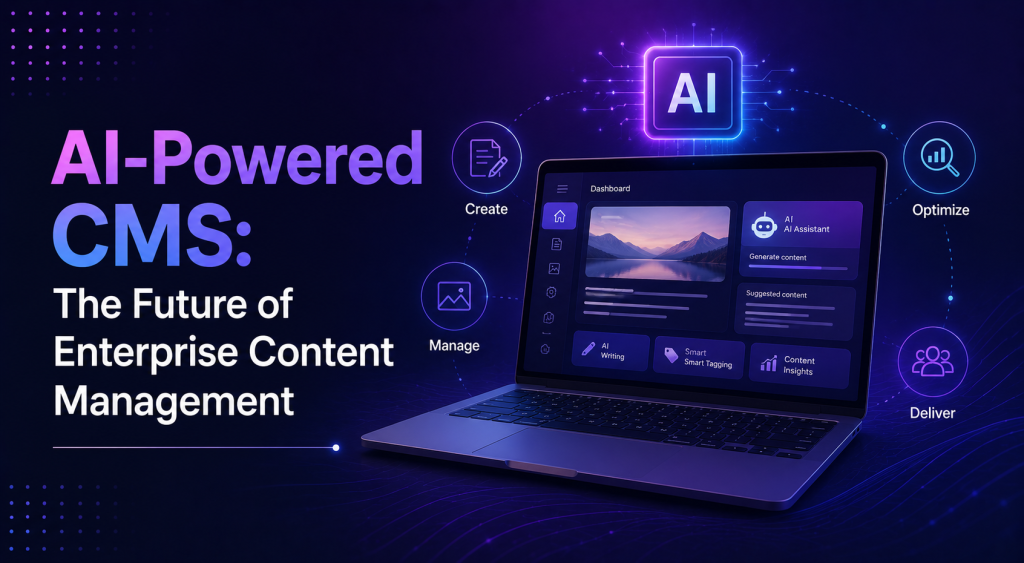
An ai powered cms is an advanced content management platform that integrates artificial intelligence to automate, optimize, and enhance the entire content lifecycle.
Unlike conventional CMS platforms, AI-enabled systems can:
- Generate content recommendations
- Automate tagging and categorization
- Personalize customer experiences
- Improve content searchability
- Analyze content performance
- Streamline publishing workflows
These intelligent capabilities help organizations manage content more efficiently while improving business outcomes.
Why Enterprises Need an AI-Powered CMS
Managing Growing Content Volumes
Enterprises generate large amounts of digital content daily, making manual management increasingly inefficient.
AI helps organize, classify, and manage content automatically, reducing administrative effort and improving productivity.
Delivering Personalized Experiences
Modern customers expect relevant content tailored to their interests and behaviors.
AI enables organizations to personalize:
- Website content
- Product recommendations
- Customer communications
- Marketing campaigns
- Digital experiences
This improves customer engagement and conversion rates.
Improving Operational Efficiency
Automation reduces repetitive tasks such as content scheduling, metadata generation, workflow approvals, and asset organization.
Teams can focus more on strategy and creativity instead of manual content management.
Key Features of an Enterprise CMS
A modern enterprise cms provides organizations with scalable capabilities to manage digital content across multiple channels and business units.
Key features include:
Intelligent Content Organization
AI automatically categorizes content using metadata, keywords, and contextual analysis, making information easier to locate and manage.
Workflow Automation
Content approval, publishing, and version control processes become faster and more efficient through automated workflows.
Advanced Search Capabilities
AI-powered search helps employees and customers quickly find relevant information using natural language queries and contextual understanding.
Omnichannel Content Delivery
Organizations can publish and manage consistent content across websites, mobile applications, social media platforms, and customer portals from a single platform.
Role of AI Content Management
Modern ai content management extends beyond storing digital assets. It enables organizations to optimize every stage of the content lifecycle.
Benefits include:
- Automated content classification
- Predictive content recommendations
- Intelligent asset management
- Real-time content optimization
- Performance analytics
These capabilities improve collaboration, reduce operational bottlenecks, and increase content effectiveness.
Benefits of AI-Powered Content Management Systems
Enhanced Productivity
Automation minimizes repetitive administrative tasks, allowing teams to focus on high-value business activities.
Better Customer Experiences
AI delivers personalized content based on customer preferences, browsing behavior, and engagement history.
Improved Decision-Making
Analytics and AI-generated insights help organizations understand content performance and optimize future strategies.
Stronger Scalability
As businesses grow, AI-powered CMS platforms can efficiently manage increasing volumes of content without significantly increasing operational complexity.
Greater Content Consistency
Centralized governance ensures consistent branding, messaging, and compliance across every digital channel.
Challenges Enterprises Should Consider
Data Quality
AI systems depend on accurate and well-structured content to generate meaningful recommendations and insights.
Integration Complexity
Organizations may need to integrate their CMS with CRM platforms, marketing automation tools, analytics solutions, and other enterprise systems.
Governance and Security
Businesses must establish strong governance frameworks to protect sensitive content and maintain regulatory compliance.
User Adoption
Successful implementation requires employee training and well-defined content management processes.
Future of AI-Powered Content Management
The future of enterprise content management will increasingly focus on:
- Generative AI-assisted content creation
- Intelligent content governance
- Predictive personalization
- Voice and conversational content management
- AI-driven content optimization
Organizations adopting AI-enabled CMS platforms today will be better equipped to manage growing digital ecosystems while delivering superior customer experiences.
Conclusion
Artificial intelligence is redefining how organizations create, manage, and deliver digital content. By integrating AI into a modern content management system, enterprises can automate workflows, improve personalization, and optimize content performance at scale.
As digital experiences continue to evolve, investing in an AI-powered CMS will help businesses improve operational efficiency, strengthen customer engagement, and build future-ready content ecosystems that support long-term growth.
Transform your digital content strategy with INT.’s AI-powered CMS solutions that streamline workflows, personalize customer experiences, and accelerate enterprise growth. Let’s Connect.
FAQs
1. What is an AI-powered CMS?
An AI-powered CMS combines artificial intelligence with content management capabilities to automate workflows, personalize content, improve search, and optimize digital experiences.
2. How does AI improve content management systems?
AI improves content management by automating content organization, streamlining workflows, providing intelligent recommendations, and delivering personalized customer experiences.
3. What is an enterprise CMS?
An enterprise CMS is a scalable platform designed to manage, organize, and publish digital content across multiple channels, teams, and business units.
4. What are the benefits of AI content management?
AI content management improves productivity, enhances content accuracy, supports personalization, automates repetitive tasks, and provides actionable performance insights.
5. Why should businesses invest in AI-powered CMS platforms?
Businesses benefit from improved efficiency, faster content delivery, better customer engagement, scalable content operations, and stronger digital transformation capabilities.