

Executive Summary
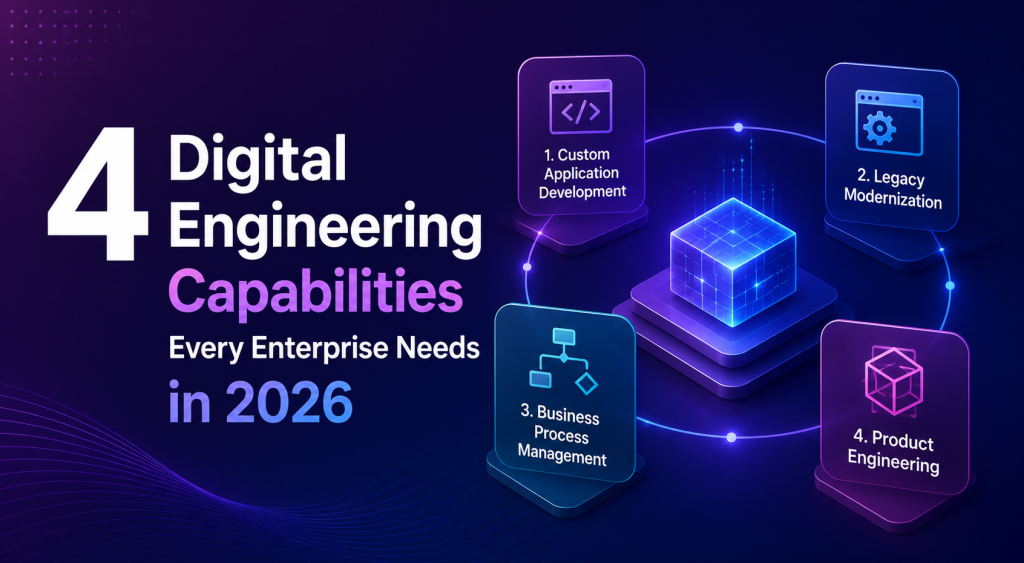
Digital transformation is no longer limited to adopting new technologies—it requires organizations to rethink how they build applications, modernize legacy systems, optimize operations, and innovate continuously. Enterprises that invest in the right engineering capabilities can accelerate growth, improve customer experiences, and respond faster to changing market demands. In 2026, four capabilities stand out as the foundation of successful digital engineering solutions: custom application development, legacy modernization, business process management, and product engineering.
- Digital engineering enables faster innovation and scalability.
- Modern applications improve business agility and customer experiences.
- Legacy modernization prepares enterprises for future growth.
- Product engineering and process optimization accelerate digital transformation.
Introduction
Today’s enterprises operate in an increasingly digital environment where speed, flexibility, and innovation determine competitive advantage. Customers expect seamless digital experiences, employees require efficient workflows, and businesses need technology that can scale with evolving demands.
Meeting these expectations requires more than isolated technology upgrades. Organizations need a comprehensive digital engineering strategy that modernizes systems, streamlines operations, and accelerates product innovation.
Ready to modernize your technology landscape? Talk with our experts to build scalable, future-ready digital engineering solutions tailored to your business.

The following four capabilities are becoming essential building blocks for future-ready enterprises.
1. Custom Application Development
Every organization has unique business requirements that off-the-shelf software cannot always address. Custom app development enables businesses to create solutions tailored to their operations, customers, and long-term goals.
Custom-built applications help organizations:
- Improve operational efficiency
- Enhance customer experiences
- Integrate with existing enterprise systems
- Support business scalability
- Differentiate from competitors
Modern enterprises increasingly invest in custom applications that align technology with business objectives rather than adapting processes to fit standard software.
2. Legacy Modernization
Many enterprises continue to rely on outdated applications that limit innovation, increase maintenance costs, and create operational risks. Legacy Modernization enables organizations to transform aging systems into secure, scalable, and cloud-ready platforms.
Benefits include:
- Improved system performance
- Enhanced security and compliance
- Reduced technical debt
- Better integration with modern technologies
- Increased business agility
Modernizing legacy environments allows enterprises to innovate without disrupting critical business operations.
3. Business Process Management
Technology alone cannot drive transformation if business processes remain inefficient. Business Process Management (BPM) helps organizations optimize workflows, automate repetitive tasks, and improve operational visibility.
Key advantages include:
- Faster process execution
- Improved collaboration across departments
- Reduced operational costs
- Better compliance and governance
- Data-driven decision-making
By streamlining business processes, enterprises can improve productivity while delivering better experiences for customers and employees.
4. Product Engineering
Continuous innovation is essential for enterprises developing digital products and platforms. Modern product engineering services in India enable organizations to design, develop, test, and enhance products throughout their lifecycle.
Product engineering focuses on:
- Customer-centric product design
- Agile development methodologies
- Cloud-native architectures
- Continuous innovation
- Product lifecycle management
With access to skilled engineering talent and advanced technologies, enterprises can accelerate product development while maintaining quality and scalability.
The Growing Role of AI in Digital Engineering
Artificial intelligence is reshaping every aspect of digital engineering. From intelligent automation to predictive analytics, AI enables organizations to build smarter and more adaptive digital solutions.
One emerging trend is AI-powered app development, where AI assists with coding, testing, quality assurance, and performance optimization. This enables engineering teams to accelerate development cycles, improve software quality, and reduce time-to-market while focusing on innovation.
Why Enterprises Need an Integrated Digital Engineering Strategy
Although each capability delivers significant value individually, organizations achieve the greatest impact when they combine all four into a unified transformation strategy.
Together, these capabilities help businesses:
- Accelerate digital transformation
- Improve operational efficiency
- Deliver better customer experiences
- Scale technology with business growth
- Increase innovation and resilience
A holistic engineering approach ensures that applications, processes, infrastructure, and products evolve together.
Conclusion
Digital engineering has become a strategic enabler of enterprise growth. By investing in custom application development, legacy modernization, business process management, and product engineering, organizations can build agile technology ecosystems that support long-term innovation and operational excellence.
As digital transformation accelerates in 2026, enterprises that strengthen these four engineering capabilities will be better equipped to adapt to change, deliver exceptional customer experiences, and maintain a competitive advantage.
Accelerate enterprise transformation with INT.’s digital engineering expertise, from modern applications to intelligent product innovation. Let’s Connect.
FAQs
1. What are the core capabilities of digital engineering?
The four core capabilities include custom application development, legacy modernization, business process management, and product engineering.
2. Why is custom application development important for enterprises?
It enables businesses to build tailored applications that improve efficiency, scalability, integration, and customer experiences.
3. What is legacy modernization?
Legacy modernization involves upgrading outdated applications and systems to improve performance, security, scalability, and compatibility with modern technologies.
4. How does business process management support digital transformation?
Business process management streamlines workflows, automates repetitive tasks, improves productivity, and enhances operational efficiency.
5. How is AI changing digital engineering?
AI accelerates software development, automates testing, improves engineering productivity, and enables smarter, data-driven product innovation.