Tag: technology

How Beacons and Proximity Marketing Can Enhance Sales at Stores?

Location-based marketing has been around for a while now. Using the latest in technology, stores can send marketing messages to shoppers’ smartphones when they are in the vicinity of stores. This is made possible by the use of beacons, or iBeacons, which were introduced by Apple in 2013. These Bluetooth low energy (BLE) devices broadcast messages one-way, and can be used to provide information about deals products, make billing easier, etc. Most importantly, beacons have begun to revolutionize the way stores market their products and services. In this article, let us take a look at how proximity marketing makes use of beacons. Quick facts According to an article published on the Forbes:   53% of users are willing to share their location with stores. 57% of users are open to the idea of receiving location-based ads. 63% feel coupons on mobile phones are great. 62% share deals they find interesting with their friends. Certainly, these facts point toward a trend that is likely going to normalise location-based marketing that makes use of beacons. What do beacons do to help drive sales? Beacons help in providing several payment options to customers. Loyalty programs can be shared via beacons when customers are in store. Recommend products based on individual user attributes Broadcast coupon details to customers who are likely to make purchases. Help customers navigate stores and find products they want easily. Here is how marketers can use beacons and proximity marketing to drive sales:  Gain customer insights Beacons help you to understand how your customers are spending money, how long they spend time at your store on average and what they are doing while they are at your store. This information can be further processed to design personalized campaigns that help to drive sales. Boost customer loyalty You can use beacons to reward customers who may arrive at your store repeatedly. The moment they walk in, you can send coupons and if they are regulars, you can ask them to ‘click and shop’ for goods previously purchased. While this a utility for the customer, it drives sales for you.   Kick-start proximity marketing Beacons help you to gain a variety of information based the customer. One of these is their location data. Location-based information can be used to kick start proximity marketing, suggesting information, products and services which may be available close to where your customer is around at that particular moment. Offer discounts and coupons Nothing entices customers more than a good discount or a coupon. If you want to turn walk-ins to sales, you can use beacons to send coupons to users’ smartphones, so that they purchase something, instead of walking away. Geo-targeted messages are known to drive sales, especially if you have a store in a place where footfalls are high. Even if they are in the vicinity to buy something else, a coupon or a discount that flashes on their screen may tempt them to walk into your store. Help customers Beacons are all about the location. If your customer is looking for something, beacons can be used to help them find the right aisle, or the right product. If it is a man that walks into your store, you would probably direct him to the men’s section of your clothing store, instead of him having to look or them himself. The possibilities are endless. Beacons can help you maximize sales by customizing location-targeted messages. Enable cross-channel experience With so many options to make sales happen these days, many stores are opting for online sales. While this takes place mostly on desktops or smartphones, brick and mortar stores are still around. By offering a custom sales experience across all these channels, beacons help you to offer a cross-channel experience. This is important when your competitors are already engaging in multi-channel delivery.   Thwart shoplifting While this is not part of traditional marketing, beacons do help you to thwart shoplifting when they happen. Though it may not directly boost sales, preventing shoplifting helps you to save valuable products which will add up to your bottom-line. Many supermarkets and departmental stores have begun to use beacons to monitor and track customers when they are in the store. Data and analytics Analysis if data that is collected by beacons provides valuable information about the kind of people who purchase your products. This is the target demographic that you should be targeting in order to boost sales. There are several analytic tools available to help retailers drive sales with the help of beacon-based analytics. Business intelligence tools can be customized to integrate beacon data and help you come up with useful insights.   3 Examples of companies using beacons to enhance sales:   Woolworths, a British supermarket chain has successfully used beacons across its 254 stores. Push notifications are sent too consumers when they arrive within a certain radius of the store so that they can ‘click and collect’. Venerable Macy’s installed more than 4,000 beacons to provide an omni-channel retail experience. The store also brought a beacon-triggered mobile game which allowed users to win Macy’s coupons and prizes. McDonald’s used beacons to engage in proximity marketing across its Istanbul outlets. A loyalty app was used to target customers near McDonald outlets and then offer them coupons and try new drinks for free.        Highlights More marketing agencies believe location based data can help them design better campaigns. Proximity marketing campaigns can be weaved along with social media campaigns for a more nuanced approach. Data collected by beacons can be used to improve products. The same data can be used to manage shelves and product locations within a store. Use beacons to push discounts and coupons, which in turn help drive sales. Use analytics for a deeper insight about customers, their behaviour and their needs. Monitor and track individuals to avoid unwanted activities such as shoplifting. Provide an enhanced shopping experience to your store visitors, by combining in-store, social media, online and mobile experiences.
Read More »

How is Augmented Reality Different from Virtual Reality

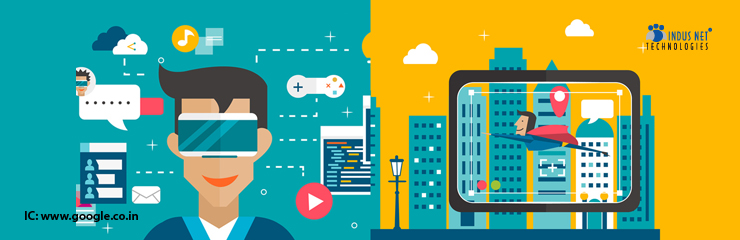
Augmented reality has received a lot of attention in recent years. Yet, a lot of people are not sure how different it is from virtual reality, a technology that is closely related. While media attention has been given to both these technologies, many people erroneously use these terms interchangeably. In this article, let us take look at how these two groundbreaking technologies are different from each other. What is virtual reality? Virtual reality is a situation or environment where a person experiences simulated reality thanks to visual and auditory stimuli. This simulation takes place with the help of computer-enabled technologies. Virtual reality creates a simulated environment where the user feels like they are experiencing the simulated environment truly. Many headsets that are currently used by people to enjoy entertainment make use of this technology. Gaming, movie and entertainment industries, professional simulators for pilots and other situations make use of virtual reality,. Virtual reality usually uses Virtual reality Modeling Language (VRML) in order to create images and specify the kind of interactions that could be made possible when viewing them. What is augmented reality? Augmented reality, on the other hand, superimposes computer-generated enhancements over a reality that actually exists. Mobile technologies, app development, and even certain games make use of AR, in which the real-world is inter-weaved with digital components. Augmented reality is being used in a. number of domains, and not only in the gaming arena. If you have ever seen a youth waving hands furiously in front of a screen at a mall, he is probably playing a game that comes with some AR-ability. The main difference between VR and AR is that virtual reality provides a simulated version of a reality that doesn’t quite exist, whereas, augmented reality creates a situation where computer-enhanced situations superimpose over an existing reality. Virtual reality and augmented reality have some similarities Both virtual reality and augmented reality have some similarities. This is probably why people confuse between the two terms and use them interchangeably. if you know the similarities between the two, you will later be able to tell them apart. Both AR and VR use computer-enabled technologies to create an altered environment for the user. They are both used extensively in entertainment especially the gaming and movie industries. Both AR and VR are finding their place in health care and medicine. Surgeons are known to use virtual reality to practice their skills, while augmented reality finds its use in actual medical settings. Both technologies are used by psychologists to enhance in-vitro behaviour therapies. What are the differences then? If you would like to know the differences between AR and VR, things can get a little dicey. Augmented reality enhances an existing reality by adding images, sensations and sounds. Virtual reality creates a situation where images and sounds can feel real, though they do not exist. Virtual reality is usually delivered through a head-mounted or hand-held controller. Augmented reality can be used in a variety of situations and a specific tool may not be required. If your apps jiggle on your iPhone while trying to delete them, that is a form of augmented reality. Is it possible for them to exist together? Mixed Reality. Many times, augmented reality works in conjunction with virtual reality. This is especially true in video games, where the aforementioned young man probably felt that he really was being shaken by a. demon on the screen, thanks to haptic feedback. When virtual reality and augmented reality work together, it is known as mixed reality (MR). Mixed reality is an effort where the best of AR and VR are spun together so that the user is not only experiencing the real world in an enhanced state but is also experiencing something that probably doesn’t exist. Mixed reality is going to get a lot more popular in the future because of its applications in gaming, movies, entertainment and also events. However, if we are discussing medicine and health, AR and VR will remain operate and distinct. Now let us take a look at some of the non-traditional situations in which VR can be used: Live communication VR can be used during meetings and conferences, where the simulation of a board room can be created. A conference room can be simulated and participants can feel like they are in an actual meeting. This helps to psychologically tune the participants to be more attentive, and pay attention to what is being said during the conference or meeting, instead of getting distracted, which is possible during virtual conversations and meetings. Sales exhibitions There is no place better than a trade show to experience the goodness of virtual reality. If your company is trying to exhibit product A, you can quickly use VR to simulate an environment where visitors to the exhibition can ‘experience’ your product. In other words, sales demos become more life-like and helps in immersing clients in a simulated reality. Product testing Virtual reality also helps in testing products, even in the most adverse conditions. Thanks to virtual reality, companies and manufacturers can Crete impossible situations or difficult-to-test situations and ensure that the product doesn’t malfunction. A few of the non-traditional situations where augmented reality can be used are: Augmented reality works very well on mobile apps. Thus, it can be used in design and retail, marketing, and B2B sales. For instance, customers can try their glasses on, using their own image. The app helps them to try glasses or clothes on an image that resembles them. Augmented reality can also be used to create interactive billboards, displays and immersive branding experiences. There’s no race between AR and VR By looking at these examples and the similarities and differences between AR and VR, it becomes clear that they are not going to outpace one another. They may be similar in some respects but they both have their uses and utilities. While they can exist separately, they can also exist in conjunction with each other, a technology which is known as

Read More »

The Rise of the Chief Marketing Technologist

  Five years back, research and advisory firm Gartner had predicted that by 2017, the chief marketing officer (CMO) of an organization will be spending more on technology than the CIO. Today, it’s no secret that there is an increasing influence of technology in marketing. The confluence of marketing and technology (MarTech) has resulted in accelerating client acquisition, enhancing brand awareness, allocating budget for more marketing and technology operations and upgrading customer experience. Over the years, the line between CMOs and CIOs has blurred and a new C -level position has gained popularity: chief marketing technologist (CMT). In simple words: the new hybrid role combines the previous job profiles of CMO and Chief Technology Officer (CTO). He must be hands on with marketing and furthermore have knowledge about capabilities and budget of the IT departments. According to a research by Foundation Capital, martech is expected to grow 10X in 10 years (from a $12B Billion dollar market into a $120B industry).  The rising popularity of martech has further augmented the demand of CMTs. An ideal CMT would be a vital business player alongside being a technology leader, who will be involved in data and analytics, planning, content marketing, product development, digital engagement, marketing automation, sales and web mechanics. He should have the vision to drive both technology and marketing in the digital age, thus helping in the agile administration of the business. As per a Harvard Business Review article by Scott Brinker and Gartner Analyst Laura McClellan, the CMT’s job is to align marketing technology with business goals, serve as a liaison to IT, and evaluate and choose technology providers. Here are 4 key roles of a CMT in an organization: To bridge the gap between CMO and CIO To nurture technology in marketing departments To ensure marketing teams aren’t left behind in terms of IT To keep marketing up-to-date with changing technologies. Also, let’s look at four areas chief marketing technologist must be accountable for: Confluence of marketing and technology to achieve business goals Earlier marketing and technology were seen as separate verticals but today they are increasingly overlapping. Today, marketing is reliant on analytics and other forms of business intelligence. The data that is aggregated from various sources, thanks to cloud computing is being analyzed to derive insights. These insights have pushed organizations to strategize their marketing campaigns, both digital and traditional. Automation of processes has only spurred the growth of big data, and with that, the resulting insights from analytical software. In fact, marketing is so dependent on data that it is impossible to visualize a marketing campaign that is not built around analytics. This convergence of marketing and technology require the decisions of someone (read: chief marketing technologist) who has mastery in both the domains at the same time. Easy communication between IT and marketing teams   Marketing departments have often overlooked technical aspects, but the rise of digital marketing has forced most marketers to adopt technology. At this juncture, CMT joins the organization and facilitates more ventures and correspondence between the teams. He is required to identify the current state of tech ecosystem and craft marketing campaigns to drive business. He also streamlines the planning and execution of marketing technology projects and coordinates with the staff of both divisions effectively and keeps an update of their activities. Development of strategic roadmap and budget allocation in marketing technology According to Gartner’s CMO Spend Survey 2015-2016, 33% of marketing budget go to technology. Gartner also reported that nearly 65% of marketing departments are expanding spending plans for service providers that have technology-related offerings. The CMTs is required to amalgamate the technology and marketing budgets for a common vision. CMTs’ leadership abilities coupled with market and competitive intelligence help in improving the infrastructure of the company with the strategic application of technology.  He also allocates money for innovation, which might include experiments with new innovations and techniques. CMTs also develop the strategic roadmap for the companies on where to invest money to engage with the customers.  Fostering technology-positive work culture The multi-layered role of CMT provides marketing professionals with guidance and inspiration. He additionally encourages a work culture that is innovation positive. In this sense, CMTs not only make decisions, but also help foster environments that nurture technology in places where it is not usually welcomed. Here are some Chief Marketing Technologists, who are active on Twitter Nicole Pereira @Nicca619 – Co-Founder & Chief Marketing Technologist, Campaign Creator Eric Hollebone @erichollebone – Chief Marketing Technologist, DemandLab. John Kottcamp @jkottcam – Chief Marketing Technologist, Tahzoo Hitesh Bhatia @hiteshbhatia – Chief Marketing Technologist, CBREX Andrew Epperson @eppand ‏- Chief Marketing Technologist, PBISRewards Steve Glass @Oinkodomeo- Chief Marketing Technologist, Oinkodomeo Rise of Chief Marketing Technologist In the previous C-level hierarchical setups, the CMO took the marketing leadership responsibilities, while the CIO took the technology and IT-related leadership roles. Now, envision a circumstance where a CIO of a company is not effectively connected with the marketing team. Neither is usually in a position to comment on the other’s leadership vision. A CMT acts as a bridge between a CIO and CMO. A CMT’s combined knowledge of marketing and technology help him to weave marketing vision with technical depth. He will ensure that business is aligned with the right variables, and that there are right incentives and accountability overall. A CMT usually has the background in IT management, and also hold specialization in marketing. Most of them might have an undergraduate degree in computer science or in business administration. To whom the CMT reports to will rely on upon individual associations. The CMT coordinates with both technical and marketing teams, but concentrates on making marketers within an organization cultivate an interest and fondness toward technology and IT. According to a study in 2016, globally, 70% of marketing teams have a person dedicated to marketing technology, and in Europe, 66% of marketing teams have an individual devoted to this role. Now, why there is a rise in companies to employ CMTs? Here are 5 reasons why there is an increasing

Read More »

Why Inexpensive Developers Can Prove to Be Expensive In the Long Term?

Regardless of the industry that we are in, most of us have witnessed the rise of affordable services, made possible due to telecommuting and remote working. For instance, it is now possible to get your sales copy written at a fraction of the cost when compared with going to a traditional marketing agency. All one needs to do is look around. Yet, even in this post-freelance, post-telecommuting world of agencies and professionals, there are clear demarcations when it comes to pricing of services. This is especially true when it comes to web and app development. There is a grand level of inconsistency when it comes to developers’ rates, for the same amount and level of work. The instinctual response is often to choose the cheapest developer available, so that costs can be cut. Yet, this approach can be very problematic in the long term, even if it helps to save money in the short term. In this article, let us take a look at why hiring inexpensive developers can prove to be expensive in the long term, and what you, as a client, can do in order to mitigate the costs incurred by hiring good quality developers. Here are three important aspects of programming that you risk losing when you hire a one-time developer who is probably very cheap.   Software needs to be updated regularly Once a program has been developed, it is not the end of the story. It still needs to be updated and bugs need to be fixed. When platforms are updated, the software needs to be updated too. Cheap developers will often not provide you with this kind of support, and you may not even be able to contact them on a regular basis. Even if they do, the costs will always add up and prove to be more expensive. Experienced IT agencies specialize in updating previously released software, and ensuring that you do not have to contact different developers each time an app needs to be updated. Code needs to be centralized In order to ensure stability, cohesion and smoothness of a software program, code needs to be centralized. Codes cannot exist separately from other tools that may interact with them. Everything needs to be cohesive. Your inexpensive developer may not take all this into account, and will most certainly not offer to take a look at connecting technologies, projects, etc that may interact or communicate with the current one. This only leads to a situation where you will spend more on tweaking, enhancing and eventually, centralizing the code for your software program.   Programs require maintenance, support and customizations Inexpensive developers often do not provide maintenance services and even if they do, their charges will add up to more than what you probably would have paid an ‘expensive agency’ upfront in the beginning. Lack of support and failure to customize your app or website as and when required can prove to be a big liability. Running to different developers each time will not only cost you more, but will leave your software project incoherent. What is a ‘good developer’ anyway? How does one find them? A good developer is one who is credible, reliable and responsible. Good developers usually have a business address, a firm or consultancy, or a fully-functioning agency. If something goes wrong with your program or software, you will be able to walk-in to their office, and seek their developers’ help, while also being treated to a nice cup of coffee and macaroons. In other words, they are always available even after the first version of the software is released, because as the old saying goes, software development is a continuous process. Yet, there are a few more things you need to consider before you decide somebody is good for your project.   Look for a team of developers Web or app development usually requires the skills of a group of developers. Each developer will probably be good at a different language or skill. Pooling together all these skills within a team helps to build great software programs. A team works as a cohesive unit, and this cohesion is translated to the software project they work on.   Seek accountability and real-time communication Most software projects fail because real-time communication (on the Internet or on telephone) is not available. Moreover, lack of accountability leads to more expenses because if something goes wrong, you are left with your project on your own. A good IT service team owns up, takes accountability and provides great communication. This helps you communicate your problems and also seek help when it is required. Seek agreements, estimates and continued support Professional agencies place a lot of emphasis on legalities and agreements. This is because; neither the client nor vendor should have to keep guessing about the services that are to be delivered. When there are clear goals and objectives that have been printed and agreed upon, the deliverable’s will be so much more efficient. Always look for teams that will list everything in an agreement and hire those teams that offer continued support, even after the project has been delivered. Why are credible and experienced developers more expensive? They spend on training They spend on overheads, which includes a great office for employees to work, good hardware for your software project to take shape, and miscellaneous expenses Their employees are treated better, which means they are focused on the project rather than making some quick money. They are subject to within-group and between-group competition, which ensures software development is competitive. They monitor your project even after the delivery, which ensures that you don’t face problems with your software program after it has been launched. Because, experience and confidence. Look for experience and support, not the initial costs As we can see from this article, it is easy to be lured into the nets of an inexpensive developer, who will prove to be costlier in the long term. You may spend less in the beginning, but

Read More »

The Most Valuable Programming Languages to Learn for IoT

With more objects becoming ‘smart’ and with more products being able to communicate with users with the help of Internet, it is becoming increasingly clear that programming for things is a new reality. Internet of Things, or IoT as it is popularly known, is spurring a new set of demands and targets for programmers. Developers are often left mystified about the nature of programming that is required for IoT and also the languages that are specifically required to program IoT applications. In the coming future, more objects and products will be connected to the internet to make interaction with users and data seamless and easy. With this in mind, it makes sense to look at some of the most important and useful programming languages that may help developers to develop applications and software for smart objects. What we need to remember is that while Internet of Things is a reality, it is still in a nascent stage. Most objects do not have the processing capacity that regular computers do. The computers or chips that are installed in these objects are quite basic, and they need very basic programming skills. What is C? C is a structured and procedural programming language widely used by programmers. C was originally developed by Dennis Ritchie between 1969 and 1973 at Bell Labs. It was first used to develop UNIX operating system. Today, it is used for developing operating system, compiler, network devices, assemblers, application software like database/ spreadsheets; computer and mobile games etc. Why C for IoT? Many IoT devices are embedded and have limitations like low computing power, low RAM and storage. Most embedded operating systems like Contiki, mbed, TinyOS etc support C.  C is highly efficient and you can tweak every part of the code to get the best performance out from an underpowered device. Therefore, it remains the first choice for constrained IoT devices and can be used to write the lowest layer of software, the layer closest to the hardware. It is simpler to complete complex tasks in C.  Moreover, many popular programming languages use C syntax. Finding developers with extensive experience in C is easy. The only limitation of C is its inadequate support to Graphical User Interface.  Nonetheless, its proximity to machine language makes it impressively fast.   Difficulty level C is a basic programming language and has been a reference point for many other languages. It is easy to learn, can create efficient programs, handle low-level activities and can be compiled on a variety of computer platforms.   C++ What is C++? C++ is an enhanced version of C language typically used for object-oriented programming.  It was designed to run large-scale applications, a limitation in C. C++ is widely used in embedded systems, GUI based applications, web browsers, operating systems with application across industries like healthcare, finance, defense etc. Why C++ for IoT? If IoT devices are expected to do complex tasks, C++ is chosen over C.  C++ comes with added abilities like data abstraction, classes and objects. C++ creates compact and faster runtime code. Line of code can be compiled into a couple of instructions leading to high runtime speeds and low energy consumption and is therefore suitable for writing IoT and embedded system code. According to C++ developer, Bjarne Stroustrup, there is still no other language that makes it better than C++ when it comes to specialized hardware to be used for Internet of Things. C++ is designed to handle both hardware and complexity simultaneously. It has apparent advantage of running seamlessly with systems with a few hundred kilobytes of memory. And there are not many languages that can work within such a framework. Difficulty level C++ is a relatively complex language to learn because it is designed to accomplish big and complex tasks. It may take years to master it. If you transition from learning C to C++, adaptability is faster.   Java What is Java? Java is a powerful programming language that enforces object-oriented programming model. It was developed by Sun Microsystems on the same lines as C/ C++, however it is simpler to run than C++. It can used to create applications run on single computer or distributed among servers. Java has wide-ranging applications including development of Android apps, server-side apps, Java web applications, software tools, trading applications, J2ME apps, big data technologies etc. Why Java for IoT? Java codes are portable and it is easy to move them to the smallest devices with the help of Java Virtual Machine. There is a lot of focus on Java SE Embedded today where classes can be eliminated leading to computing resource savings. Consequently, all communication goes through the network. Apart from that, Java has in-built capabilities like hardware support libraries thereby requiring bare minimum hardware dependency. Therefore, it is easy to control a device with a Java-written code. Java has huge potential for consumer IoT as well as industrial IoT.  It is not surprising that many experts consider Java to be the best language for IoT devices.   Difficulty level Java is one of the easiest languages to learn and is good for beginners. Once you understand its syntax, packages and frameworks, it is swift to learn.   Python What is Python? Python is a high level, object-oriented programming language. A general purpose language, Python works perfectly for backend web development, data analysis, artificial intelligence and scientific computing.  Developers also use it to build productivity tools, games and desktop apps. It is one of the fastest growing languages for embedded computing.   Why Python for IoT? Python is well-known for its writability, error reduction and readability. It is easily decipherable and its design is in line with today’s agile environment. With embedded algorithms becoming complex with the use of neural network and other heavily-involved processes, Python is just the right language for IoT projects.   Python can easily aggregate data coming from microcontrollers like Adruino, pass on commands, and display/log results in IoT projects. It is being used to interface with high-performance

Read More »

Is Machine Learning Overrated or Overhyped?

Not a day passes without us hearing or reading something about machine learning or artificial intelligence. It is almost certainly a buzzword, vigorously lapped by journalists, analysts and even CEOs. Of course, a C-level executive of a company has to drop in these buzzwords in front of investors and others in order to seem relevant. However, it does not take us long to realize that there is a staggering increase in the number of times we hear the words ‘machine learning’ or ‘artificial intelligence’. We need to acknowledge the fact that machine learning has been around since the World War 2, and that it continued to evolve over time. It was only limited because of the limitations of hardware. The algorithms, the concepts and the idea were all there of course. Scott Aaronson, a theoretical computer scientist at MIT opines that the way machine learning is being discussed today is very similar to how people discussed computers in the 1950s. People discussed computers and humanoids in the same breath but they did not foresee the Internet coming. Yet, military officials and others did have inkling about Internet and how it might change the world. Similarly, machine learning is certainly big, and it does deserve the hype it is receiving. Yet, it is overhyped because machine learning isn’t new. It is just computer algorithms that have been branded as something futuristic, while it has been there all along. In this article, let us take a look at why machine learning is overhyped and yet, it probably deserves that extra attention. It’s been around The history of machine learning dates back to 1959 when Arthur Samuel defined it as something that gives computers the ability to learn without being programmed explicitly. From then, it was closely associated with artificial intelligence, which is more theoretical in nature and is concerned with giving computer systems the ability to perform tasks for which human intelligence is required. Machine learning later came to be defined as something that is practical, more than theoretical. This happened during the 1980s and 1990s when computers were developed to operate autonomously. However, machine learning is more realistic and objective in nature, and is concerned with what can actually be achieved in realistic terms as of today. Artificial intelligence on the other hand focuses more on research and changing times. With Internet of Things becoming more common today, machine learning is not as farfetched as it once seemed. However, the way the phrase is being dropped at conventions, seminars and networking events, especially by those in the software or computer science industry makes some people a little skeptical. This is because, machine learning isn’t new, and all computers are machines and they do learn to work autonomously. That is exactly what programming is all about. It’s got future It doesn’t need to be repeated that programming, artificial intelligence, Internet and everything that we know related to computer science and information will continue to grow. When someone repeatedly discusses machine learning as if it were something new and special, it gives a sense of trying too hard to prove something. While machine learning is an established scientific field, the over usage of the term has led some to believe it is a new science that is going to change things quite dramatically. On the contrary, machine learning has always been around in the last few decades, and its application will be quite widespread. The reason for machine learning’s wider growth and application will probably because of IoT growing in nature and stature. As more objects will become ‘smart’, more machines can be ‘taught’ to interact with humans and computers in a more advanced manner. This is probably a more realistic approach to understanding machine learning than discuss it as if it were a fad. Machine learning isn’t a fad but it is an established field of computer science. Be wary of over usage Machine learning, like all other tech buzzwords, seems very appealing. Once you begin to read the many articles that are churned glorifying it, you might end up using the word too, all too often. It is neither impressive nor necessary to use buzz words in order to sound informed. In fact, using the word all too often may actually harm those who are really working at machine learning. Machine learning in reality is quite a tedious and difficult science that involves lot of programming and coding. It is not half as glamorous as a journalist might make it seem to be. Yet, it is an extremely important part of computer science and it is certainly changing the world as we know it. It is important to remember that all fields of science change the world as we know it. Even something as basic as neuroscience is responsible for a better understanding about how humans work and think, leading to improved treatments. Yet, nobody discusses neuroscience as they would discuss machine learning, though it is advancing at probably the same rate. Certainly, one might want to be wary of hype over machine learning. However, the field itself is very promising and will continue to evolve, just as another field of science. Avoid the hype, embrace the facts There is a lot of hype around different technologies today. It s important to remember that no particular technology is superior to another and that every field has its role to play in the development of society. Similarly, machine learning has been around for decades and it is only now that it is receiving a lot of attention. This neither means that it doesn’t deserve the attention that it is getting nor does it mean that the hype is right. The hype can be translated to mean that machine learning is very relevant today than it was yesterday. And most certainly, it is going to remain as important as it seems today. On that note, it probably deserves the hype that it is receiving.

Read More »

Apple Allows Its AI Team to Publish Papers

Apple has often been tight-lipped about its research in order to keep its technical prowess from being used by competitors. Now, the technology giant is going to let its artificial intelligence teams to publish research papers in journals. While this is a great move for academics and science-buffs, it remains to be seen if it’s going to help the company financially. #Apple #technology

Read More »

Bluetooth 5 Is Officially Adopted

Bluetooth’s previously announced fifth version was officially adopted by the Bluetooth Special Interest Group. This does not mean you will begin to see super-fast Bluetooth 5-enabled devices. However, such devices should be available sometime in 2017, particularly between February and June. #technology

Read More »

PaaS to Build Your Next SaaS Product

Developers with experience in application development know that platform-specific applications outperform others and are fairly easy to manage. Similarly, cloud application development for public or private cloud is best carried out in cloud environment.  The most efficient way to build a SaaS (Software-as-a-Service) application is using PaaS (Platform-as-a-Service).   PaaS allows you to develop and manage SaaS application within the cloud. It promises faster development by quickly putting applications into production without having to set up the corresponding hardware and software.  Not surprisingly, PaaS is registering a phenomenal growth and is expected to hit $34 billion by 2018. Here is why you should draw on PaaS to build your next SaaS application.   What is PaaS? Platform as a Service is a cloud service that provides computing platform for creation of web applications. As a result, users don’t need to invest in underlying software and hardware to build a new application. PaaS is in contrast with SaaS where instead of computing platform on-demand software is delivered over the web. How does PaaS help to build a SaaS application? PaaS offers you the ability to self-provision development and testing environments that enables you to start application development instantly. It makes it easier for developers to collaborate with other developers and architects.  It simplifies the deployment and management of web applications besides making the applications more resilient. Salient features offered by PaaS   Centralized hosting   A number of web servers happen to sit idle in your data center when you are running only a few applications. As a result, resource utilization is poor coupled with low software security and wasted energy.  You end up using multiple servers to host various individual sites.   PaaS optimizes server space utilized by various applications by offering a centralized host that can be optimized for loads of internal or external web applications. You can exploit centralized hardware for various needs like application development, staging, QA and production. Consequently, PaaS helps in the reduction of server sprawl.   Scalability   PaaS allows you to add computing resources as and when you require them. Leading PaaS providers offer automatic scaling or user-driven resizing to adapt to fluctuating demands. Therefore, memory allocation to deploy a web application can be instantly increased or decreased.   Previously, organizations had to resize their computing infrastructure to meet peak demands that was left underutilized for prolonged durations. Thus, PaaS helps you to save significant amount of money.  Moreover, the entire computing environment is under your control.   Fabric allocation   PaaS offers you an excellent opportunity to focus solely on your application. Instead of deploying to a server, applications are deployed to a PaaS fabric. This means as a developer you just have to push applications to the existing PaaS environment and all other steps are taken care of.  PaaS infrastructure is designed to deliver automatic patching, scaling and monitoring.   Multi-tenancy   PaaS products are designed in such a manner that they can host multiple applications or tenants simultaneously. Apart from providing significant computing capacity, PaaS platform offers built-in load balancing services and failover in the event of server failure. Multi-tenancy ensures that code updates are deployed across the board thereby boosting reliability and performance of each application hosted in the cloud.   Services beyond hosting   PaaS is not limited to hosting web applications. It offers many add-on services like database, storage, identity management, caching etc. API management and service catalogs are some other complimentary services offered.  All these services can be used along with hosting without provisioning for additional hardware thus saving you from a lot of hassle.   Programmable User Interface   PaaS offers drag and drop method that allows you to create and configure UI components.  Pre-defined standard UI elements can be used in building applications. Reusable UI components like grids, tree-like hierarchies can be used with the help of simple html code with minimal coding requirements. This PaaS offering gives UI designers control over application interface and allows them to add new designing layers faster.   Database customizations   A key aspect of PaaS offering is database customization. Objects are fundamentally used to store data in cloud applications. A declarative web interface provides visual control at meta-data level. Declarative web-based interface facilitates developers to define objects and specify relationship between objects.   Flexible services-enabled integration   PaaS leverages Service Oriented Architecture to enable seamless integration of cloud app data and functionalities to amalgamate with other applications. Therefore, SaaS integration is an important feature offered by many PaaS products. Integration between cloud-applications and on-premise systems is enabled through a range of pre-built connectors.   Robust workflow   PaaS platform offers a business-logic engine that supports the definition of workflow processes. Workflow process defines status of business object flow during its lifecycle. With a combination of workflow processes, developer can model different business processes within the web browser. PaaS also includes the ability to programmatically define powerful trigger conditions using scripting language like JavaScript. Leading PaaS providers   Amazon EC2   The core components include computing power, storage and database services. Key features: Supports multiple operating systems Control access to instances in AWC environment Enables users to scale across servers and procure compute resources to design fault-tolerant applications Easy to move existing applications into EC2 Allows you to define scale-up or scale-down conditions

Read More »

What Is Ransomware and How to Protect Your Data against It?

Most of us already know that clicking on unsolicited links and downloading suspicious files could lead to malware wreaking havoc on our computers. However, in recent times, there has been a more malignant kind of malware. Ransomware, as it is popularly known, a kind of malware that restricts your access to your files, devices or computers until you make a certain amount of payment. In other words, ransomware hijacks your device or files, and holds it up for a ransom demand . If you do not pay the ransom, you will lose access to your files and devices permanently. How does a ransomware attack your computer or files? Ransomware employs methods similar to a Trojan. It deceptively enters your computer in the form of a message, email, or web file that is downloaded intentionally or unintentionally. Once you are fooled into clicking a link, downloading a file or visiting an infected website, the ransomware encrypts files on your computer and displays a message informing files can be accessed only after the ransom is paid. If you do not pay this ransom amount, the attackers may increase the ransom amount of delete your files altogether. While most attackers demand less than $200, some have been known to demand almost a million dollars. Ransomware can wreak havoc on your company in multiple ways Ransomware features unbreakable encryption. This means, you cannot hire decryption professionals to decrypt the files that have been encrypted. Ransomware can encrypt all kinds of files on your computer or device. Whether it is personal photos or company-related executable files, everything can be infected and access to these files will be blocked. File names can get mixed up deliberately, so that you won’t know which file is encrypted or not. Traditional antivirus cannot detect ransomware, as these malware feature complex evasion techniques. In other words, you cannot remain complacent thinking you have the best anti-virus system installed. If you have many computers connected to each other on a local network, all of these computers can get infected, making accessing any file next to impossible until you pay up. If files have sensitive information, ransomware attackers can actually use this information against you and get you into further trouble. If confidential business documents are leaked, you will probably end up bearing legal costs as well. Things you can do to protect your data from Ransomware   Be prepared   The first step toward protecting oneself from any adversity is to expect it. Much like most armies in the world remain prepared for a future attack, you will probably have to live in fear of being attacked by ransomware too. Fear isn’t always a bad thing. It helps you to take necessary precautions and to consider a threat as real. This isn’t being paranoid as ransomware is real, and not a bogeyman in the corner. It could happen to anyone and to any company. The only way to trick ransomware is to expect it to attack you. This will help you to take steps that will succeed in thwarting attempts to encrypt your files. And even if a ransomware manages to encrypt your files, you will still have a safe backup copy somewhere in the cloud or on an external hard disk.   Use external backup drives correctly   This is the cheapest and easiest way to protect yourself from ransomware. Unfortunately, this isn’t efficient or effective in most cases. What you could really do is, connect the external hard disk as little as possible to your computer. Do not let it remain connected to the computer even when you are not using it. This will allow ransomware to attack your external device and encrypt files stored on it too. Also, you should begin to use backup programs that have versioning feature. Versioning enables you to retain backups of older versions of data, so that if a hard disk is maliciously encrypted, you will always have an older version of the disk to fall back upon. This is not a perfect method to tackle ransomware, as your recent changes will be lost.   Start using cloud-based backups   Cloud-based backups are always on but the files do not get uploaded quickly. However, this works in your advantage, when it comes to ransomware. Even if a ransomware encrypts your data, it will take days to weeks for it all to get uploaded. Meanwhile, you can contact your backup service company and ask them to wipe and reinstall. This will again result in recent changes being lost but at least, you will not lose all the data. Cloud-based backups are safe at the moment, though ransomware attacking cloud-data is not too far-fetched. If you make regular backups to your cloud service, chances are, there will always be a version that hasn’t lost a lot of changes that were made recently.   Do not open suspicious emails or links   Most attackers send spam messages and hope that you will click on an email or link that will allow them to install the ransomware on your device or computer. So, first and foremost, use discretion while downloading attachments, opening suspicious links or emails. Even if these emails originate from an address or contact you recognize, bear in mind that anyone’s email account can get hacked. If you sense the tone of the email or the language that is used is different from the person you know, do not click on the link or attachments. Most of the times, ransomware gets installed after people click on links sent by people whom they know. Always train your employees to right-click on attachments and scan them before opening them. If you train your employees well enough, they will become an integral part of protecting your company against ransomware attacks. In other words, employee training is a crucial part of protection against ransomware.   Invest in a good anti-malware tool   While most traditional malware protection tools do not offer security against ransomware, there are a few

Read More »
MENU
CONTACT US

Let’s connect!

Loading form…

Almost there!

Download the report

    Privacy Policy.