Tag: customer engagement

Improving Customer Experiences Through Real-Time Analytics

Improving Customer Experiences Through Real-Time Analytics

Executive Summary Modern enterprises are increasingly relying on real-time analytics to deliver personalized, seamless, and data-driven customer interactions. As customer expectations continue evolving, businesses must respond instantly to behavioral insights, preferences, and engagement patterns. Real-time analytics enables organizations to improve decision-making, optimize digital experiences, and strengthen customer relationships across multiple channels. In 2026, enterprises investing in intelligent analytics ecosystems can significantly enhance operational agility, improve personalization strategies, and create scalable digital experiences that drive long-term business growth and customer loyalty. Introduction Customer expectations have changed dramatically in today’s digital-first economy. Modern consumers expect fast, personalized, and seamless experiences across websites, applications, customer support channels, and digital platforms. Traditional analytics models often provide delayed insights, limiting an organization’s ability to respond quickly to changing customer behaviors and operational challenges. Real-time analytics is transforming this approach by enabling enterprises to process and act on customer data instantly. Organizations leveraging intelligent analytics platforms can improve responsiveness, optimize digital experiences, and strengthen customer loyalty through proactive engagement strategies. Looking to build intelligent and data-driven customer experience ecosystems? Talk with our experts to create scalable and future-ready digital engagement strategies. What is Real-Time Analytics? Real-time analytics refers to the process of collecting, analyzing, and acting on data immediately as it is generated. Unlike traditional reporting systems, real-time analytics enables enterprises to: Modern analytics ecosystems help organizations respond proactively instead of reactively. Why Real-Time Analytics Matters for Customer Experience Faster Decision-Making Real-time insights enable businesses to make immediate operational and engagement decisions based on customer behavior and system performance. Personalized Digital Interactions Organizations can deliver more relevant recommendations, messaging, and experiences based on live customer activity and preferences. Improved Operational Agility Businesses can quickly identify issues, optimize workflows, and respond to customer demands more effectively. Enhanced Customer Satisfaction Faster responses and personalized interactions improve trust, engagement, and long-term customer relationships. A strong customer experience strategy increasingly depends on intelligent and real-time data ecosystems. Role of Real-Time Analytics in Customer Engagement Behavioral Insights and Personalization Real-time data allows enterprises to understand: These insights help businesses create targeted and personalized engagement strategies. Omnichannel Experience Optimization Organizations can unify customer interactions across: This improves consistency and overall customer satisfaction. Proactive Customer Support Real-time monitoring helps businesses identify and address customer issues before they escalate. Modern analytics-driven support systems improve responsiveness and operational efficiency significantly. Effective Customer engagement strategies increasingly rely on predictive and real-time analytics capabilities. AI and Automation in Real-Time Analytics AI-powered analytics platforms help enterprises: Automation improves scalability while reducing manual intervention and operational complexity. Modern enterprises increasingly integrate analytics with intelligent customer experience solution ecosystems to improve personalization and business agility. Role of Digital Platforms and Experience Design Customer experiences today are heavily influenced by website speed, usability, responsiveness, and interface design. A modern professional website redesign strategy combined with analytics-driven optimization helps businesses: Optimized digital platforms improve both operational efficiency and customer satisfaction significantly. Challenges Enterprises Must Address Data Privacy and Governance Organizations must manage customer data responsibly while complying with evolving privacy regulations. Integration Complexity Many enterprises struggle to integrate analytics systems across multiple digital platforms and legacy infrastructure. Managing Large Data Volumes Real-time ecosystems require scalable infrastructure capable of processing high-speed data continuously. Accuracy and Data Quality Businesses must ensure analytics systems provide accurate and actionable insights consistently. Strategic planning and scalable digital ecosystems are essential for overcoming these challenges successfully. Future of Real-Time Analytics in Customer Experience The future of customer analytics will increasingly focus on: Organizations investing in advanced analytics and digital transformation strategies will be better positioned to deliver future-ready customer experiences. Conclusion Real-time analytics is transforming how enterprises engage with customers by enabling intelligent, personalized, and data-driven digital experiences. Businesses that leverage real-time insights can improve responsiveness, operational agility, and customer satisfaction significantly. As customer expectations continue evolving in 2026, organizations investing in advanced analytics ecosystems, AI-driven personalization, and optimized digital experiences will gain stronger competitive advantage and long-term customer loyalty. Enhance customer experiences with INT.’s advanced analytics, AI-driven engagement, and digital transformation solutions. Let’s Connect. FAQs
Read More »
Customer Experience Transformation: A Strategic Guide

Customer Experience Transformation: A Strategic Guide

Executive Summary Customer experience transformation is a strategic priority for enterprises aiming to stay competitive in a digital-first world. Businesses are shifting from traditional engagement models to more personalized, data-driven approaches that enhance interactions across all touchpoints. This transformation involves integrating technology, optimizing processes, and aligning customer journeys with business goals. Organizations that invest in modern platforms and design strategies can significantly improve engagement, retention, and overall satisfaction. A well-executed approach enables enterprises to deliver seamless experiences, drive growth, and build long-term relationships with customers in an increasingly competitive marketplace. Introduction Customer expectations are evolving rapidly, driven by digital innovation and increasing demand for seamless interactions. Organizations can no longer rely on traditional systems that provide fragmented and inconsistent experiences. Customer experience transformation focuses on creating a unified, efficient, and personalized journey across all customer touchpoints. It enables businesses to better understand their users, improve interactions, and build stronger relationships. What is Customer Experience Transformation? Customer experience transformation refers to the process of redesigning how a business interacts with its customers by leveraging technology, data, and strategic planning. It involves: A well-defined customer experience solution helps organizations achieve these goals by providing the tools and frameworks needed for seamless engagement. Ready to deliver seamless, personalized experiences? Talk to our experts now. Why Customer Experience Matters for Enterprises Delivering a superior customer experience is no longer an option- it is a key differentiator in competitive markets. Organizations that focus on experience can: By prioritizing experience, businesses can create meaningful interactions that lead to long-term success. Key Elements of Customer Experience Transformation Data-Driven Insights Understanding customer behavior through data enables businesses to personalize interactions and improve decision-making. Omnichannel Engagement Customers expect seamless interactions across channels, including web, mobile, and support systems. Integrating these channels ensures consistency. Personalization at Scale Tailoring experiences based on preferences and behavior enhances satisfaction and engagement. Continuous Optimization Regular analysis and improvements ensure that customer journeys remain effective and relevant. Enhancing Customer Engagement Through Digital Strategies Effective Customer engagement is at the core of transformation. Businesses must create meaningful interactions that go beyond transactions. This can be achieved by: Strong engagement strategies help organizations build trust and strengthen relationships with their customers. The Role of Digital Platforms and Design A modern digital presence plays a critical role in shaping customer perceptions. Investing in professional website redesign ensures that businesses provide intuitive, visually appealing, and user-friendly experiences. An optimized website: Digital platforms act as the foundation for delivering consistent and scalable experiences. How Enterprises Can Implement Customer Experience Transformation To successfully transform customer experience, organizations should: A strategic approach ensures that transformation efforts deliver measurable results. Conclusion Customer experience transformation is essential for enterprises looking to thrive in a competitive digital landscape. By focusing on personalization, integration, and continuous improvement, businesses can deliver seamless and engaging experiences across all touchpoints. Investing in the right strategies and technologies enables organizations to build stronger relationships with customers, improve operational efficiency, and drive long-term growth. Enterprises that prioritize customer experience today will be better positioned to succeed in the future. Transform every customer interaction into a growth opportunity- start your CX transformation today. Let’s Connect. FAQs

Read More »
Conversational AI vs Traditional Support Systems

Conversational AI vs Traditional Support Systems

Executive Summary Customer support has evolved significantly with the rise of conversational AI. Traditional support systems, while reliable, often struggle with scalability and real-time responsiveness. In contrast, AI-driven systems enable faster, more personalized, and efficient interactions. Enterprises are increasingly adopting modern technologies to enhance customer experience and reduce operational costs. However, transitioning from legacy systems requires strategic planning and investment. Understanding the differences between conversational AI and traditional support systems helps businesses choose the right approach to improve engagement, streamline operations, and stay competitive in a digital-first environment. Introduction Customer expectations have shifted toward instant, seamless, and personalized interactions. Traditional support systems, built on manual processes and static workflows, often fail to meet these demands. Conversational AI is transforming how businesses interact with customers by enabling intelligent, automated conversations. As organizations move toward digital-first strategies, understanding the difference between these two approaches becomes essential for delivering better customer experiences. Deliver faster, smarter support experiences; talk to our AI experts now. What is Conversational AI? Conversational AI refers to technologies that enable machines to interact with users through natural language, including chatbots and virtual assistants. These systems use natural language processing and machine learning to: Conversational AI allows businesses to deliver consistent, real-time support across multiple channels. What are Traditional Support Systems? Traditional support systems rely on human agents, ticketing systems, and predefined workflows to handle customer queries. While effective in structured environments, they: These limitations become more evident as customer demands increase. Key Differences Between Conversational AI and Traditional Support Speed and Efficiency Conversational AI provides instant responses, while traditional systems often involve wait times due to manual handling. Scalability AI systems can handle multiple interactions simultaneously, whereas traditional systems depend on workforce capacity. Personalization AI uses data-driven decision making to deliver tailored responses, improving Customer engagement Cost Efficiency AI reduces operational costs by automating repetitive tasks, while traditional systems require higher manpower. The Need for Modernization Many enterprises still rely on outdated infrastructure, making it difficult to scale and innovate. This is where legacy system modernization becomes critical. By upgrading existing systems, organizations can: Modernization ensures that businesses remain competitive and adaptable in a rapidly evolving landscape. Choosing the Right Approach for Your Business The choice between conversational AI and traditional support systems depends on business goals and operational needs. Enterprises that strategically adopt AI while modernizing their infrastructure can achieve better efficiency and customer satisfaction. Conclusion The shift from traditional support systems to conversational AI represents a significant step in the evolution of customer experience. While traditional methods still have value, they are no longer sufficient to meet modern expectations. Conversational AI offers speed, scalability, and personalization, making it a critical component of digital transformation. By modernizing legacy systems and adopting cloud-based infrastructure, enterprises can build efficient, future-ready support systems. Organizations that embrace this transition will be better equipped to deliver superior customer experiences and maintain a competitive edge in an increasingly digital world. Upgrade your customer support- move from manual to intelligent conversations today. Let’s Connect FAQs

Read More »
The impact of social media on BFS and the potential for social media analytics to inform marketing and customer engagement strategies

The Impact Of Social Media On BFS And The Potential For Social Media Analytics To Inform Marketing And Customer Engagement Strategies

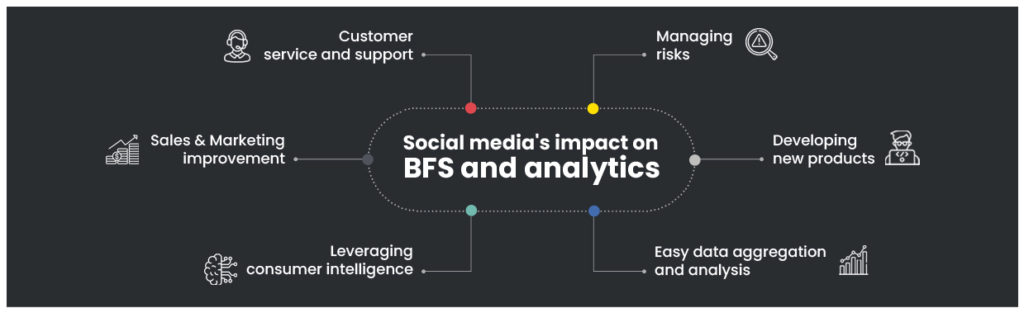
The impact of social media on the BFS (banking and financial services) industry cannot be underestimated today. Social media adoption has earlier been slower in this segment due to several concerns relating to compliance, perception, and industry regulations along with anxieties regarding reputation. The industry was hitherto regarded as conservative. However, banking and financial services entities are venturing into social media for tapping its sheer potential in recent years. Many retail BFS players are now developing their digital presence via mobile banking and other digital applications, in addition to building omnichannel touch points for customers through social media platforms. Social media analytics is redefining customer engagement and driving marketing strategies for BFS firms. With AI and machine learning for the analysis of innumerable data points garnered via social media platforms and combining the same with existing customer database intelligence and reviews, brands are steadily tapping data-driven insights which are shaping their future products. The importance of social media for banking and financial institutions Digital marketing and target marketing campaigns executed by banking and financial services players are now increasingly being shaped by social media analytics. Consumers are spending more time on social media platforms and they are steadily becoming ideal avenues for raising awareness, disseminating consumer education, and enabling potent customer engagement. Reports indicate how leading banks in the U.S. scaled up their overall digital followings by a minimum of 30% (quarterly basis) last year, across social media platforms like Twitter, Instagram, and YouTube.  From tapping customer metrics to doing research on prospects in the enterprise space, forecasting consumer trends, and backing data-based innovation, social media analytics is transforming the entire rules of marketing and outreach for BFS firms. How social media analytics helps BFS entities Social media analytics is immensely helpful for banking and financial services institutions in the following ways:  Leveraging consumer intelligence- Social media analytics helps greatly in terms of evaluating both external and internal datasets across platforms and touch points. Social data insights are also being tapped more efficiently and shared throughout multiple teams, with real-time access to consumer feedback and trends in conversations.  Easy data aggregation and analysis- Social media analytics enables easier aggregation of unstructured information throughout social networks and objective data analysis for enabling enterprises to take better decisions. Huge chunks of data are swiftly processed through automated social media tools, thereby helping companies build superior communication channels with customers and other stakeholders, while ensuring better opportunities for cross-selling and providing better customer experiences.  Sales and Marketing Impact- Social media analytics ensures an in-depth study of consumer behavioral trends, preferences, and conservations. Institutions can easily structure their new services and products, brand marketing and promotional initiatives, announcements, marketing blueprints, and advertising plans for higher brand alignment and equity.  Developing new products- Analytics can also tap consumer data and preferences, helping large enterprises develop new services and products for meeting particular needs of targeted customers.  Customer service and support- Several institutions can understand how effective their offerings are, through an analysis of feedback on social media platforms. Banks and financial services institutions may leverage available feedback for making sure that all grievances are swiftly addressed, thereby enabling higher retention and satisfaction levels of customers.  Managing risks– Social media analytics can also enable institutions to adopt a more pro-active approach towards handling their risks. Through the analysis of data across social media platforms along with consumer behavior, they can evaluate and manage their risks in a more effective manner.  Banks and financial institutions have multiple advantages to harness through social media analytics. Financial firms can gain multiple advantages through integrating these tools into their  business blueprints. They can also become more customer-focused entities that can reach out to their audience base with specifically targeted products and services.  At the same time, they can also analyze or revamp strategies for businesses on the basis of customer preferences and feedback. They may also boost overall customer experiences, while tackling and tracking risks in a more pro-active manner. It is time that financial institutions should incorporate social media-based strategies into their strategies in the near future.  FAQs What social media platforms are most relevant to the BFS industry, and how can they be leveraged for marketing and customer engagement? Social media platforms like Twitter, Facebook, Instagram, and YouTube are highly relevant for the banking and financial services industry. They can be tapped with social media analytics in order to generate consumer feedback, insights, and preferences, which can help drive marketing and customer engagement strategies.  What regulatory considerations should BFS companies be aware of when using social media analytics for marketing and customer engagement? There are several global regulations instituted throughout several countries and regions. These include the fair lending act or equivalent regulations along with other ethical considerations as outlined by the authorities.  What are some emerging trends and technologies related to social media analytics that BFS companies should be aware of? AI-based content, integration of social media metrics into KPIs of companies, and business intelligence are major emerging trends and technologies linked to social media analytics. These are trends that BFS entities should be aware of.  How can social media analytics be used to identify and address customer complaints and concerns in real-time? Social media analytics can be used for identifying customer grievances and complaints on a real-time basis. It can be used to address and respond to these concerns in real-time as well. This can be done through analyzing voluminous data across social media platforms. 

Read More »
MENU
CONTACT US

Let’s connect!

Loading form…

Almost there!

Download the report

    Privacy Policy.