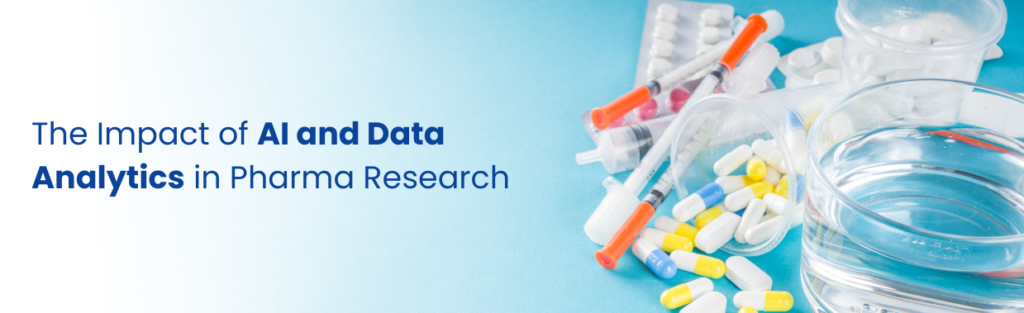
The Impact of AI and Data Analytics in Pharma Research
The pharmaceutical industry is on the cusp of a seismic transformation. No longer simply buzzwords, AI and data analytics have emerged as mission-critical technologies powering the next wave of data-driven drug discovery and pharma R&D efficiency. From predicting disease progression to identifying molecular drug targets, AI transforms pharmaceutical research. Data analytics for pharma is rapidly evolving as companies adopt AI for pharmaceutical analytics to improve drug development and patient outcomes. AI analytics for pharma is transforming how companies optimize drug development and patient outcomes, making data analytics in the pharma industry more powerful and predictive than ever. Understanding the challenges AI foundation models pose for therapeutic development in biopharma is essential for addressing the broader challenges biotech companies face when adopting AI for drug discovery. Effective data strategies in AI-driven drug discovery can create a significant competitive advantage in pharma, especially when combined with the power of advanced analytics in pharma to accelerate decision-making and innovation. In 2025, the challenges in pharma investment in AI platforms are increasingly linked to the impact of reducing AI partnerships on pharma innovation, creating strategic uncertainty for companies aiming to accelerate drug discovery and development. In 2025, the growing challenges in pharma investment in AI platforms are raising concerns about the impact of reducing AI partnerships on pharma innovation. In this blog, we explore how AI and analytics are revolutionizing pharma, highlighting recent breakthroughs and tools, and providing expert perspectives on what’s next. Generative AI and pharma are increasingly shaping the breakthroughs highlighted in recent pharma AI news. Data analytics in pharma R&D is being rapidly transformed by AI for pharmaceutical analytics, enabling deeper insights and faster decision-making throughout the drug development lifecycle. AI in Pharma R&D: Redefining the Research Life Cycle Conventionally, R&D in Pharma has been a lengthy process with high investments. This paradigm changes with AI by: Accelerating compound screening: Machine learning models analyze large chemical libraries much faster than classical wet-lab approaches. By integrating AI customer insights for pharma with advanced data analytics for pharma, companies can better understand patient needs and optimize commercial strategies. Predictive modeling by AI can anticipate the behavior of molecules in biological systems, hence reducing the need for expensive clinical trials. Recent pharma data analytics news often highlights growing challenges in pharma AI data strategies for drug discovery, especially around data quality, integration, and regulatory compliance. Optimizing clinical trials: Advanced algorithms help in the design of trials, improved cohort recruitment, and early detection of side effects. Dr. Anjali Mehra, Chief Data Scientist at BioSynthAI, said, AI isn’t replacing scientists; it’s making scientists more efficient by transforming billions of data points into actionable insights in seconds. Data-Driven Drug Discovery: The Power of Predictive Analytics Data-driven drug discovery currently enables pharma companies to accelerate innovation: It helps analyze complex genomic data sets to find new targets for therapy. Real-world data: RWD involves mining data from patient health records, wearables, and even social data to spot patterns and risks. Digital twins: simulated models of human organs are tested with drugs, reducing the need to conduct trials on live ones. Visual Insight: Below is the comparative chart for 2025, depicting the reduction of time in varied R&D stages due to AI integration: R&D Phase Avg Time (Pre-AI) Avg Time (With AI Tools 2024) Time Reduction Target Identification 2 years 6 months 75% Compound Screening 1.5 years 4 months 78% Clinical Trial Design 1 year 3 months 70% New Pharma AI Tools in 2025 You Should Know Some of the most sophisticated pharma AI tools at the forefront of the race in 2025 include: DeepMind’s AlphaFold 3 Predicts protein structures with unprecedented accuracy. Insilico Medicine’s Pharma.AI It automates the complete drug discovery pipeline. BenchSci It uses machine learning to decode scientific experiments and suggest the best pathways. Atomwise Deep learning-based drug design based on structure. BioSymphony Indian startup that makes use of AI to synthesize generative compounds with higher efficacy. Ready to Leverage AI for Your Pharma Innovation? Partner with INT Global to develop and deploy AI and data analytics solutions tailored towards your pharma enterprise’s needs. Benefits of AI in Pharma: What Makes It a Game Changer? Shorter development cycles mean faster drugs to market. Lower R&D costs = Higher ROI. Better targeting leads directly to better treatment outcomes. Better reporting and safety profiling are a result of regulatory compliance. Challenges & Ethical Considerations Despite the benefits, challenges like Data Privacy and Patient Consent Algorithmic bias Integration with legacy systems Regulatory uncertainty Clearing these hurdles will necessitate sheer AI governance, multidisciplinary collaboration, and continuous regulatory evolution. By combining data analytics in pharma R&D with AI-driven customer insights, pharmaceutical companies can accelerate innovation while delivering more personalized healthcare solutions. Generative AI continues to reshape drug discovery, a trend highlighted in recent pharma AI news reporting breakthroughs in molecule design and clinical trial optimization. Future of AI in Pharma: What Lies Ahead? The future is promising and fast-evolving: AI-driven personalized medicine will become the norm. Quantum computing and AI will boost simulation speeds. Collaborative AI models across pharma giants will improve global research. Innovate Smarter with AI & Data-Driven Strategies The integration of AI and data analytics is no longer optional—it’s the cornerstone of modern pharma research. Whether you’re a biotech startup or an established pharmaceutical leader, the time to act is now. 👉 Transform your pharma R&D with INT Global. Let’s build AI solutions that save lives. 🔗 Get in Touch with Our Pharma AI Experts Frequently Asked Questions Q1. How is AI used in pharma R&D today? AI is used to analyze chemical compounds, design clinical trials, predict drug efficacy, and more. It helps speed up research, lower costs, and improve accuracy. Q2. What are some of the best pharma AI tools in 2024? Top tools include AlphaFold 3, Pharma.AI, Atomwise, and BenchSci. Q3. Is AI replacing human scientists in pharma? No. AI is an augmentative tool that enhances human decision-making, not a replacement. Q4. What challenges do pharma companies face with AI adoption? Major challenges include data