Category: Healthcare

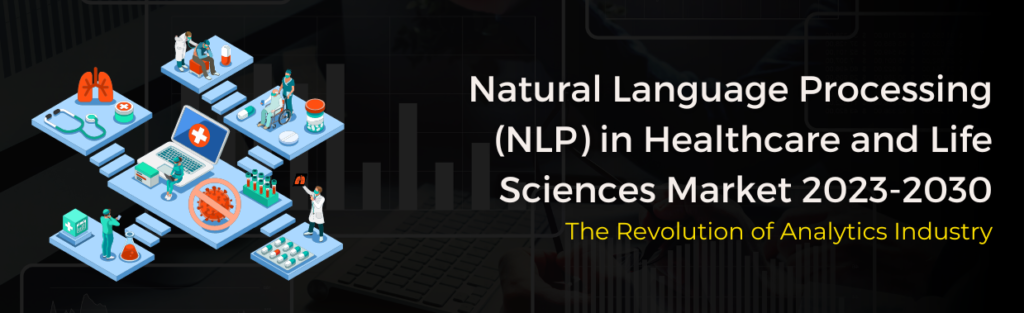
Natural Language Processing (NLP) in Healthcare and Life Sciences Market 2023-2030

Natural Language Processing (NLP) in Healthcare and Life Sciences Market 2023-2030 | The Revolution of Analytics Industry

Natural language processing (NLP) is widely hailed as a future game-changer that will revolutionize various industries, including healthcare and life sciences. There are diverse NLP applications in the space which may foster an industry revolution in the future years. According to research reports, the NLP segment in the healthcare and life sciences category saw sizable revenue growth in 2022 with future forecasts of an increase by 2030. Here are some fascinating trends that industry watchers should keep an eye on.  Biggest NLP Providers in Healthcare and Life Sciences Some of the largest natural language processing (NLP) providers in this category globally include:  Key Trends in Natural Language Processing (NLP) for the Healthcare and Life Sciences Industry Here are some key facets that point towards an industry revolution driven by NLP applications in the healthcare and life sciences sectors.  Following current trends, NLP is poised to witness widespread adoption throughout the healthcare and life sciences industry. Healthy market size growth forecasts for the sector are based on extensive R&D and innovations done by leading players across major global regions. The suite of applications will only increase over the years, with better data extraction and comprehension for enhancing the overall efficiency of the healthcare and life sciences sectors.  FAQs The NLP market is poised to touch a handsome USD $ 9.54 billion by 2030, which indicates a CAGR of 19.1% from the 2022 market size of USD $ 2.35 billion.  Natural language processing (NLP) in healthcare and life sciences offers technology-driven abilities with regard to identifying contexts for the usage of words. This enables a more accurate understanding and interpretation of conversations with patients and other stakeholders while capturing vital nuances of health conditions. This helps manage treatment data and follow-ups. It also helps identify data patterns and automates various tasks in the life sciences and pharmaceuticals sector.  NLP is helpful for processing the electronic health records (EHRs) of patients with an aim to extract valuable information including medication, diagnosis, and other symptoms. This helps enhance overall patient care while ensuring personalized treatments accordingly.  4. What is the future of natural language processing?  Natural language processing (NLP) is expected to expand in the future with diverse applications and other possibilities. There will be more cutting-edge technological innovations in segments like sentiment analysis, speech recognition, Chatbots, and automated machine translation among others. 

Read More »
AI and life sciences: Navigating risks and challenges

AI and Life Sciences: Navigating Risks and Challenges

With the increasing penetration of artificial intelligence (AI) in life sciences, there has been a barrage of questions regarding the risks and challenges involved in this integration. While AI has already started its transformative journey throughout multiple other industries, the life sciences sector has recently woken up to the potential of the same.  Some factors that are key moot points in this regard include the role played by AI in developing COVID-19 vaccines in quicker time (less than one year as opposed to a decade in most cases), AI-driven drug discovery where a novel drug candidate was found for liver cancer in only 30 days, and more. Even Google Cloud has unveiled new AI-backed tools that facilitate quicker drug discovery. Many other technology companies are coming up with tools for automating processes that were manual and time-consuming in nature earlier.  How it stacks up  Life sciences and healthcare AI have already reached a watershed point where there are challenges and disruptions to contend with, but the speed and scale of adoption continue unhindered. Here are some points worth noting in this regard:  Yet, ethics, data privacy, regulatory aspects, and other challenges must be tackled with care to ensure widespread benefits from integrating artificial intelligence (AI) in life sciences. Let us first look at the range of its applications in this space.  Applications of AI in life sciences and healthcare Here are a few points that should be noted in this context:  Now that the benefits of AI are clearly visible, let us take a closer look at the challenges mentioned above and the ways to navigate them for swifter progress in the domain.  Major challenges of AI in life sciences Here are the risks that still remain while deploying artificial intelligence (AI) in life sciences.  Signing off, it can be said that the AI-enabled transformation drive is now in the second phase, i.e. completing patterns and going beyond the initial brief of recognizing them. The life sciences sector will greatly benefit from this current AI stage, provided it can counter the challenges mentioned above.  FAQs AI has a vital role to play in the life sciences industry, enabling faster drug discovery and development along with boosting clinical trial design and data-gathering. It helps analyze vast data sets and generate better insights from the same.  2. What are the key challenges and risks associated with implementing AI in healthcare and life sciences? There are a few challenges and risks that companies have to face while implementing AI in the life sciences and healthcare industry. These include the lack of skilled talent, regulatory compliance hurdles, ensuring data privacy and patient confidentiality, and steering clear of biases in AI algorithms. 3. How can data privacy and security concerns be effectively addressed when using AI in life sciences? Data security and privacy concerns can be tackled effectively with a few proactive steps while using AI in the life sciences sector. These include dedicated patient confidentiality and privacy approaches along with an increased focus on secure data transmission and usage. Governance and data security protocols should be established as per regulatory standards for secure storage, processing, and collection of patient data.  4. What ethical considerations should be taken into account when deploying AI in medical decision-making? The biggest ethical consideration that should be kept in mind while AI is being used for medical decision-making, is the elimination of biases. While training AI models based on real-world data and inputs, there are unconscious biases that get embedded into the same. This may have negative consequences for patients if they are not tackled at the outset.

Read More »
Clinical Trials 2.0: The Impact of Digitisation

Clinical Trials 2.0: The Impact of Digitisation

Digitised healthcare is a compelling proposition for industry stakeholders today, since it carries with it the promise of enhanced consumer benefits and operational efficiencies alike. There are several clinical trial innovations that digitisation has enabled in recent years, paving the way forward towards better data integration, virtual clinical trials, eClinical solutions and patient-centric trials. Digital health technologies have shown their propensity towards boosting objective data collection in trials, scaling up patient access, and facilitating improvements in terms of clinical outcomes. Here’s taking a closer look at digitisation and its overall impact in this space. Recruiting and Retaining Participants in Clinical Trials Digitised healthcare technologies have a leading part to play in terms of participant retention and recruitment for clinical trials. Here are some aspects worth noting in this regard:  Here’s taking a closer look at how technology impacts clinical trials in the current landscape.  How does technology affect clinical trials?  Here are a few pointers that illustrate the impact of technology on clinical trials. Now that the positive effects of technology on clinical trials are visible, let us take a closer look at the impact of digitalisation on healthcare.  How does digitalisation affect healthcare?  Digitalisation-driven healthcare or digitised healthcare, whichever way you choose to see it, will eventually be the future for the entire ecosystem. This is how digitalisation affects healthcare in multifarious ways:  FAQs 1. How are cutting-edge technologies like AI and IoT contributing to the success of Clinical Trials 2.0? IoT is already contributing towards better clinical trials through enabling easy monitoring and gathering of information that can be swiftly accessed in real-time. AI is also identifying and screening potential trial participants based on diverse criteria. Both technologies are reducing costs and timelines for patient recruitment and data gathering alike. They are also making clinical trials more accessible and user-friendly.  2. Can you elaborate on the advantages of virtual and decentralised clinical trials in the context of digitisation? Decentralised and virtual clinical trials are enabling easier access to participants across remote and under-served areas/sites. Remote data gathering and monitoring is one advantage along with combating logistical, transportation, and access hurdles. There is also the opportunity to access bigger and more diverse populations with these trial systems. These are some of the biggest advantages of virtual clinical trials.  3. What challenges arise in adapting legacy systems to the demands of digitised clinical trial processes? Legacy systems need to be adapted to digitised clinical trial processes in the current scenario. Some of the major challenges in this case include software and technological costs, awareness and education on new technological procedures, choosing suitable technologies, and technological literacy of participants.  4. What role does real-world data integration play in driving insights and innovation within digitised clinical trials? Real-world data integration plays a crucial role in enabling greater innovation and insights as far as digitised clinical trials are concerned. Wearables, remote tracking, and virtual clinical visits may enable more patient-focused trials. This will enhance patient engagement greatly while enabling higher accuracy in terms of insights on how medicines perform in actual settings and scenarios.

Read More »
Blockchain's Impact on Data Interoperability in the Healthcare Industry

Blockchain’s Impact on Data Interoperability in the Healthcare Industry

Data interoperability is a buzzword that has gained traction throughout the healthcare industry. This usually comes with multiple levels, including semantics, foundational, and structural. At the same time, data standardisation and privacy are key concerns, since the system should enable interoperability of data with full consent, trust, and permission support.  Blockchain can thus add a whole new dimension to healthcare data management while solving several interoperability challenges simultaneously. It ensures a proper framework for anonymised information while making sure that the data cannot be modified, forged, or tampered with. Blockchain can thus add a whole new dimension to healthcare data management while solving several interoperability challenges simultaneously. It ensures a proper framework for anonymised information while making sure that the data cannot be modified, forged, or tampered with. Authenticity and data security are major worries that are solved with this technology and the owner of data through smart contracts can make it more accessible across treatment sites and providers in a selective way. Here are some of the vital aspects related to the impact of Blockchain on healthcare data interoperability.  Blockchain for clinical trials: Along with data interoperability, Blockchain has enabled better clinical trial management. Here are some core points worth noting in this regard:  Hence, Blockchain technologies can boost the quality and volumes of patients who are recruited for clinical trials. Distributed ledger technologies will help patients store medical information through anonymous mechanisms and it can be visible to recruiters who may reach out if the data is eligible for the trial. Blockchain for patient consent: Patient consent is another vital facet of healthcare data management and this is also enhanced by Blockchain. Here are some factors worth noting in this regard:  These are some of the ways in which Blockchain technologies contribute immensely towards enabling patient consent and putting data management in their hands.  Blockchain for drug supply chain management: Blockchain technology also helps immensely in terms of drug supply chain management. Here are some aspects that can be highlighted in this regard:  Hence, Blockchain technology is a game-changer in terms of ensuring seamless data interoperability in the healthcare industry and also ensuring better consent management, clinical trials, and drug supply chain management. The possibilities are endless in terms of reshaping and refining these systems to ensure the best possible outcomes for the sector.  FAQs 1.How does blockchain improve the accuracy and integrity of healthcare data during interoperability? Blockchain greatly improves the integrity and accuracy of healthcare information during interoperability. This is possible with the immutable nature of data that is securely stored on its networks. Blockchain enables one version of the truth that cannot be tampered with.  2.What are the potential cost savings and efficiency gains from implementing blockchain for data interoperability in healthcare? There are several benefits of using Blockchain for healthcare data interoperability. The first one is the higher efficiency involved in secure storage of immutable records with full authenticity and the second one is the lower cost involved in the process. Along with data security and authenticity, financial losses due to data breaches and losses are also prevented.  3.Are there any real-world examples or success stories of blockchain’s impact on data interoperability in the healthcare industry? There are numerous real-world success stories and examples of how Blockchain has positively affected data interoperability in the healthcare sector. For example, several healthcare stakeholders are already using this technology to ensure authentic data for clinical trials. At the same time, smart contracts are being used for securely storing patient data.  4.What are the main challenges in achieving data interoperability in healthcare, and how can blockchain help overcome them? Some challenges exist in terms of data interoperability in the healthcare sector and Blockchain solves them with ease. These include the absence of data standardisation, security, privacy, consent, and technological expertise. Blockchain ensures a secure and standardised way of storing verifiable records with full consent and privacy. 

Read More »
Predictive Models for Chronic Diseases: Transforming Healthcare

Predictive Models for Chronic Diseases: Transforming Healthcare

A major healthcare transformation is in the works, considering the growing integration of the sector with cutting-edge technologies. Along with data-driven insights and personalised medicine, there are other steps being taken for early detection of chronic diseases, such as the usage of advanced predictive models. If implemented suitably, this could herald a mega healthcare revolution in the near future.  Predictive analytics may become a tool for preventing chronic ailments, while enabling providers to swiftly detect early signs of ailments and intervene accordingly. Here is a closer look at these aspects. 1.What are disease prediction models? Disease prediction models are essentially advanced predictive models that are deployed for early detection based on data-driven insights. Machine learning (ML) models help in the swift diagnosis of chronic ailments. Those suffering from the same usually require lifelong medical aid. Here are a few other points worth noting in this regard:  2.What predictive models are used in healthcare? 3. What types of data are used in predictive modelsfor chronic diseases? There are various kinds of data used by advanced predictive models for chronic ailments. Here are a few aspects worth keeping in mind:  FAQs 1.What are the potential benefits of using predictive models for chronic diseases in healthcare resource allocation? Predictive models can help healthcare providers detect early signs of chronic diseases in patients based on diverse data points. At the same time, they can speed up early interventions and reduce the chances of disease contraction and fatalities with these insights. It will also reduce a major chunk of healthcare costs and resources allocated towards the treatment of these diseases. 2.How can predictive models contribute to cost savings in healthcare? Predictive models can help save costs that are otherwise allocated for treating chronic ailments. Early detection of signs and vulnerabilities can help facilitate strategic interventions and medical advice that may prevent these diseases from occurring. Naturally, this helps reduce healthcare costs related to treatment and resource allocation. 3.How do predictive models improve their performance with time? Predictive models keep enhancing their overall performance with the passage of time due to the nature of their algorithms. The more a provider feeds data into algorithms, the more the accuracy levels of predictive models. This helps in the generation of more accurate and helpful insights. 4.What are some of the challenges associated with implementing predictive models for chronic diseases? Some of the common challenges associated with implementing predictive models for chronic ailments include poor data quality, insufficient data, issues with accuracy levels at times due to the complexity of medical data, and technological integration.

Read More »
MENU
CONTACT US

Let’s connect!

Loading form…

CONTACT US

Let’s connect!

    Privacy Policy.

    Almost there!

    Download the report

      Privacy Policy.