Category: AI & MI

For Enterprises, what does it mean to be AI ready?

It would be so cool if we can ask Amazon what shoes should I buy, ask Siri about the cause of the delay in my cab or even request Google AI to fix my fuse. AI is expected to dramatically reshape fundamental business processes that serve faithfully in the background, enabling digitization to fully penetrate key business interactions and transactions. Why do enterprises need AI? Businesses today need to run at the same pace to stay in this competitive market while balancing the wavering factors like knowledge retention, sustainability, scalability, etc. To achieve the pace and agility, an enterprise requires exemplary harmony, self-governing data, content and strong management in such a way that it provides meaningful support to all the business problems. As the volume of this data keeps increasing exponentially, it becomes a little difficult to derive valuable insights from them. As a result, it affects the decision-making process. AI is helping in creating the maximum opportunities by being a great business driver. A survey conducted by BCG (Boston Consulting Group) among 112 CIOs across multiple industries saw that Artificial Intelligence technologies could significantly improve the cost-effectiveness and performance of IT operations, allowing organizations to stimulate innovation rapidly without making any sacrifice on service, security, or stability. Where does the setback originate? AI has proved itself to be revolutionary but if we look at the other side, it leads to certain setbacks too. Data crisis can lead to hazardous errors Development and training go hand in hand. When you develop an AI-based product, it needs to be supported by both monetary and non-monetary factors like training. A recent failure tasted by IBM purely justifies the statement. In 2013, IBM partnered with The University of Texas MD Anderson Cancer Center and developed a new health care system called “Oncology Expert Advisor” with a mission to eradicate cancer. In July 2018, it was found that the AI was recommending erroneous treatment solutions. The technical experts suggested that the main reason behind it was the lack of training on real cancer patients. Too fragile to respond to the supporting data There are several instances where the outcome of AI and machine learning proves to be biased, sexist and misogynistic. There cannot be a better case study than Amazon’s AI for recruitment to justify the statement. Amazon has developed an AI that shortlists the best 5 candidates out of the given 100 resumes. They trained their AI based on current engineering employees who were male and white. Therefore AI learned that white men are the perfect fit for engineering jobs. Lacks a mind of its own AI is artificially sensed, as it does not have a brain of its own. It was witnessed in the case of our commuter partner Uber. Uber’s self-driving car was running at a speed of 61kmph and could not recognize the lady who appeared from nowhere in the dark, resulting in a crash. In the previous couple of years, enterprises have seen many cases of AI failures. The tiniest of loopholes can lead to big problems. The product managers need to spend the maximum time testing the product. Can AI still be game-changing? There are two areas of artificial intelligence that are most applicable, such as Machine learning and Natural Language Processing. Machine learning is a subset of AI techniques that uses statistical methods to enable machines to improve with experiences. Whereas Natural Language Processing is a subsidiary technology of AI that understands and responds to everyday conversational language such as Alexa, Google assistant, chatbot. These artistic features are world-changing algorithms. According to a report, It is claimed that, by 2035, Artificial Intelligence will have the power to increase productivity by 40% or more. Enterprises who have explored the core use of artificial intelligence have reached a long way. There are a few examples that satisfy the statement pretty well. Dominate the global business The e-commerce giant Alibaba used Artificial intelligence and machine learning to expand its business operations all over the world. They collect the data related to the purchasing habits of the customers. With natural language processing, it automatically generates product descriptions for the site. It has also used AI algorithms to reduce traffic jams by monitoring every single vehicle in the city. Additionally, with the help of its cloud computing division called Alibaba Cloud, it is helping the farmers to monitor crops to improve yield cost-effectively. China is planning to be a dominant AI player and build an AI industry worth $1 trillion by 2030. Back up huge profits An AI software company, Sidetrade, has built a core AI platform known as AIMIE (Artificial Intelligence Mastering Intercompany Exchanges) that processes 230 million B2B transactions. That’s equal to around $700 billion sales and finance undertakings over the last three years. Web-crawling robots further enrich this data with 50 billion data points collected through websites, social networks, and online media sources that are relevant to the activity of 23 million European companies. What AI can do for your enterprise? If a business looks at Artificial intelligence with the lense of business capabilities, it will wipe off 50% off their pressure. AI majorly contributes to three major areas in business: Business process automation, Customer engagement, and Insight development through data analysis. AI can help an organization in creating new products, enhancing its features, providing a creative workspace to the employees by automating tasks, making better decisions, optimizing market operations, etc. In a survey conducted among 250 employees of a particular organization, the percentage of the contribution made by AI in an organization was found. Is your Organisation AI ready? Every enterprise needs to analyze if they are ready for the AI revolution. To bring AI into the business mainstream, companies need to complement their technology advances with a focus on governance that drives ethics and trust. If they fail to do so, their AI efforts will fall short of expectations and lag the business results delivered by competitors that responsibly embrace machine intelligence. Organization gotta embrace the


Read More »
AI-Powered Autonomous Vehicles Header

The Rise Of AI-Powered Autonomous Vehicles : Forces Powering The Evolution In The Auto Industry

In the world of technology when we talk about Self-driving cars it’s often paired with artificial intelligence. Simply put, you cannot really discuss one without the other. Though AI is being implemented at rapid speed in a variety of sectors, the way in which it’s being used in the automotive industry is a hot-button issue right now. 2020 is going to be a big year for autonomous transport. Tesla has tentatively announced that next year, it will be “feature complete” when it comes to self-driving, meaning that a car can find a passenger in one location and drive them to another without any human intervention. With other big advancements coming in the industry, driverless cars may well become more popular and may as well define the next 18 months in the AI community.  Impact of 5G on Autonomous Driving Technology  Fifth-generation cellular network technology or 5G has already been rolled out in certain areas around the world in the past year. In 2020 it is expected, there will be more countries embracing 5G technology with supporting devices the following suit. 5G technology allows for faster speeds as it operates at a higher frequency in the wireless spectrum thus resulting in quicker processing with lower latencies. Not only this, but it also operates at a lower power compared to previous generations along with providing mass connectivity between devices. So you may ask, what does this mean for autonomous vehicle? C-2VX (vehicle-to-everything) will harness the power of 5G for vehicle-vehicle (V2V), vehicle-to-infrastructure (V2I) and vehicle-to-network (V2N) communication. Low latency rates coupled with the fact that the infrastructure is likely to be in place by 2020, 5G will be the natural solution to take autonomous driving to the next level. 5G will allow driverless cars to react to surroundings, identify obstacles and relay such information to the computers on-board in real-time. To estimate the potential of autonomous vehicles and to approximate a timeline of it become the norm we must map the journey from zero autonomy to complete automation in the following steps: Autonomy in respect to self-driving vehicles comes about in 6 stages: No Autonomy: Zero autonomy, the driver performs all driving tasks. Driver Assistance: Vehicle comes with some driving assist features but is still under control from the driver Example: Cruise Control, wherein the car can accelerate/decelerate autonomously to maintain a set speed limit. Partial Automation: Vehicle has combined automated functions, like acceleration as well as the steering, but the driver must remain engaged with the driving task and monitor the environment at all times. Example: Current gen auto-pilot feature on Tesla cars where the car autonomously accelerates and steers to maintain lanes. Conditional Automation: Driver is a necessity, but is not required to monitor the environment. The driver must be ready to take control of the vehicle at all times within notice. High Automation: The vehicle is capable of performing all driving functions under certain circumstances. The driver may have the option to take control of the vehicle. Full automation: The vehicle is capable of performing all driving functions under all circumstances. The driver may have the option to take control of the vehicle. In January 2019, Nvidia announced ‘Nvidia Drive Autopilot’, which seeks to bring AI-powered Level 2+ autonomous driving with AI-assisted smart cockpits, to mainstream passenger vehicles. It has received support from OEM’s like Mercedes-Benz, Volvo and auto parts suppliers like ZF and Continental. The Dubai Future Foundation, along with Dubai’s Roads and Transport Authority, has already launched the Dubai Autonomous Transportation Strategy. The strategy hopes to transform 25% of all transport in Dubai autonomous by 2030. Autonomous technology firm FiveAI hopes to start passenger trials in 2020 for driverless cars. Businesses are more likely to invest in autonomous vehicles before consumers. Hence, industrial vehicles such as tractors, bulldozers and others will be the first ones turning autonomous. They may now accomplish commercial tasks efficiently with higher accuracy in a shorter period of time as the element of human fatigue is no more a hindrance. There’s a valid reason for businesses to embrace this technology first. We witness a general sense of doubt in the eyes of public regarding the safety of this technology, however, if the industries lead the initiative they will be able to establish the successful real-life application of this technology and gain public confidence. Corporations doing research and development in autonomous driving technology – such as Google, can make use of the learnings and proofs-of-concept in other domains of their business. To summarize- It’s established that there is a lot of potential in the technology to cut costs, make roads safer both for passengers as well as pedestrians, take manufacturing efficiency to its peak. What is lacking is supportive infrastructure, which in the form of 5G network and support from automotive OEM’s seems promising. Second, safety concerns regarding this technology which will be eliminated once businesses set new benchmarks of its industrial application. The 2020s probably won’t bring flying cars, solar roads or robotic gas pumps, like much of our current world and technology this decade will see a blend of the amazingly futuristic and frightfully analog. Level 5 automation is still far from reality but we will inch closer to it in the coming decade.

Read More »

Conversational AI in Insurance: Nullifying false positives

Conversational AI problem statement: Operating as an Insurer for the modern-day, on-the-spot solution craving customers is a constant battle between passing out relevant information in the quickest possible turn around. As a thumb rule, insurers can’t keep their customers waiting and then pass on incorrect or unwanted information (false positives). While having a dedicated customer service team for this problem may seem like a tried and tested formula, it brings along its own set of business implications which can hinder profitability as well as brand reputation. Who are conversing through AI, and how? Research shows insurance companies across the globe are investing in conversational AI tools and solutions to overcome this problem, with the broad objective of delivering customer delight and higher recommendation rate. Conversational AI has already proven its merits amongst several leading insurers: • Tryg, a Denmark based insurance operator enjoys 97% resolution rates of all internal chat queries; the company has successfully enhanced the abilities of its existing customer support staff. The number of calls from support to back-office teams has also dropped substantially in just one year, post adoption of Conversational AI. • In a similar instance, Storebrand also claims to have achieved a major break-through in the usage of AI laced chat interactions. Presently, the company powers more than 70% of its chat interactions through AI-chat tools and zero human interventions; additionally, the company also registered a 162% increase in customer interactions through chat mechanisms. Even though Tryg and Storebrand are two distinct companies operating in separate geographies, they have a strikingly similar strategy of adopting the AI tools. Both the companies have adopted the AI as a complementary solution to their customer servicing team. The two insurance giants have actually deployed their chat tools as the ‘first line of defence’ for the ping traffic inbound. The tools generally soak up all the repetitive and mundane queries which suck up employee bandwidth, unproductively. These tools have been carefully planned, crafted and developed to delimit themselves from more serious and business critical queries, which are eventually transferred to more experienced and skilled customer service executives, owing to obvious reasons. Who is driving AI-based conversations? The conversational AI adoption trend is basically fuelled by the fact that customers, especially the millennials prefer fast, efficient and reliable modern communication over traditional channels such as emails and telephonic conversations. Insurers will have to address this sense of instantaneous resolution among millennials in order to carve a better market share among this cohort, which is fast becoming rich and finding ways to manage their finances. According to Accenture, in the next 30 – 40 years, millennials are expected to inherit wealth worth over USD 30 trillion in North America alone. This makes them the next important chunk of population wherein insurers will have to focus more often and create a groundwork necessary for the future to avoid becoming irrelevant and a tech laggard. How do you jump into the bandwagon? To kick off a Conversation AI adoption journey, Insurance players will have to begin from their drawing boards and slate down opportunities to improve the critical interactions customers have. Some important areas may comprise the provision of human support over and above AI support, positioning of the tool in the customer’s digital journey in a manner which highlights the scope of the AI chat assistant, induction of “pre-trained’’ insurance specific modules, deciding the key performance indicators for the solution and lastly, a reliable technology partner that can factor in all of the above and come up with a solution that can efficiently manage near 100% of all customer interactions and void of any false positives.

Read More »

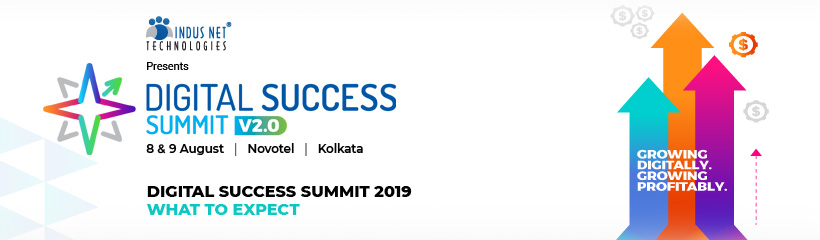
Digital Success Summit 2019: What to Expect

A stimulating conference program focused on digital innovation and transformation. Over the years Indus Net has partnered in digital systems with a number of established players. We regularly innovate in Cloud/Data center, AI, Cyber Security, IoT & Mobile Technologies providing organization with the opportunity to keep in pace with global trends. Our Digital Success Summit V2.0 on 8-9 August 2019 with the theme, ‘Growing Digitally, Growing Profitably’ will encompass 7 deep dive workshops on Day 1 and back to back sessions by speakers from around the country on Day 2. Attend Day 1 to gain actionable insights on How to leverage businesses through powerful storytelling with Indranil Chakraborty The need and know hows for digital innovation with Abhishek Rungta How you can leverage content marketing to build your consumer base with Shubho Sengupta Learn the sorceries of social selling with Kiruba Shankar Get your digital marketing right with Aji Issac Mathew How can you use a combination of storytelling, imagery, and testimonials to boost business with Soumitra Paul Learn the best branding practices for your brand sustenance with Laeeq Ali Attend Day 2 to learn from discussions with the likes of Amit Ranjan is Co-Founder of SlideShare, which got acquired by LinkedIn. Since then he has worked with Government of India to build the DigiLocker project, which is used by more than 10 million citizens. Amit has always been passionate about building outstanding products that sell themselves. Learn from him about building virality into the product or service design. A star teen entrepreneur, Atreyam (Leo) Sharma who has been addressing leading technology events globally since 2014, including TEDx talks in India and Luxembourg.He started coding at the age of 11 and the following year, Co-Founded Workshop4Me. Vikas Malpani, a serial entrepreneur who also co-founded, India’s leading property listing platform-CommonFloor.Com. He is ranked as Business World’s India’s Hottest Young Entrepreneur & has won MIT TR35 Young Innovator Award for his growth advices. And hear many others speak on how to make your product or service viral, sales team management hacks, how to build and manage a remote team, consumer marketing on a shoestring budget and about personal branding Why Should You Attend? We are flying in a delegation of 500+ representing 100+ business covering the country, providing your organization with the opportunity to reach an audience including Enterprise CEOs, CIOs, CISOs, MIS / IT Directors PLUS Cloud Operators, Telcos, SPs, etc. Our Summit provide a highly efficient, cost-effective and proven formula for tech industry CEOs and senior execs, to learn through networking in a single location, in just 48 hours.

Read More »

Why API Integration Is A Must For Digital Banking Growth In 2019

The banking industry is currently overwhelmed by technological disruptions and heightened customer expectations, with non-traditional players such as Facebook, PayPal, Google, and others quickly usurping roles previously played by banks. Non-traditional players have access to cutting-edge technology, which results in excellent user experience (UX) and innovative financial solutions. Customer expectations cannot be met by traditional banks which restrict themselves to digital solutions such as mobile apps or 24/7 customer service. However, banks can choose to be savvy and make the right choice of opening up their APIs to these third-party products and applications. According to one survey, 55% of financial institutions believe that API integration is critical to business strategy. Banks need to collaborate with newer and non-traditional players and open up their APIs in order to remain competitive and witness growth. API integration is an urgent need Behavioral changes and customer preferences have vastly changed over the years, with millennials and Generation Z expecting more from their banks than older users. Providing excellent customer service and a great mobile application are simply not enough anymore, because of the innovative disruptions initiated by non-traditional players. According to a report published by Intelligent Finance, Baby Boomers (or those born between 1946 and 1964) considered poor face-to-face customer service as a major determinant to exit a bank, while millennials revealed they would exit a bank not only if they disliked its smartphone app but also if it suffered from security breaches. Younger customers are also likely to quit a bank if they are unable to use their bank accounts on third-party applications and products. This is a gap that non-traditional players have capitalized on, and is an existential threat to traditional banks. People aged between 18 and 34 are two times likelier than older customers to use mobile payments and P2P lending products. In addition, the same demographic group prefers to receive constant updates via preferred channels such as text message, app notifications, etc. As Millennials grow older and more affluent, and as Generation Z takes the place of the millennials, the importance of digital banks providing a holistic financial ecosystem consisting of third party products and services used by customers become more apparent. Here are some successful examples of API integration: People with financial difficulties in the USA have started to use P2P lending tools such as Earnin and PayActive. It is now possible to consolidate debt too, thanks to debt aggregators. Marcus from Goldman Sachs and SoFi are often cited as examples for non-traditional lenders. Often, these tools are integrated with e-commerce sites or food delivery apps so that people can purchase what they need on credit, bypassing banking lending rules. Credit unions are a non-traditional alternative to bank loans. Walmart MoneyCenters are extremely popular today because they offer a borrowing alternative to people with poor credit histories. If banks integrate their data with these products, customers can continue to make payments for P2P loans without canceling their accounts. One of the best examples of API integration is when PayPal decided to integrate its API with Siri. iPhone users can send and receive money via PayPal by speaking to Siri. Wave is an invoicing and accounting software used by businesses and individuals. Wave uses banking APIs to help users control all their business finances in a single place. It collects as much data as possible from various sources and even markets loans provided by OnDeck on its platform to eligible users. Larger banks have started to offer data aggregation services to their customers. For instance, HSBC recently launched its Connected Money app, on which customers can view their account details in 21 other banks without ever leaving HSBC’s application. Facebook Messenger payments allow Facebook users to transfer money to their friends without ever having to leave the network. Facebook currently has integrated the APIs of PayPal, Stripe, Visa, MasterCard, American Express and others. If traditional banks do not understand the metamorphosis that has already taken place, they stand to lose more of their existing and future customers to non-traditional players. Specific reasons for API integration In order to survive technological disruption, banks need to engage in business model reinvention, which includes open banking and partnering with the newer third-party apps and products. While the producer market consists of banks and other financial enterprises that create products and services, customers can access these products and services on third-party applications, websites and or use voice control. Capitalizing on these distribution channels by opening up APIs is very important for banks survival. E-commerce and on-demand services such as Uber and Airbnb have spurred a customer-centric demand for always-on banking Internet of Things (IoT) enabled devices have led to a growing need for smart solutions and banking services available on intelligent devices Omni-channel banking experience requires data exchange between apps, and customers take this facility for granted now What kind of apps need integration? New services and applications that need API integrations with banking applications include: Payments, clearing and settlement services Mobile and web-based payment applications Digital currencies (DCs), Blockchain and Distributed Ledgers Deposits, lending, and capital raising services Crowdfunding Market provisioning services such as smart contracts and e-aggregators Emerging technologies such as Big Data, cloud computing, Artificial Intelligence (AI) and robotics (Robo-advice) Electronic trading and insurance API Integration can prove to be challenging If you thought your in-house developers can release an API along with the application, you will be disappointed to learn that in 2019, it is a very complex situation. Developing an integration workflow consumes the most amount of time during API Integration, and requires special skills. Event Driven Integration is far more complex than simple API integration, as it needs to provide real-time status updates to customers. Real-time status updates are crucial in today’s financial market. APIs are not always uniform and there are no industry standards at the moment. 70% of the developers work with REST APIs, which makes it a wise choice for API Integration. However, REST APIs will not work for all kinds of applications and

Read More »

How To Enrich Customer Experience Using AI?

Artificial Intelligence has become a buzzword over the last two years and there has been good development around it as well. However, customer experience still hasn’t seen any drastic improvement. The reason often stated is that automation lacks creating an atmosphere of emotional engagement which is a must for positive customer experience. This is where artificial intelligence is going to come to our rescue. AI-enabled technologies can help us understand customers at a deeper level, and predict what they really want, helping us craft campaigns and product experiences that lead to better customer experiences. Let us take a look at how you can start using artificial intelligence quickly and easily, in order to enrich the customer experience. Implement AI-enhanced customer service Artificial intelligence-enabled tools process gigantic amounts of data to quickly understand the situation and history of a customer, helping customer service agents to respond accurately. In addition, customer service enhances customer experience only when it is available 24/7, on all channels. Only artificial intelligence can make that possible for you in a cost-effective manner via chatbots and virtual assistants. Here are some specific uses of implementing AI-enhanced customer service: Chatbots can respond to queries on a number of channels 24/7 Virtual assistants can provide human-like customer service via text and voice AI-enabled tools can assist customer service agents to ingest a customer’s entire history while answering queries Identify customer emotions and provide context-appropriate customer service Use case: CIMB Bank now offers 24/7 customer service by integrating EVA, a Chabot-enabled mobile app. Bank customers can perform a number of activities such as transferring money. paying bills, checking balance, etc. The bank could reduce its dependence on human customer service agents, and also provide 24/7 customer service. Point to note: AI can be used independently if you cannot afford an in-house customer service team. Consider AI-assisted after sales support From Internet of Things to predictive analysis, after-sales support is rapidly changing in recent years. Thanks to artificial intelligence and the many technologies that fall under this bracket, implementing after-sales support is easier than ever. Internet of Things-enabled devices can help provide predictive product support, thereby enhancing customer experiences. Here are a few situations when you can use IoT-enabled after-sales support: Identify when parts are malfunctioning and send technicians immediately Observe downtime and uptime of products and make product enhancements Gather data related to product usage Make improvements to your product and enhance customer experience Use case: Syncron Uptime is an IoT-enabled product by Syncron, which helps manufacturers to provide after-sales support. The technology helps identify when a product will require replacement or repair, by tracking equipment in real time. It uses sensor data to identify malfunctioning and other anomalies, and help manufacturers respond before the customer has knowledge of something going wrong. Point to note: If you provide services rather than products, you can use textual analytics to process natural language on social media or email to identify what your target audience wants. Invest in intelligent data analytics While older data analytics tools only processed data and generated reports, AI-enabled tools can unify various data sources and bring real-time insights to you. Most importantly, AI helps you put insight into its business context. Text analytics solutions are increasingly being used to identify patterns and predict outcomes and take action when required. By using an AI-enabled data analytics tool, you can: Build a dynamic customer profile that recognizes individual interests, previous communication, loyalty, etc. Offer predictive personalization to your customers for enhanced satisfaction Unify data related to customer journeys and generate insight that is more predictive in nature Identify when customer churn might occur based on text communications Use case: Nordea is a Swedish bank that uses an AI-based text analytics solution. The tool analyses hundreds of inbound customer communications every second and processes them intelligently. Each communication is forwarded to the right business unit, eliminating customer frustration. The tool can also be used to recognize customer churn and eliminate it. Point to note: Customer behaviours are chaotic and their interaction datasets are messy. Data insights can bring discipline into an otherwise undefined and unchartered territory. Understand your customers at a deeper level Affective computing, a branch of artificial intelligence that recognizes people’s cognitive and emotional states, is expected to grow to a $41 billion industry by 2022. Apple, Facebook, Google, and other companies are currently working with affective computing specialists such as Beyondverbal, Affective and Sensay to bring facial analysis, emotion recognition, voice pattern analysis, and other humanizing technologies to software programs that run products and services. Here is how you can implement effective computing in the coming months: Identify customer moods on social media by using textual analysis Provide customer support by recognizing negative emotional states such as frustration or anger Use conversational IVRs to recognise frustration during telephone calls Chatbots can recognize emotions and respond appropriately by using neuro-linguistic programming Use Case: Ford is working with Affectiva to bring AutoEmotive, an Automative AI, to its cars in order to prevent accidents and incidents of road rage. This emotion-recognition software uses AI to identify human psychological conditions such as lack of attention, rage, anxiety, etc. in order to take control over the vehicle or just stop it from moving. Point to note: Implement a solid privacy and consent policy to keep yourself safe from litigations, and protect your customers as well. Focus on the humanization of customer interactions A monogamous relationship with AI may spell doom to your customer experience strategy. Nearly 50% of those interviewed in a survey expressed that they would prefer if AI-enabled interactions were more human-like. While AI has obvious benefits of cost reduction, efficiency in customer service, and access to valuable insight, it may reduce customer experience unless you humanize it as well. Here are a few tips to humanize an AI-enabled customer support strategy Implement natural language processing and human voice to bring a “real human” experience Use AI-enabled data density to provide personalized and individual attention to customers Implement real-time support with

Read More »

How To Enrich Customer Experience Using AI In 2019?

Artificial Intelligence has become a buzzword over the last two years and there has been good development around it as well. However, customer experience still hasn’t seen any drastic improvement. The reason often stated is that automation lacks creating an atmosphere of emotional engagement which is a must for positive customer experience. This is where artificial intelligence is going to come to our rescue. AI-enabled technologies can help us understand customers at a deeper level, and predict what they really want, helping us craft campaigns and product experiences that lead to better customer experiences. Let us take a look at how you can start using artificial intelligence quickly and easily, in order to enrich the customer experience. Implement AI-enhanced customer service Artificial intelligence-enabled tools process gigantic amounts of data to quickly understand the situation and history of a customer, helping customer service agents to respond accurately. In addition, customer service enhances customer experience only when it is available 24/7, on all channels. Only artificial intelligence can make that possible for you in a cost-effective manner via chatbots and virtual assistants. Here are some specific uses of implementing AI-enhanced customer service: Chatbots can respond to queries on a number of channels 24/7 Virtual assistants can provide human-like customer service via text and voice AI-enabled tools can assist customer service agents to ingest a customer’s entire history while answering queries Identify customer emotions and provide context-appropriate customer service Use case: CIMB Bank now offers 24/7 customer service by integrating EVA, a Chabot-enabled mobile app. Bank customers can perform a number of activities such as transferring money. paying bills, checking balance, etc. The bank could reduce its dependence on human customer service agents, and also provide 24/7 customer service. Point to note: AI can be used independently if you cannot afford an in-house customer service team. Consider AI-assisted after sales support From Internet of Things to predictive analysis, after-sales support is rapidly changing in recent years. Thanks to artificial intelligence and the many technologies that fall under this bracket, implementing after-sales support is easier than ever. Internet of Things-enabled devices can help provide predictive product support, thereby enhancing customer experiences. Here are a few situations when you can use IoT-enabled after-sales support: Identify when parts are malfunctioning and send technicians immediately Observe downtime and uptime of products and make product enhancements Gather data related to product usage Make improvements to your product and enhance customer experience Use case: Syncron Uptime is an IoT-enabled product by Syncron, which helps manufacturers to provide after-sales support. The technology helps identify when a product will require replacement or repair, by tracking equipment in real time. It uses sensor data to identify malfunctioning and other anomalies, and help manufacturers respond before the customer has knowledge of something going wrong. Point to note: If you provide services rather than products, you can use textual analytics to process natural language on social media or email to identify what your target audience wants. Invest in intelligent data analytics While older data analytics tools only processed data and generated reports, AI-enabled tools can unify various data sources and bring real-time insights to you. Most importantly, AI helps you put insight into its business context. Text analytics solutions are increasingly being used to identify patterns and predict outcomes and take action when required. By using an AI-enabled data analytics tool, you can: Build a dynamic customer profile that recognizes individual interests, previous communication, loyalty, etc. Offer predictive personalization to your customers for enhanced satisfaction Unify data related to customer journeys and generate insight that is more predictive in nature Identify when customer churn might occur based on text communications Use case: Nordea is a Swedish bank that uses an AI-based text analytics solution. The tool analyses hundreds of inbound customer communications every second and processes them intelligently. Each communication is forwarded to the right business unit, eliminating customer frustration. The tool can also be used to recognize customer churn and eliminate it. Point to note: Customer behaviors are chaotic and their interaction datasets are messy. Data insights can bring discipline into an otherwise undefined and unchartered territory. Understand your customers at a deeper level Affective computing, a branch of artificial intelligence that recognizes people’s cognitive and emotional states, is expected to grow to a $41 billion industry by 2022. Apple, Facebook, Google, and other companies are currently working with affective computing specialists such as Beyondverbal, Affective and Sensay to bring facial analysis, emotion recognition, voice pattern analysis, and other humanizing technologies to software programs that run products and services. Here is how you can implement effective computing in the coming months: Identify customer moods on social media by using textual analysis Provide customer support by recognizing negative emotional states such as frustration or anger Use conversational IVRs to recognise frustration during telephone calls Chatbots can recognize emotions and respond appropriately by using neuro-linguistic programming Use Case: Ford is working with Affectiva to bring AutoEmotive, an Automative AI, to its cars in order to prevent accidents and incidents of road rage. This emotion-recognition software uses AI to identify human psychological conditions such as lack of attention, rage, anxiety, etc. in order to take control over the vehicle or just stop it from moving. Point to note: Implement a solid privacy and consent policy to keep yourself safe from litigations, and protect your customers as well. Focus on the humanization of customer interactions A monogamous relationship with AI may spell doom to your customer experience strategy. Nearly 50% of those interviewed in a survey expressed that they would prefer if AI-enabled interactions were more human-like. While AI has obvious benefits of cost reduction, efficiency in customer service, and access to valuable insight, it may reduce customer experience unless you humanize it as well. Here are a few tips to humanize an AI-enabled customer support strategy Implement natural language processing and human voice to bring a “real human” experience Use AI-enabled data density to provide personalized and individual attention to customers Implement real-time support with

Read More »

Implementing Machine Learning Strategies for Business Success

With each passing day, machine learning’s business implications are becoming clearer. Machine learning is a branch of artificial learning in which systems identify patterns from data, learn from insights, and make autonomous decisions with very little human intervention. As the number of smart devices connected to internet increase, so will the data generated by them. This deluge of data is also known as Big Data, and machine learning applies complex algorithms to understand patterns in Big Data to make decisions. Machine learning can provide real-time insights based on data, giving businesses a competitive edge over their peers. In this article, let us take a look at how machine learning is going to influence businesses across the spectrum. Where is machine learning used? Currently, machine learning is being used across industry verticals for business success. Here are some examples: In the media, machine learning is used to personalize content and to make recommendations, predict paywall price, and to optimize layouts. In marketing, data insights can be used to make upsell forecasts and churn predictions, while it can also help in lead scoring. Machine learning also assists in making KPI predictions such as CLV (customer lifetime value). The eCommerce industry has begun to use machine learning to promote products in a targeted manner. The retail industry, on the other hand, uses machine learning to make predictions related to inventory and store layout. Financial services use machine learning to predict churn rate and to reduce it. It is also used to predict loan outcomes and identify risky customer behavior patterns. Three scenarios in which you can implement machine learning immediately Make better sales forecasts, improve marketing campaigns, and enhance customer satisfaction You can start using machine learning to consume and analyze data from unlimited sources. You can also rapidly process analyses and make predictions related to sales and marketing campaigns. In addition, you can use machine learning tools to evaluate past behaviors of customers. According to Forbes, 84% of marketing organizations currently use some form of machine learning or AI to enhance their services. Use cases Example 1: Azure Machine Learning can be used to analyze customer churn and minimize it as well. This is more cost-effective than other traditional and time-consuming methods to minimize customer churn. Interactive Pricing Analytics Pre-Configured Solution (PCS) is a Microsoft Azure machine learning solution that helps to determine the pricing elasticity of every product that you may sell. In other words, this tool can be used to offer contextually relevant pricing. Example 2: Salesforce Einstein is a great example of what machine learning and AI can do to enhance existing CRM solutions. Salesforce Einstein can be used to implement predictive lead scoring, and the tool looks at various demographic and behavioral data sets. It can also help recommend products to your customers based on their interests, and to cross-sell and up-sell products more effectively. Offer predictive maintenance and avoid downtime Most businesses rely on corrective maintenance to fix machines and applications. Corrective maintenance requires one to wait until an issue arises, but the costs in downtime, unscheduled maintenance requirements, and labor can increase the overall expenditure exponentially. Some businesses have begun to use preventive maintenance, which urges customers (and their own staff) to replace spare parts regularly or to ensure certain security and upgrading protocols for software tools. Even scheduled downtime and under-utilization of spares before their full lifetime can result in unnecessary losses. Machine learning helps businesses to undertake predictive maintenance at the right time, whether onsite or for customers. It is the smartest way to ensure that equipment and systems are used to their full lifetime and that problems are identified before they cause issues. You can implement predictive maintenance to reduce over-corrective maintenance, scheduled downtime, and labor costs by analyzing user data and identifying when interventions need to be taken. Specific benefits include: Detecting anomalies in system performance or in equipment Predict when an asset may fail Estimate how long an asset may remain useful Recognize the reasons for an asset’s failure Recognize what steps need to be taken to offer maintenance support to Azure Machine Learning and Microsoft Azure AI platform can help in the predictive maintenance of both onsite infrastructures and provide support for customers. Detect fraud and enhance security An important function of machine learning in businesses is to detect fraud and enhance security. Machine learning technology can be used to manage portfolios, engage in algorithmic trading, underwrite loans, and detect financial fraud. Here are a few ways you can implement machine learning to enhance security: eCommerce websites can make use of machine learning to prevent credit card fraud. Create real-time behavioral profiles that interpret the actions of customers, merchants, individuals, and other entities. Supervised machine learning that uses algorithms to detect fraud after having “learned” from innumerable examples of fraudulent and legitimate transactions. Supervised machine learning can only detect fraudulent activity that has taken place previously, and thus, unsupervised machine learning is the next step. This self-learning algorithm predicts fraud and by detecting outlier behavior and transactions. Adaptive analytics helps machine learning models to continuously learn from feedback. These models can be used to detect spam and thwart IT security threats as well. For example, PayPal uses an open-source based homegrown AI and ML engine to detect fraud. After implementing this model, PayPal reduced fraud by 50%. Implementing machine learning in your business Before you implement a machine learning model, follow these steps for a customized solution: Recognize the problems which machine learning will solve Identify the data sets that will help the machine learning model to solve a problem Determine which machine learning platform you will use to build your custom model Consult a data engineer or determine yourself how you will stream data into the machine learning platform Build or choose the right machine learning model to address your issues Continuously test and adjust the model Machine learning does something for every business With proper planning, you can implement machine learning to enhance sales and marketing campaigns, make

Read More »

What We Learnt From The AI Summit, London

The world’s largest AI event for business ‘The AI Summit’ took place in London from 12-14 June. Artificial Intelligence or AI is a big thing at the moment and this event showed what kind of impact AI is bringing forth in the business world. The event was supported by industry stalwarts like AWS, IBM Watson, Microsoft, Cisco, Oracle, Google, HCL, PwC, Intel, Genpact among others. Here are some updates from the event for your perusal: ‘This is a technology that changes everything, and we are living through it’. Great to hear Secretary of State for business and industry, Greg Clarke, set out the significance of AI and its role in transforming businesses and skills. Exciting times for@IBMWatson #AISummit #ai pic.twitter.com/0QWw8zgIHD — Paul Ryan (@pauldtryan) June 13, 2018 BBC team used machine learning to train a model to recognise credits across thousands of TV Programmes so they could recommend the next show to watch. – Ali Shah #AISummit @Business_AI #AI @BBC @BBCiPlayer #MachineLearning pic.twitter.com/fZCQYs6gCu — Darryll Colthrust (@dcolthrust) June 13, 2018 #ArtificialIntelligence isn't something that's on the horizon! People are, right now, using #AI solutions which are opening doors to a new wave of possibilities. #Accessibility #LTW #London #Tech #AISummit #LondonTechWeek @MSFTBusinessUK @MSNewEngland pic.twitter.com/iW9HQIY9jz — Evan Kirstel #B2B #TechFluencer (@EvanKirstel) June 13, 2018 "It's very very important that the data we are using takes place based on an incredibly transparent basis and is largely anonymised. For us it is a commercial, ethical, and moral consideration." Richard Potter of @MicrosoftUK speaking on the finance #AI panel #AISummit #fintech pic.twitter.com/jkta2MUJqx — AI Business (@Business_AI) June 13, 2018 #AI offers truly transformational opportunities for business & society. But can you explain how some of the most complex algorithms are making their decisions? We’re discussing #ExplainableAI live on stage at the #AIsummit now, paper available here https://t.co/B3lkswMhOg #LTW — Felicity Main (@felicitymain) June 13, 2018 Christina San Jose, group chief data strategist @bancosantander says 80% of her teams’ time & resources are spent on data normalisation because data was originally intended for simple reporting or a byproduct or a back office app, not for #datascience purposes. #AISummit #AI — Nick Patience (@nickpatience) June 14, 2018 Fascinating insight on the progress of #Santander’s #machinelearning activities. Here are the bank’s key customer-facing use cases for #AI & what the model deployments look like internally. They also regularly test their algorithms via sponsored competitions on @kaggle #AISummit pic.twitter.com/UOgA4X5TAw — Nicholas McQuire (@nickmcquire) June 14, 2018 Keep watching this space! We regularly publish similar blogs with current happenings from around the globe in the world of Tech and Digital.

Read More »

Disruptive Innovation in Payments

We could have written paeans about FinTech a couple of years ago, but to do so now would be to sing praises about what is already the norm. FinTech, the inevitable result of finance services making use of technology to enhance solutions and services, is the single largest disruptor in the world of finance. In addition to being a disruptive development, FinTech has evolved into becoming almost conventional, replacing legacy methods and making them seem archaic. Yet, a closer observation reveals that there is a lot of disruption taking place even within contemporary FinTech. Technology has driven FinTech to continuously evolve itself, and newer players continue to give a run for their competitors’ money almost every day. In this article, we briefly recap the growth of FinTech and contextually place this growth in a situation that continues to bring disruptive innovation in payments. We shall also take a look at certain trends driving this disruption, and what we can expect from this exciting development in the near future. The growth of FinTech While it may sound like a fancy term, FinTech isn’t actually very new. Using technology to drive financial procedures has been around since the 1900s in various forms. From being able to wire money to someone in a different part of the world to modern peer-to-peer payments, FinTech has come a long way. Barclays opened the first ATM in the world in 1967, and Wells Fargo kick-started the world’s first online checking account in 1995. PayPal came to being in 1998, and online transactions and payments have grown exponentially ever since. Apple Pay, which was announced in 2016, was another watershed moment, as it heralded a new smartphone-based payments solution. Finally, blockchain-based payment technology gave rise not only to cryptocurrency, but also to smarter payments, seamless insurance claims processing, loan disbursals, and contactless payments. We had recently written an article about how Blockchain is bringing winds of change to the insurance sector. Drivers of the change As we can see, FinTech has evolved dramatically in the last few years due to rapidly evolving technology. However, market behavior and changes within finance sector have also been major drivers of change. In this section, let us take a look at three aspects of this disruptive innovation in payments. Technological development It goes without saying that technology is a big reason for disruptive changes in FinTech. In particular, artificial intelligence and blockchain have caused tremendous changes in the finance sector, propelling drastic changes that have taken even FinTech players by surprise. For example, PayPal and other peer-to-peer payments solutions were taken by surprise when cryptocurrency came to being. Blockchain in fintech is the single-most disruptive situation at the moment. Cryptocurrency players like Bitcoin etc. were taken by surprise when Ethereum-based legal peer-to-peer payments application started to be launched. For instance, blockchain-based claims processing, stock purchase, and Ethereum-based P2P payments solutions are quickly taking over traditional smartphone-based payments applications. Smart contracts have enabled seamless and secure transactions, making financial procedures more reliable than they ever were. In fact, it wouldn’t be an exaggeration to call blockchain a cultural phenomenon. For an industry that focuses much of its energy on building and maintaining trust, blockchain and smart contracts-enabled applications are almost a godsend. It wouldn’t be an exaggeration to state that technology itself is driving change and causing more disruptive innovation in the field of FinTech. Those who aren’t part of this exciting evolution will quickly be left behind. In-store mobile payments are touted to exceed $503 billion by 2020. Just in the US, a whopping 150 million people are expected to use in-store mobile payments. The spending ability of mobile payments users is very high. They spend twice as much as non-users do, and earn at least $70,000 a year. Security-related doubts have been a hurdle for mobile payments adoption. 47% of cybersecurity professionals felt mobile payments weren’t secure enough at the moment, as opposed to just 23% feeling confident. Public Wi-Fi is the greatest vulnerability with respect to mobile payments, with a threat figure of 26%. This is closely followed by stolen devices, a situation whose threat figure is 21%. Market trends Increasingly, users have come to expect a lot more than what technology can offer at the moment. We can describe this as a market that’s so spoiled by choices that even the most disruptive technology no longer feels like disruption. Consumer behavior has shifted from being awestruck by disruption to expecting innovation by default. In other words, services that do not seem innovative enough for consumers simply get ignored. This has forced most industry players to closely study consumer behavior and surpass their expectations. This isn’t usually possible because users have come to expect a lot more than what technology realistically allows us to do. Yet, FinTech companies and solutions providers have to work harder to keep pace with market expectations ad and focus on driving change. Adopting innovation and complex technologies such as artificial intelligence, data analytics, and blockchain will help FinTech companies to surpass market expectations and bring value to the services they launch. Data analytics, in particular, can help FinTech entities to study consumer behavior closely and launch FinTech products that match market expectations. Industry changes There are a number of changes within the industry that are propelling disruptive changes within FinTech sector. Banks are desperate to retain their roles in the finance space, and payments intermediaries may simply vanish, because of smart contracts and distributed ledger technology. The same distributed ledger technology is helping FinTech organizations to make cross-border payments instantaneous, giving rise to new corporate and consumer solutions that will enable instant international payments a reality. Fintech companies have also begun to make use of open APIs, machine learning, and robotic process automation to enhance the experience. Most importantly, a lot of FinTech activity currently is focused on thwarting cyber-attacks, ensuring data privacy and safety, secure financial transactions, and eliminating payment frauds. Blockchain, smart contracts, artificial intelligence and machine learning are currently top

Read More »
MENU
CONTACT US

Let’s connect!

Loading form…

CONTACT US

Let’s connect!

    Privacy Policy.

    Almost there!

    Download the report

      Privacy Policy.