

Visibility is not the same as decisiveness
In many organizations, dashboards are everywhere.
They are projected in meetings, shared through links, embedded in tools, and refreshed automatically. Leaders can see performance at any moment. And yet, when decisions are made, dashboards often fade into the background.
This is not because dashboards are inaccurate or poorly designed—though that sometimes happens. More often, they fail because visibility alone does not compel action.
Even organizations that invest heavily in business intelligence services and business intelligence consulting services often discover that better tools do not automatically produce better decisions.
Understanding why this happens requires looking beyond screens and into how organizations actually decide.

The Illusion of Control
Dashboards create a powerful illusion: if something is visible, it is under control.
Metrics updating in real time signal transparency and responsiveness. Leaders feel informed. Teams feel monitored. The organization appears data-driven.
But control is not visibility. Control requires ownership, thresholds, and consequences. Without those elements, dashboards become observational instruments—useful for awareness, insufficient for action.
Explore our latest blog post, authored by Dipak Singh: Dashboards vs. Reports vs. Insights: What’s the Difference?
The Missing Link: Decision Ownership
One of the most common reasons dashboards fail is the absence of clear decision ownership.
Dashboards show what is happening but rarely specify:
- Who is accountable when a metric moves?
- What action should be considered, or
- What trade-offs are acceptable?
When ownership is diffuse, dashboards trigger discussion rather than decisions. Metrics are debated, contextualized, and explained—but rarely acted upon.
In this environment, dashboards feel busy but inconsequential.
Why More Metrics Make Things Worse
When dashboards fail to drive action, the typical response is to add more metrics.
The logic is understandable: perhaps the right signal is missing. In practice, this usually deepens the problem.
More metrics dilute attention. Leaders scan rather than engage. Teams argue about which number matters most. Decision thresholds become ambiguous.
Instead of clarity, dashboards create noise.
The paradox is that dashboards become less actionable as they become more comprehensive.
Dashboards as Reporting Theater
In some organizations, dashboards become performative.
They are reviewed regularly, but outcomes remain unchanged. Metrics are acknowledged, but follow-through is inconsistent. Over time, leaders stop expecting dashboards to influence behavior.
This creates a dangerous equilibrium. Dashboards exist to signal diligence rather than to drive change. Meetings move forward without resolution. Data is present but optional.
Once dashboards reach this stage, redesign alone will not fix them.

The Role Leadership Plays (Often Unintentionally)
Leadership behavior determines whether dashboards matter.
When leaders ask for dashboards but make decisions based on intuition, teams learn quickly that metrics are decorative. When inconsistencies are tolerated, trust erodes. When no action follows deviation, signals lose meaning.
These behaviors are rarely deliberate. They emerge under pressure and time constraints.
But their impact is profound. Dashboards mirror leadership expectations faithfully.
Why Dashboards Struggle in Cross-Functional Contexts
Dashboards often fail hardest where decisions cross functional boundaries.
A sales dashboard may highlight pipeline issues. An operations dashboard may flag capacity constraints. Finance may raise margin concerns. Each view is valid. None is decisive on its own.
Without an explicit mechanism to resolve trade-offs, dashboards expose conflicts without resolving them. Leaders default to negotiation rather than evidence.
This is not a data problem. It is a governance problem.
Organizations that approach this challenge through structured business intelligence services and business intelligence consulting services tend to see stronger alignment—because the focus shifts from reporting to decision architecture.
What Makes a Dashboard Actionable
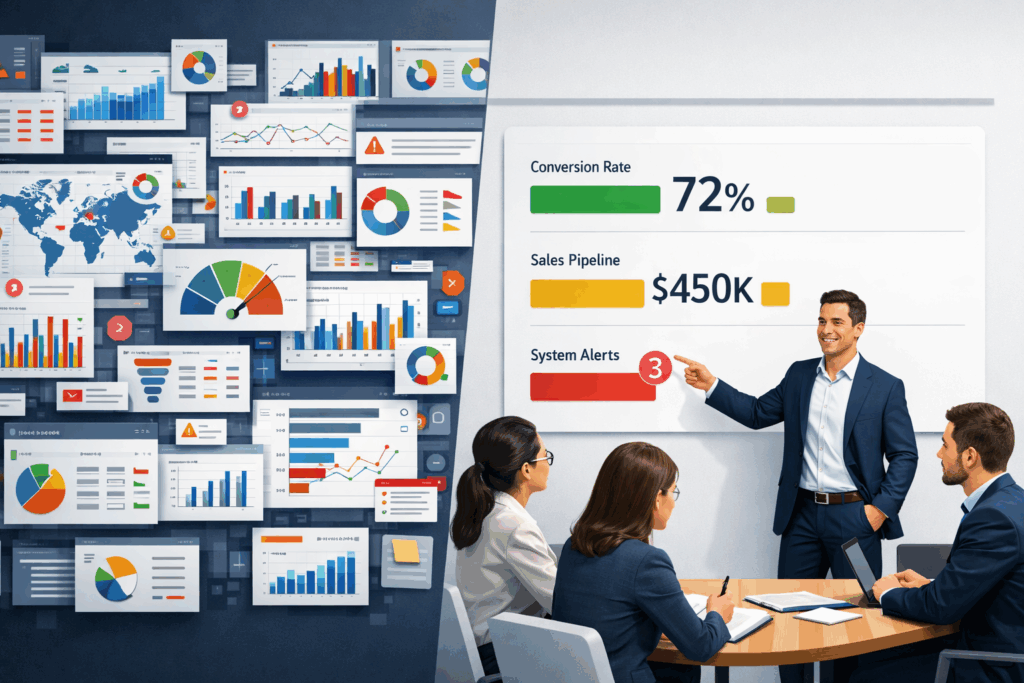
Dashboards drive action only when three conditions exist.
First, the decision context is explicit. The viewer knows why the dashboard exists and what it is meant to influence.
Second, thresholds are agreed upon. There is clarity on what constitutes normal, concerning, or unacceptable performance.
Third, accountability is clear. Someone is expected to respond when thresholds are crossed.
Absent any one of these, dashboards revert to observation tools.
A Subtle Shift That Restores Value
One of the most effective shifts leaders make is to stop asking,
“Why isn’t this dashboard working?”
and start asking,
“What decision is this dashboard supposed to support?”
That question forces prioritization. It reduces metrics. It clarifies ownership. It turns dashboards into instruments rather than artifacts.
Often, fewer dashboards deliver more value.
The Core Takeaway
For CXOs, the core insight is this:
- Dashboards do not drive action—decisions do.
- Visibility without ownership creates noise.
- More metrics rarely compensate for unclear accountability.
Dashboards succeed when they are treated as part of a decision system, not as standalone products.
Organizations that make this shift find that dashboards become quieter, meetings become shorter, and actions become clearer.
Get in touch with Dipak Singh
Frequently Asked Questions
1. Why do most dashboards fail to drive action?
Most dashboards fail because they focus on visibility instead of decision ownership. Without clear accountability, defined thresholds, and agreed actions, metrics remain informational rather than operational.
2. How many metrics should an effective dashboard include?
There is no universal number, but fewer is usually better. A dashboard should contain only the metrics directly tied to a specific decision. If a metric does not influence action, it likely does not belong.
3. Can better visualization tools solve the problem?
Improved visualization can enhance clarity, but tools alone cannot fix governance or accountability gaps. The issue is rarely the chart type—it is the decision framework behind it.
4. What role does leadership play in dashboard effectiveness?
Leadership sets expectations. When leaders consistently act on metrics, dashboards gain credibility. When they ignore data or tolerate inconsistency, dashboards lose influence quickly.
5. How can organizations make dashboards more actionable?
Start by defining the decision each dashboard supports. Establish clear thresholds and assign ownership for responding to deviations. Align dashboards with strategic priorities rather than reporting completeness.