For years, business intelligence has been synonymous with visualization.
Dashboards improved. Charts became interactive. Data became more accessible. Yet despite these advances, many organizations find that decision quality has not improved at the same pace.
This gap has fueled the next wave of BI ambition: decision automation. Predictive models, prescriptive analytics, and AI-driven recommendations promise to move beyond seeing what happened to determining what should happen next.
But here is the uncomfortable truth: automating decisions does not fix broken decision systems. It amplifies them. Understanding the future of BI therefore, requires stepping back from tools and asking a more fundamental question: What decisions are we actually ready to automate?
Leading organizations are now turning to structured business intelligence services and specialized business intelligence consulting services to evaluate this readiness before moving toward automation.
Why Visualization Has Reached Its Limits
Visualization solved an important problem, access.
Leaders no longer had to wait for reports. Information became available on demand. Transparency improved.
But visualization has diminishing returns. Once visibility is achieved, adding more charts rarely increases clarity. Instead, attention fragments. Leaders scan rather than engage. At this point, the constraint is no longer access to data. It is decision discipline. This is where automation enters the conversation.
What Decision Automation Really Means
Decision automation is often misunderstood as letting machines “decide.”
In practice, it means encoding decision logic, thresholds, rules, trade-offs- into systems so that responses are triggered consistently and quickly.
This can range from simple alerts and recommendations to fully automated actions. The critical point is this: automation makes existing assumptions executable. If those assumptions are unclear, contested, or misaligned, automation simply operationalizes confusion.
This is why mature business intelligence services increasingly focus not only on dashboards, but on formalizing decision logic, an area where experienced business intelligence consulting services provide significant strategic value.
Why Many Automation Efforts Fail Quietly
Most decision automation initiatives do not fail dramatically. They fade.
Models are built. Pilots run. Dashboards gain “recommended actions.” Over time, these features are ignored, overridden, or disabled.
This happens because automation exposes unresolved questions:
- Who owns the decision?
- What risk is acceptable?
- When should human judgment override the system?
- What happens when outcomes are poor?
If these questions are not answered explicitly, automation remains optional.
The Prerequisites for Effective Decision Automation
Organizations that succeed with automation share a few common traits.
They have clear decision ownership. KPIs are stable and trusted. Trade-offs are acknowledged. Review mechanisms exist to learn from outcomes.
In other words, automation works only where decision systems already function reasonably well. Trying to automate before these foundations are in place is like accelerating on an unstable road.
Why “Human-in-the-Loop” Is Not a Compromise
A common misconception is that automation replaces human judgment.
In reality, the most effective systems combine automation with oversight. Humans define intent, boundaries, and escalation. Systems handle speed and consistency.
This partnership allows organizations to act faster without surrendering accountability. For CXOs, this framing matters. Automation does not remove responsibility, it sharpens it.
The Evolution of BI in Practice
The future of BI is not a leap, but a progression.
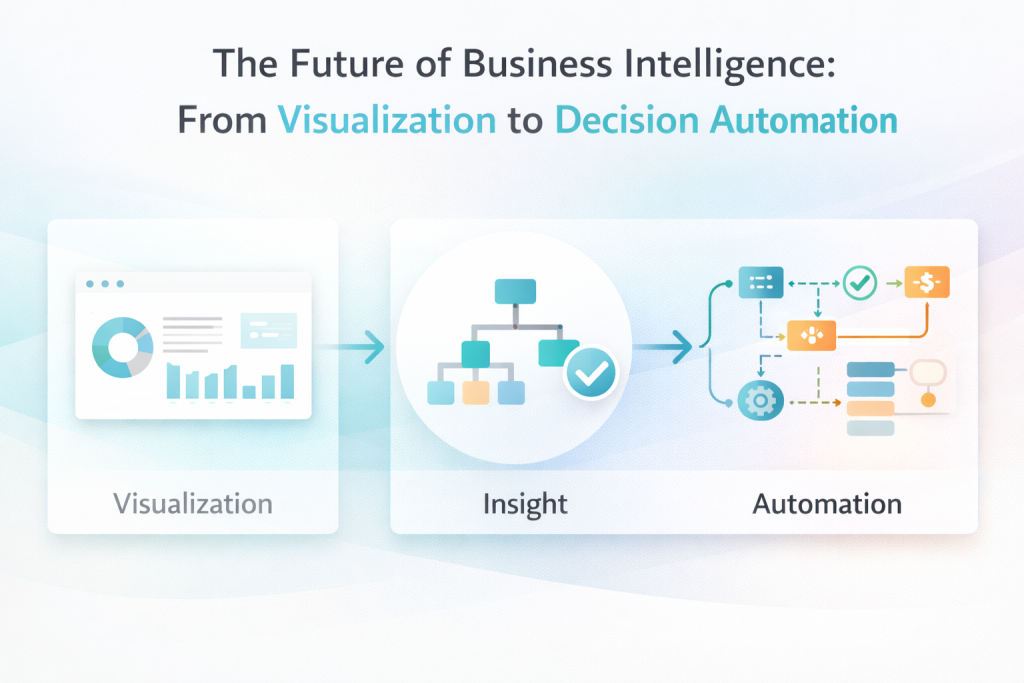
Organizations move from descriptive analytics to diagnostic insight. From insight to recommendation. From recommendation to automation, selectively and deliberately. Each step requires more clarity, not just more technology. Those that skip steps struggle to sustain impact.
The Leadership Role in the Future of BI
The future of BI cannot be delegated entirely to data teams.
CEOs must decide which decisions are strategic and which can be operationalized. CFOs must define acceptable risk. COOs must embed responses into processes. CIOs must ensure reliability and governance.
When leadership alignment is weak, automation initiatives drift into experimentation without adoption. When alignment is strong, BI evolves naturally from visibility to action.
A Critical Question for CXOs
Instead of asking, “How can we automate decisions?”, a more productive question is:
“Which decisions do we want to make the same way, every time?”
Automation is valuable where consistency matters more than discretion. Where speed matters more than debate. Where learning can be encoded over time. Answering this question clarifies where BI should go next and where it should not.
The Core Takeaway
For CXOs, the closing insight is clear:
- The future of BI is not more dashboards.
- It is fewer, better decisions made consistently.
- Automation amplifies clarity or confusion.
Organizations that treat BI as a decision system, not a visualization layer, will extract lasting value from AI and analytics. Those that do not will continue to see impressive screens and inconsistent outcomes.
Final Call to Action
If your organization is exploring automation but is uncertain whether your decision systems are ready, now is the time to assess your foundations.
Engage with experienced business intelligence services and strategic business intelligence consulting services to clarify decision ownership, formalize logic, and build governance structures that support sustainable automation.
The future of BI is not about faster dashboards; it is about better decisions.
Start by defining the decisions that truly matter. Let’s Connect.
FAQs
Decision automation refers to embedding predefined rules, thresholds, and decision logic into systems so that actions are triggered consistently and efficiently, reducing reliance on manual intervention.
Traditional BI focuses on visualization and reporting. Decision automation moves further by operationalizing insights into recommendations or automated actions based on defined rules.
They often fail due to unclear decision ownership, misaligned KPIs, undefined risk tolerance, or lack of governance. Automation exposes these weaknesses rather than solving them.
No. The most effective systems use a human-in-the-loop approach where humans define boundaries and oversight while systems handle speed and consistency.
They must establish clear decision ownership, stable KPIs, governance mechanisms, and defined escalation processes before implementing automation.