As client advisory services mature inside CPA firms, one tension surfaces repeatedly—often quietly, but persistently.
Clients want advice that feels tailored, contextual, and deeply specific to their business.
Partners take pride in delivering exactly that. Yet internally, firms are under growing pressure to scale CAS profitably, maintain consistency, and avoid overdependence on a handful of senior advisors.
This is where the trade-off emerges.
On one side lies custom advisory work: high-touch, bespoke, intellectually satisfying, and often difficult to repeat. On the other lies standardized value structured, repeatable, and scalable, but sometimes feared as “too generic” for true advisory.
Most CAS leaders instinctively lean toward customization. It feels closer to real advisory. But over time, firms begin to realize that unchecked customization is one of the biggest threats to sustainable CAS economics.
The challenge is not choosing one over the other. The challenge is understanding how—and where—each belongs.

Why Custom Work Feels Like Real Advisory
Custom advisory work appeals to how CPAs have historically built trust. It is grounded in context, nuance, and professional judgment. No two clients are the same, and advisory conversations often reinforce that belief.
When a partner helps a client navigate a pricing decision, a capital investment, or a cash crunch, the value feels deeply personal. The insight is shaped by industry knowledge, financial acumen, and an understanding of the client’s risk tolerance.
This work is rewarding. Clients appreciate it. Partners feel indispensable. But beneath the surface, a pattern often develops. Each engagement becomes a one-off. Models are rebuilt. Analyses are recreated. Insights live in individual heads rather than firm-level frameworks. Over time, CAS becomes harder—not easier—to scale.
The firm begins to rely on heroics instead of systems.
The Hidden Cost of Over-Customization
The problem with custom work is not quality. It is economics.
Highly customized advisory engagements consume disproportionate senior time. They are difficult to delegate, harder to price confidently, and nearly impossible to standardize across teams. Margins often look acceptable in isolation but fragile at scale.
More importantly, custom work creates inconsistency. Two clients paying similar fees may receive very different advisory experiences, depending on which partner or manager is involved. This makes it difficult to define what “good CAS” actually looks like inside the firm.
Over time, leadership teams begin asking uncomfortable questions. Why does CAS feel so dependent on specific individuals? Why is onboarding new advisors so slow? Why do insights vary in depth and clarity across clients?
The answer is rarely a lack of talent. It is a lack of standardized value architecture.
Please find below a previously published blog authored by Dipak Singh: Hours → Outcomes: Why CAS Economics Are Fundamentally Changing
What Standardized Value Actually Means in CAS
Standardization is often misunderstood in advisory contexts. It is not about templated advice or generic dashboards. It is about standardizing the thinking, not the answer.
In mature CAS practices, standardization shows up as repeatable insight frameworks. The questions asked are consistent, even if the conclusions differ. The analytical models are stable, even if the outcomes vary by client.
For example, margin analysis should follow a consistent logic across clients, even if the drivers of margin erosion are unique. Cash flow insights should be grounded in the same structural view of working capital, even if operational realities differ.
Standardized value creates a common language inside the firm. It allows junior teams to support advisory work meaningfully. It ensures that every client receives a minimum threshold of insight quality—regardless of who leads the conversation.
Most importantly, it allows CAS to scale without diluting its advisory nature.
The False Dichotomy: Standardized vs. Custom
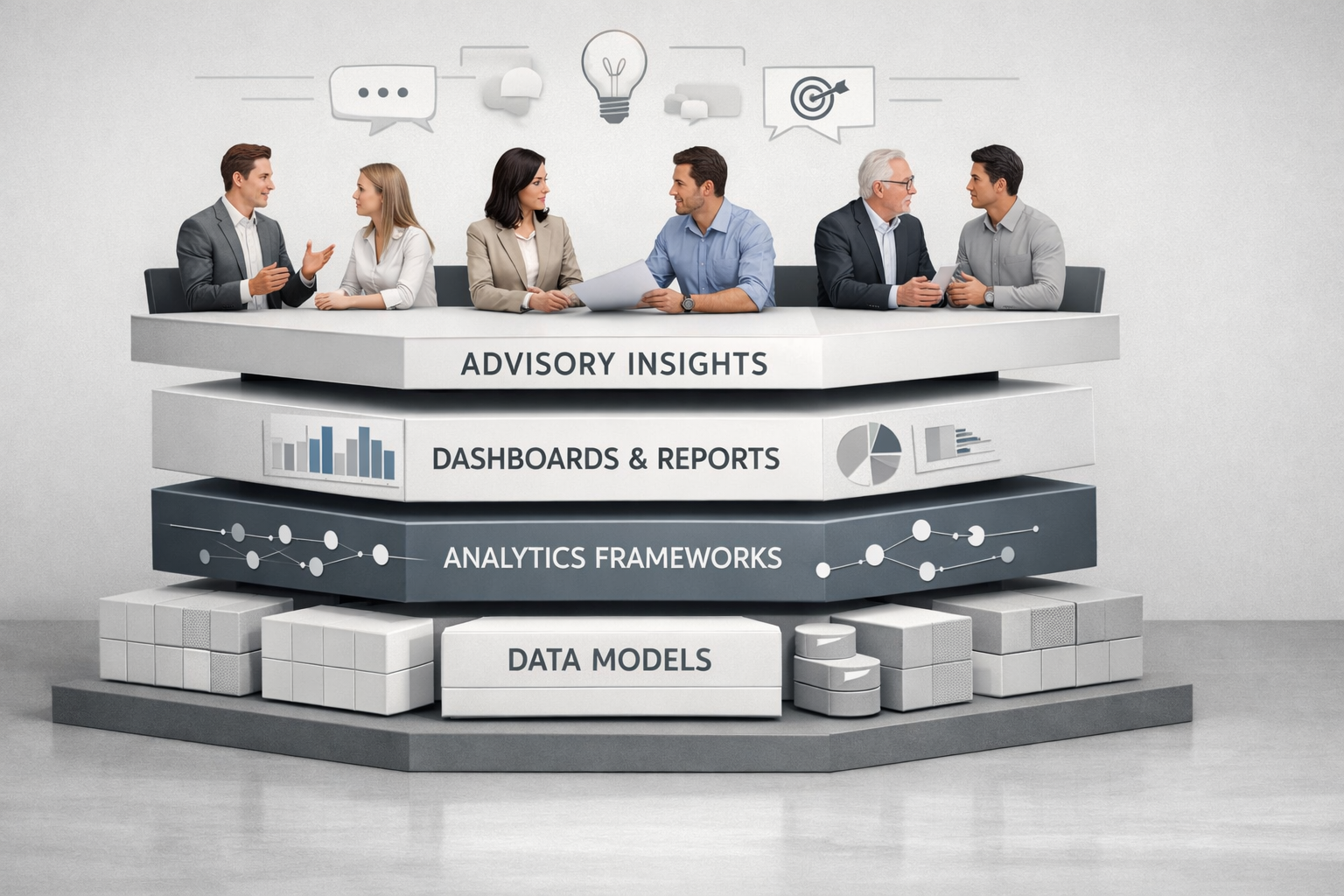
Many firms frame this as an either-or decision. In reality, the most effective CAS practices treat standardization and customization as layers, not opposites.
Standardization should exist at the foundation. Data models, KPI logic, analytical workflows, and reporting structures should be consistent and repeatable. This creates efficiency, reliability, and comparability.
Customization should exist at the interpretation and recommendation layer. This is where professional judgment, industry context, and client-specific nuance come into play.
When firms invert this—customizing the foundation and standardizing the narrative—they struggle. When they get it right, CAS becomes both scalable and differentiated.

Why Clients Benefit from More Standardization Than They Admit
Interestingly, clients often benefit from standardization even when they believe they want purely bespoke advice. Consistent frameworks make insights easier to absorb and act upon.
Over time, clients develop familiarity with how performance is assessed and decisions are evaluated.
This consistency builds confidence. It allows clients to focus on decisions rather than deciphering new formats or metrics every month. Advisory conversations become sharper, faster, and more forward-looking.
Customization still matters—but it matters most in prioritization and action, not in rebuilding analytical logic from scratch.
The Role of Execution in Enabling the Balance
Achieving this balance requires disciplined execution. Insight frameworks must be built, maintained, and continuously refined. Data must be reliable. Visualizations must be intuitive. Without this backbone, standardization remains theoretical.
This is where many firms encounter practical limits. Partners know what good advisory should look like, but execution capacity becomes the bottleneck. Teams spend too much time assembling data and not enough time interpreting it.
Execution partnerships increasingly help firms resolve this constraint. By externalizing parts of the analytics and insight preparation layer, firms can standardize foundations without overinvesting internally. Advisors remain focused on client-specific interpretation and guidance—the part of CAS that cannot be commoditized.
The Strategic Question for CAS Leaders
As CAS practices evolve, the real strategic question is not whether to standardize or customize. It is where to draw the line.
- Too much customization, and CAS becomes fragile, personality-driven, and hard to scale.
- Too much standardization, and it risks losing relevance and trust.
The firms that lead in CAS are those that intentionally design this balance. They standardize the invisible machinery and customize the visible advisory conversation.
That is not a compromise. It is a strategy.
The future of CAS will not be defined by how bespoke each engagement feels. It will be defined by how consistently firms can deliver high-quality insight while preserving the judgment and trust that make advisory valuable.
Standardized value is not the enemy of customization. It is what makes meaningful customization possible at scale.
The firms that understand this trade-off early will build CAS practices that are not only respected but also sustainable.
Get in touch with Dipak Singh
Frequently Asked Questions.
1. Does standardizing CAS mean delivering generic or “cookie-cutter” advice?
No. Standardization in CAS applies to the frameworks, logic, and analytical foundations—not the conclusions or recommendations. Clients still receive advice tailored to their specific situation, but it is grounded in consistent methodologies that ensure quality, comparability, and scalability across the firm.
2. Why does over-customization hurt CAS profitability even when clients are satisfied?
Over-customization concentrates work in senior advisors, limits delegation, and requires repeated reinvention of analyses. While individual engagements may feel successful, the cumulative effect is fragile margins, inconsistent delivery, slow onboarding of new advisors, and an overreliance on specific individuals to sustain the practice.
3. How can firms decide which parts of CAS should be standardized versus customized?
A practical rule is to standardize the infrastructure—data models, KPI definitions, analytical workflows, and reporting structures—while customizing the interpretation and recommendations. When the foundation is consistent, advisors can focus their judgment where it adds the most value: context, prioritization, and decision-making.
4. Do clients actually value standardized insight frameworks, even if they ask for bespoke advice?
Yes, often more than they realize. Consistent frameworks make insights easier to understand, compare, and act on over time. Familiarity builds confidence and allows advisory conversations to move faster and focus on decisions rather than relearning metrics or formats each month.
5. What role do execution partners play in balancing standardization and customization?
Execution partners can help firms standardize the analytical and insight-preparation layers without overextending internal teams. By offloading repeatable execution work, firms preserve advisor time for high-value interpretation and client guidance—the aspects of CAS that cannot be commoditized and are most central to trust.