“In our previous blog, The Silent Revenue Drain, we explored the operational root causes behind premium leakage—manual rating, fragmented data, and visibility gaps. Here, we validate those challenges with hard data and real MGA experiences.”
Premium leakage and manual inefficiencies aren’t theoretical problems. Real-world studies and case examples from across the insurance ecosystem show how outdated workflows directly erode margins, delay operations, and limit growth. In this blog, we examine industry data, surveys, and transformation stories that validate the urgent need for automation among MGAs and brokers.
Case Study: Transportation MGA Struggles with Manual Operations
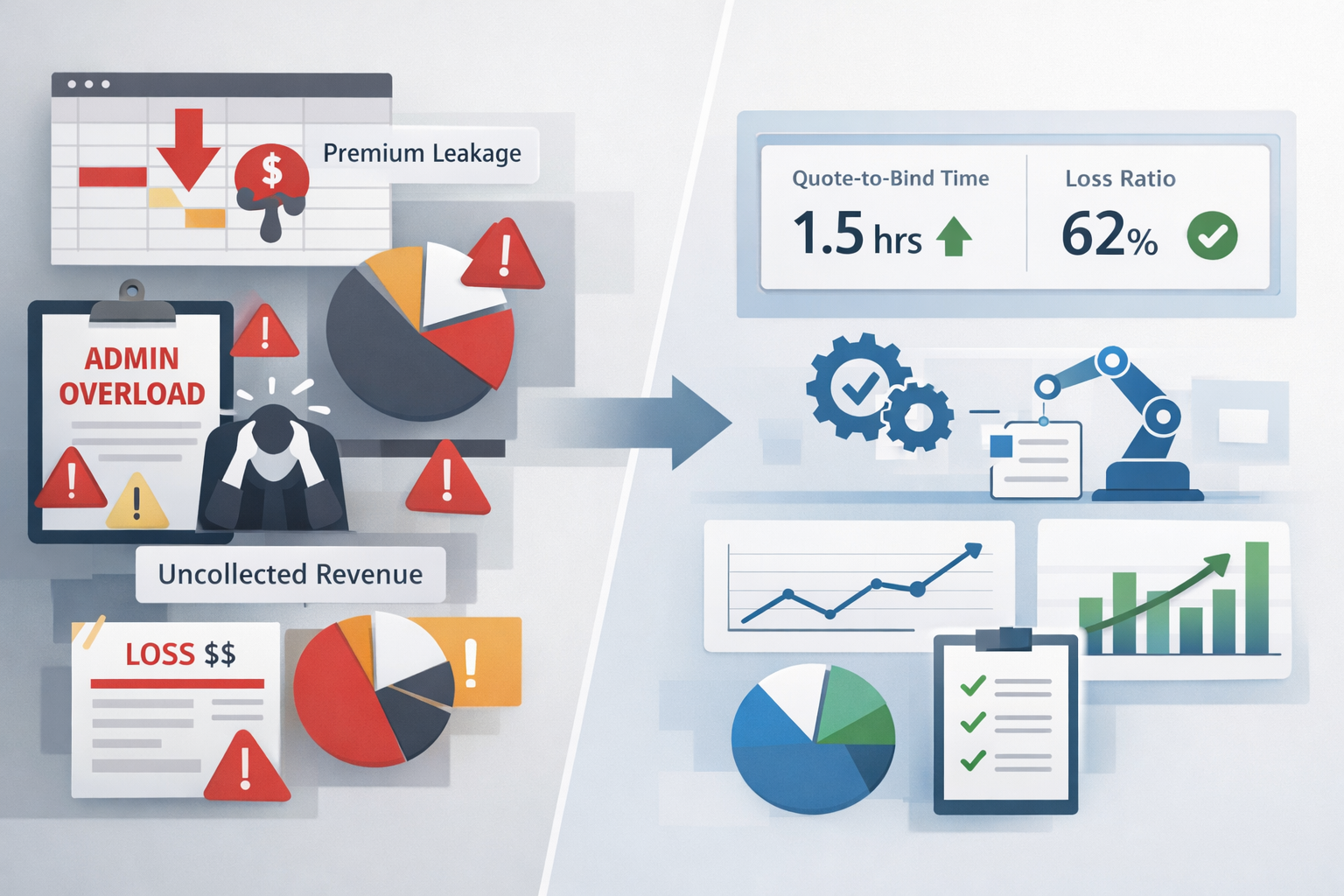
A mid-sized transportation MGA managing thousands of active vehicle policies faced serious leakage. Their underwriting relied on spreadsheets and email chains to process high-frequency changes, driver swaps, vehicle updates, and route modifications. These manual methods created bottlenecks, errors, and revenue loss:
- Lost Premium: Missed midterm changes meant policies weren’t updated or billed correctly, leading to uncollected revenue.
- Slow Quotes: Quote turnaround was delayed due to fragmented data sources.
- No Visibility: The underwriting team lacked a real-time view of the book, forcing reactive decisions.
The Fix:
By shifting to a digital workflow platform with an integrated rating engine, this MGA:
- Automated intake of changes and endorsements
- Accelerated quoting and billing
- Recovered previously leaked premium through timely midterm adjustments
Want to See Where Premium May Be Leaking in Your Operation?
If your team is still managing endorsements, pricing updates, or audits through spreadsheets and email threads, there’s a strong chance revenue is slipping through the cracks.
Contact us to discuss.
Survey Insights: Excel Fatigue and Admin Burnout
The 2025 State of Pricing Survey by Hyperexponential revealed:
- 85% of actuaries still use spreadsheets as a primary pricing tool
- 45% of underwriters cite outdated or inaccurate pricing models as a major frustration
- Top data challenge: “Hours spent rekeying data” ranked among the top three concerns
The impact isn’t just operational; it’s human. Underwriters report losing up to 3 hours per day to clerical work, with 70% of professionals saying better tools would fundamentally improve their roles.
Audit Findings: Massive Revenue Left Uncollected
One global audit and transformation firm reviewed multiple MGA books and found that up to 18% of premium was left uncollected due to inaccurate reporting and missed rating triggers.
In another example, an insurer achieved a 2.8% improvement in loss ratios after moving from manual pricing processes to governed, automated pricing.
These findings show how premium leakage compounds quietly over time and why automating reconciliation, pricing logic, and change tracking is critical to long-term profitability.
Time-to-Market Bottlenecks: Weeks Lost to Manual Launches
MGAs relying on Word documents and email-driven product setup often experience weeks, or even months, of delay when launching new programs. In fast-moving markets, that lag can cost entire opportunities.
- One insurer reduced quote-to-bind time from several weeks to under 72 hours after adopting an automated pricing engine.
- Another carrier updated catastrophe pricing within 48 hours, something previously impossible in a manual environment.
The Industry Verdict
- Spreadsheets introduce errors: Nearly 90% of spreadsheets contain mistakes
- Manual work delays everything: From quotes to audits, every manual step adds friction
- Automation drives margin gains: Carriers using modern platforms report 4–6% better combined ratios
The message is clear: MGAs that cling to outdated workflows are leaving money on the table, increasing compliance risk, and falling behind more agile competitors.
If these challenges sound familiar, the good news is they’re solvable. Automation doesn’t require ripping out your entire tech stack; it requires the right foundation.
Schedule a call with us.
Frequently Asked Questions
1. What is premium leakage, and why is it so common among MGAs?
Premium leakage occurs when policy changes, endorsements, or rating triggers aren’t captured or billed correctly. It’s common in MGA environments due to high transaction volume, manual processes, and limited visibility into midterm changes.
2. Are spreadsheets really that risky for pricing and underwriting?
Yes. Studies show nearly 90% of spreadsheets contain errors. Beyond mistakes, spreadsheets lack governance, auditability, version control, and real-time collaboration, making them unsuitable for scalable underwriting operations.
3. Can automation work alongside our existing policy admin system?
Absolutely. Modern workflow and pricing platforms are designed to integrate with existing PAS, accounting, and data sources, reducing disruption while improving accuracy and speed.
4. How quickly can automation show ROI?
Many MGAs see value within months through recovered premium, faster quote turnaround, reduced rework, and improved loss ratios, often without increasing headcount.
5. Is automation only for large carriers?
No. In fact, mid-sized and growing MGAs often benefit the most, as automation allows them to scale efficiently without adding operational complexity.
“The verdict is clear: premium leakage is measurable, preventable, and accelerating. The next question is no longer if MGAs should modernize—but how. In Blog 3, we map these industry-wide challenges directly to a modern solution: INT Origin.”