Where leaders should stop at insight, and where they can safely automate In most organizations, predictive analytics is admired. Prescriptive analytics is feared.
Prediction feels advisory. It informs judgment without challenging authority. Prescription, by contrast, commits the organization to action. It encodes priorities, thresholds, and trade-offs into systems.
This distinction matters far more than most leaders realize. Many analytics programs stall not because prediction is weak, but because organizations are not ready to be prescribed to. Understanding the difference is not about analytics sophistication. It is about decision maturity.
What Predictive Analytics Really Does
Predictive analytics estimates likelihood. It answers questions such as:
- What is likely to happen next?
- Which customers are most at risk?
- Where are outcomes deviating from expectations?
Prediction introduces probability into decision-making. It reduces uncertainty. It helps leaders prioritize attention. Crucially, it does not remove choice. Leaders remain responsible for interpretation and action. This is why predictive analytics is widely accepted, even when it is imperfect.
Why Prediction Rarely Changes Behavior on Its Own
Many organizations invest heavily in prediction and then wonder why outcomes do not improve.
Churn models identify at-risk customers, but retention strategies remain unchanged. Forecasts highlight demand shifts, but plans stay fixed. Risk scores rise, but responses are inconsistent. The issue is not model quality. It is decision inertia.
Prediction surfaces insight. It does not resolve competing priorities. When leaders are unwilling or unable to act decisively, predictions accumulate without consequence. Over time, teams stop expecting prediction to matter.
What Prescriptive Analytics Actually Implies
Prescriptive analytics goes a step further. It recommends or executes, specific actions based on defined objectives and constraints. It answers questions such as:
- Given our priorities, what should we do now?
- Which action maximizes value under current conditions?
- When should the system intervene automatically?
Prescription is not smarter prediction. It is codified decision logic. This is why it is far more sensitive organizationally.
Why Prescriptive Analytics Triggers Resistance
Prescriptive systems force clarity. They require leaders to agree on:
- what success means,
- which trade-offs are acceptable,
- how risk should be balanced against reward.
Many organizations have never resolved these questions explicitly. They manage them through negotiation, hierarchy, and discretion.
Prescriptive analytics removes that flexibility. It replaces ambiguity with consistency. Resistance is not irrational. It is a signal that decision rules are contested.
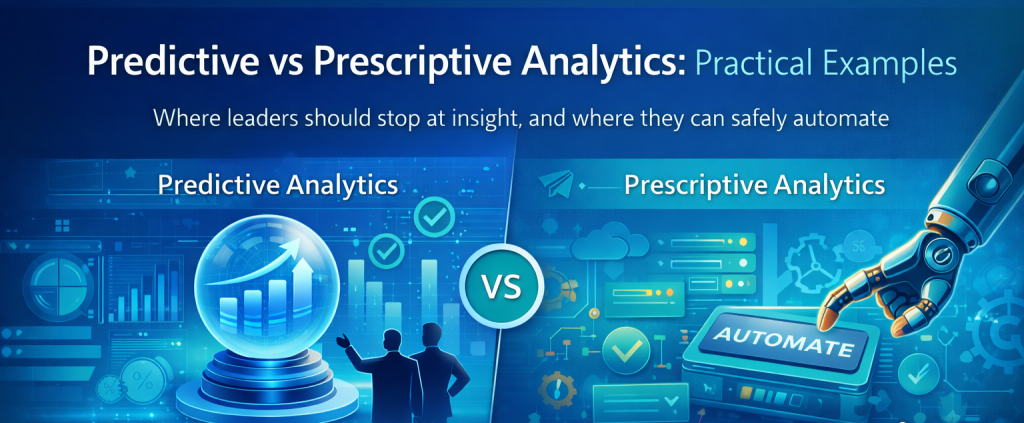
Practical Examples: Where Prediction Is Enough
Not all decisions benefit from prescription. Strategic planning, capital allocation, and leadership judgment often require deliberation, context, and qualitative input. Here, prediction supports thinking but should not dictate outcomes.
For example:
- Long-term market forecasts inform strategy but do not determine it.
- Demand projections guide planning but allow override.
- Risk assessments shape discussion rather than automate response.
In these cases, a prescription would oversimplify complexity.
Practical Examples: Where Prescription Works
Prescriptive analytics excels in repetitive, high-volume decisions where consistency matters more than discretion. Examples include:
- credit approval thresholds,
- inventory replenishment,
- fraud response,
- pricing adjustments within defined bands.
Here, speed and consistency create value. Human judgment introduces variability without commensurate benefit. In such contexts, prescription reduces cognitive load and operational risk.
The Transitional Zone: Recommendation Before Automation
Many organizations fail by jumping directly from prediction to automation. A more effective path is a recommendation.
Systems propose actions. Humans review, accept, or override. Over time, patterns emerge. Trust builds. Decision logic matures. Only then does automation become viable. Skipping this step often leads to rejection or silent override.
Why Technical Capability Is Not the Constraint
From a technical perspective, prescriptive analytics is increasingly accessible. From an organizational perspective, it remains rare.
The constraint is not the algorithms. It is governance, accountability, and leadership comfort with encoded decisions. This is why some organizations deploy prescriptive analytics in narrow domains successfully while avoiding it elsewhere.
A Diagnostic Question for CXOs
A simple question reveals readiness: “Are we willing to make the same decision the same way, every time, within defined boundaries?”
If the answer is yes, a prescription is possible. If the answer is no, prediction is where the organization should stop, for now. Both answers are valid. Confusing them is costly.
The Executive Takeaway
For CXOs, the deeper truth is this:
- Predictive analytics informs judgment.
- Prescriptive analytics institutionalizes it.
- Automation requires agreement, not intelligence.
Organizations that respect this progression avoid disappointment and build credibility slowly but sustainably. Analytics maturity is not about how advanced the models are. It is about how clearly the organization is willing to decide.
Move beyond dashboards, build analytics systems that guide decisions, and automate where consistency matters most. Let’s Connect.