There was a time when delivering KPI dashboards felt like a competitive advantage in CAS. Clients were impressed by visibility alone. Automated reporting replaced spreadsheets. Metrics became accessible, and performance suddenly felt measurable in a new way.
That phase is over.
Today, KPI dashboards are expected. They represent the minimum entry requirement for modern advisory services, not the differentiator. CAS leaders who still position dashboards as their primary value proposition often sense a plateau: adoption is high, enthusiasm is lower, and advisory conversations are not deepening at the same pace as reporting sophistication.
The dashboard solved the visibility problem.
It did not solve the interpretation problem.
The real question facing CAS practices today is no longer how to build better dashboards. It is what comes after dashboards become ordinary.
When KPIs Stop Being Insight
KPIs were designed to focus attention. Ironically, in many environments they have achieved the opposite.
Clients track more metrics than ever, yet decision clarity has not increased proportionally. The issue is not metric quality. It is metric saturation without hierarchy.
A KPI dashboard is essentially a catalog of measurements. Insight emerges only when those measurements connect to a decision framework. Without that connection, KPIs become performance scenery, informative but passive. Consider how most KPI reviews unfold. Advisors walk through the dashboard tile by tile:
- Revenue
- Margin
- Expenses
- Cash
- Accounts Receivable
- Accounts Payable
Each metric is explained. Variances are noted. The meeting ends with general observations rather than directional conclusions.
The numbers were reviewed, but they did not drive a choice. The dashboard functioned as a scoreboard, not a steering wheel. Technology alone cannot create advisory leverage. That leverage comes from how metrics are interpreted and prioritized.
The Ceiling of Descriptive Reporting
KPI dashboards are optimized for description. They answer questions such as what changed and by how much. That capability is essential, but it represents the floor of analytical maturity, not the ceiling. Clients do not run businesses at the descriptive layer. They operate at the driver layer.
They care about questions like:
- Is growth profitable or fragile?
- Is the cost structure scaling correctly?
- Is working capital tightening or stabilizing?
- Is productivity improving or eroding?
These are not new KPIs. They are relationships between KPIs.
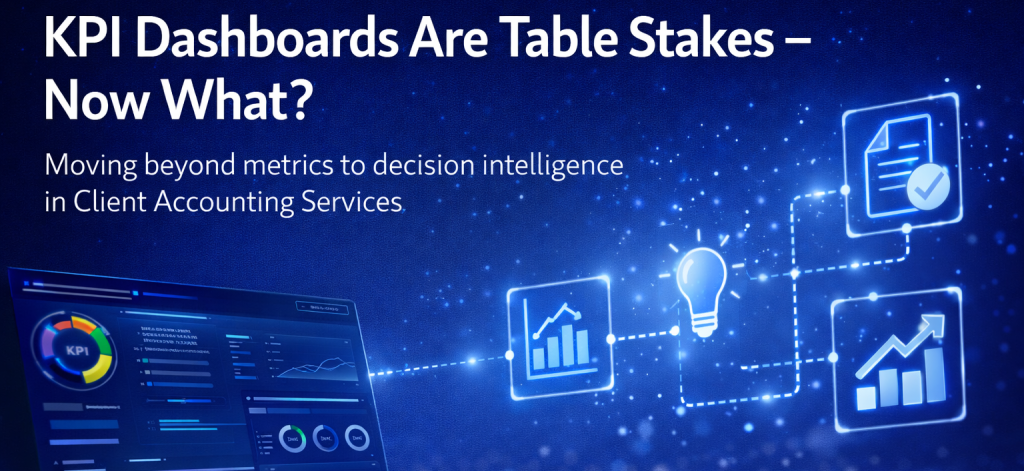
The shift from dashboard review to advisory direction occurs when CAS teams consistently analyze these relationships rather than isolated figures. Relationships turn static metrics into dynamic signals. They reveal tension inside the system.
For example:
A margin percentage alone is descriptive. Margin analyzed alongside customer mix, pricing strategy, and labor intensity becomes interpretive. That interpretation is where advisory begins. Dashboards do not prevent this level of analysis, but they do not guarantee it either.
Moving from Measurement to Modeling
Once dashboards become standard, differentiation shifts upstream into data modeling.
Measurement tells you what happened.
Modeling explains why patterns repeat.
Most CAS datasets are organized around accounts and reporting categories because that is how accounting systems store information. Advisory strength increases when data is also organized around operational dimensions, such as:
- Customers
- Products
- Services
- Capacity
- Channels
- Lifecycle stages
This additional structure transforms dashboards from simple reporting interfaces into analytical environments. Instead of merely tracking KPIs, advisors can explore:
- Profitability by decision unit
- Growth quality by segment
- Cost behavior by activity
- Capacity utilization by function
At this point, the dashboard is no longer the endpoint. It becomes a doorway into structured inquiry. Clients notice the shift immediately.
Meetings move from reviewing numbers to diagnosing performance. The dashboard stops being the agenda and becomes evidence within a broader conversation. That is the moment CAS moves beyond table stakes.
What Mature CAS Conversations Sound Like
When dashboards operate within a modeling mindset, the language of advisory changes. Instead of saying: “Expenses increased this month.” The conversation becomes: “Expenses are rising faster than output. That trend will compress margins unless productivity improves.”
Instead of saying: “Revenue grew 12%.” The interpretation becomes: “Growth is concentrated in lower-margin work, which changes the sustainability of expansion.”
The numbers themselves have not changed. The analytical posture has. Clients rarely need more dashboards. They need someone to teach the dashboard how to behave like a diagnostic instrument rather than a reporting surface.
This requires intentional framing, comparative logic, and a consistent habit of linking metrics to operational drivers. CAS firms that internalize this shift stop competing on visualization and start competing on interpretation. Visualization is easy to copy. Interpretation is far harder to commoditize.
The Strategic Inflection Point for CAS Leaders
Every CAS practice eventually reaches a maturity threshold where reporting efficiency is no longer the constraint. At that point, growth depends on advisory depth.
Firms that remain anchored to dashboard delivery risk commoditization. Clients begin to view reporting as infrastructure, necessary but interchangeable. Pricing pressure naturally follows. Firms that evolve beyond dashboards reposition themselves around decision intelligence. Their value lies in helping clients:
- Understand trade-offs
- Anticipate operational pressure
- Navigate uncertainty
In this environment, the dashboard becomes supporting evidence rather than the headline offering. The shift is not about abandoning KPIs. It is about reframing their role. KPIs should feed advisory thinking, not substitute for it. When CAS leaders recognize dashboards as a baseline capability, they free themselves to compete on analytical design rather than visual polish. That is where durable differentiation lives.
Takeaway
KPI dashboards are no longer a competitive edge, they are the starting line. The next phase of CAS advantage comes from turning measurement into modeling and modeling into direction. Metrics alone describe performance. Relationships between metrics explain it.
CAS practices that move beyond dashboard delivery and invest in interpretive structure transform reporting into decision infrastructure. And when clients begin using dashboards as tools for steering rather than reviewing, advisory stops feeling like an add-on. It becomes the natural output of the data. Dashboards show what happened. We help you decide what to do next. Let’s Connect