Why most analytics value comes from repeatable decisions, not breakthrough models
When organizations talk about analytics and AI, the conversation often drifts toward novelty. Predictive algorithms, personalization engines, and AI-driven automation dominate headlines. Yet when value is examined closely, a different pattern emerges.
Across industries, the highest-impact analytics use cases are remarkably similar. They focus on recurring decisions, modest improvements, and consistent execution. They are rarely glamorous, but they compound.
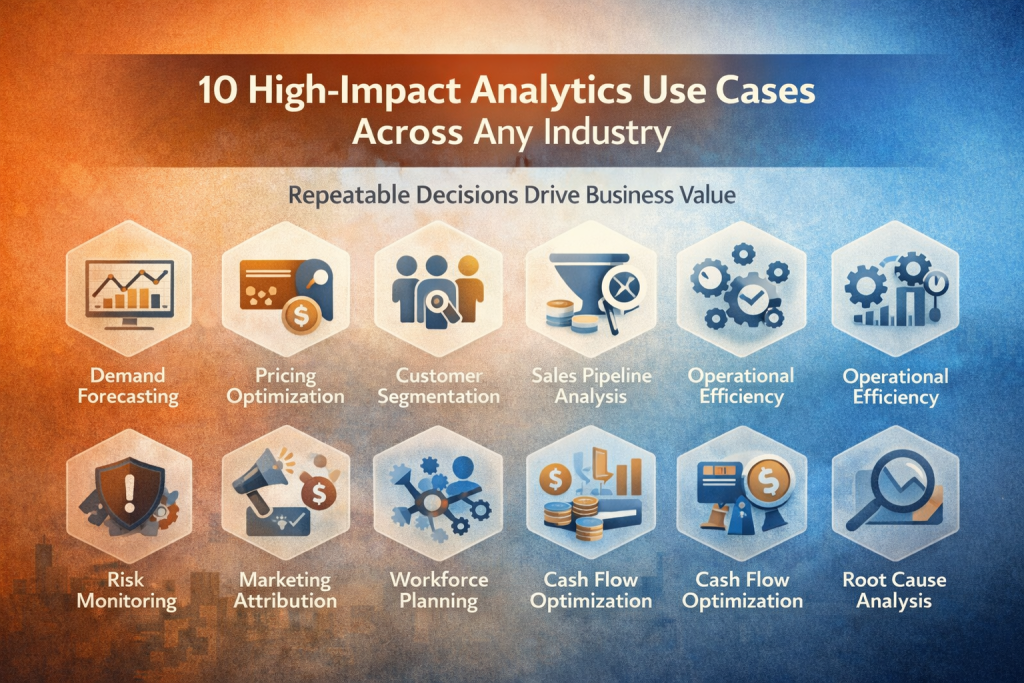
This article outlines ten such use cases, not as a checklist, but as a way for CXOs to recognize where analytics reliably delivers business value.
1. Demand Forecasting and Planning
Almost every organization struggles to align supply with demand.
Analytics improves this by introducing structured forecasts that inform production, inventory, staffing, and capacity decisions. Even modest forecasting accuracy can significantly reduce waste and volatility. The value here does not come from perfect prediction, but from better anticipation.
2. Pricing and Margin Optimization
Pricing decisions are often driven by intuition, precedent, or competitive pressure.
Analytics introduces discipline by modeling price sensitivity, cost structures, and margin trade-offs. This allows leaders to evaluate scenarios rather than react to market noise. The impact is often immediate and underestimated.
3. Customer Segmentation and Prioritization
Not all customers contribute equally to value or risk.
Analytics helps organizations segment customers based on behavior, profitability, and potential. This enables targeted engagement, differentiated service, and more effective allocation of resources. Segmentation is not about sophistication; it is about focus.
4. Sales Pipeline and Conversion Analysis
Sales teams generate large volumes of data that often remain underutilized.
Analytics identifies patterns in pipeline movement, conversion bottlenecks, and deal quality. This allows leaders to intervene earlier and coach more effectively. Here, analytics improves judgment rather than replacing it.
5. Operational Efficiency and Bottleneck Detection
Operational systems generate signals continuously. Analytics surfaces where delays, rework, or variability accumulate.
By identifying bottlenecks systematically, organizations can prioritize improvement efforts based on impact rather than anecdote. This use case thrives on consistency, not complexity.
6. Risk Detection and Exception Monitoring
From credit risk to compliance issues, analytics excels at flagging anomalies.
Rather than eliminating risk, analytics helps organizations see it sooner. Early detection enables proportionate responses, reducing downstream cost. This is often the gateway to automation.
7. Marketing Effectiveness and Attribution
Marketing decisions frequently suffer from unclear attribution.
Analytics helps quantify which activities influence outcomes and which do not. This enables better budget allocation and more disciplined experimentation. The goal is not perfect attribution, but directionally correct learning.
8. Workforce Planning and Productivity Analysis
People’s decisions are among the most sensitive and impactful.
Analytics supports workforce planning by analyzing capacity, utilization, attrition risk, and skill gaps. Used responsibly, it informs planning without reducing people to numbers. This use case demands strong governance.
9. Working Capital and Cash Flow Optimization
Finance analytics often delivers outsized value with relatively simple models.
By analyzing receivables, payables, inventory, and payment behavior, organizations can improve liquidity without structural change. For CFOs, this is one of the most reliable analytics ROI drivers.
10. Performance Variance and Root Cause Analysis
When performance deviates, explanations matter.
Analytics enables structured root cause analysis, reducing speculation and hindsight bias. Leaders can focus on drivers rather than symptoms. This use case underpins better accountability and learning.
Why These Use Cases Work Across Industries
These use cases share three characteristics.
They address recurring decisions. They rely on existing data. And they deliver value through incremental improvement, not transformation narratives. They do not require cutting-edge AI. They require clarity, discipline, and persistence. This is why they succeed where many AI initiatives fail.
How CXOs Should Use This List
This list is not meant to inspire a shopping spree.
Instead, leaders should ask:
- Which of these decisions do we already make poorly?
- Where would modest improvement compound over time?
- Which use cases align with our data maturity?
The answers reveal where analytics will matter most.
The Executive Takeaway
For CXOs, the essential insight is this:
- Analytics value is repeatable, not spectacular.
- Most ROI comes from improving everyday decisions.
- Sophistication is secondary to consistency.
Organizations that internalize this focus less on chasing AI trends and more on building analytical muscle where it counts.
That is how analytics quietly becomes a competitive advantage. Let’s Connect.
It improves a recurring, financially meaningful decision where small gains compound over time.
No. Most deliver strong value with structured analytics and disciplined execution.
Start with frequent decisions that already have usable data and a clear financial impact.
AI often overreaches. Analytics succeeds by focusing on repeatable improvements, not transformation narratives.
By linking improvements directly to revenue, cost savings, risk reduction, or cash flow impact.