Why pipeline choices quietly shape speed, trust, and accountability
Few topics in data engineering generate as much terminology—and as little clarity—as pipelines.
ETL, ELT, streaming, event-driven, zero-touch. To most CXOs, these sound like implementation details best left to specialists. And yet, pipeline choices determine how quickly data moves, how reliably it can be trusted, and how easily the organization can change.
When pipeline decisions go wrong, the consequences surface far from the engineering team: in delayed decisions, reconciliation debates, fragile analytics, and rising operational risk.
This article explains these approaches simply—not to compare technologies, but to clarify what kind of organization each approach actually supports.
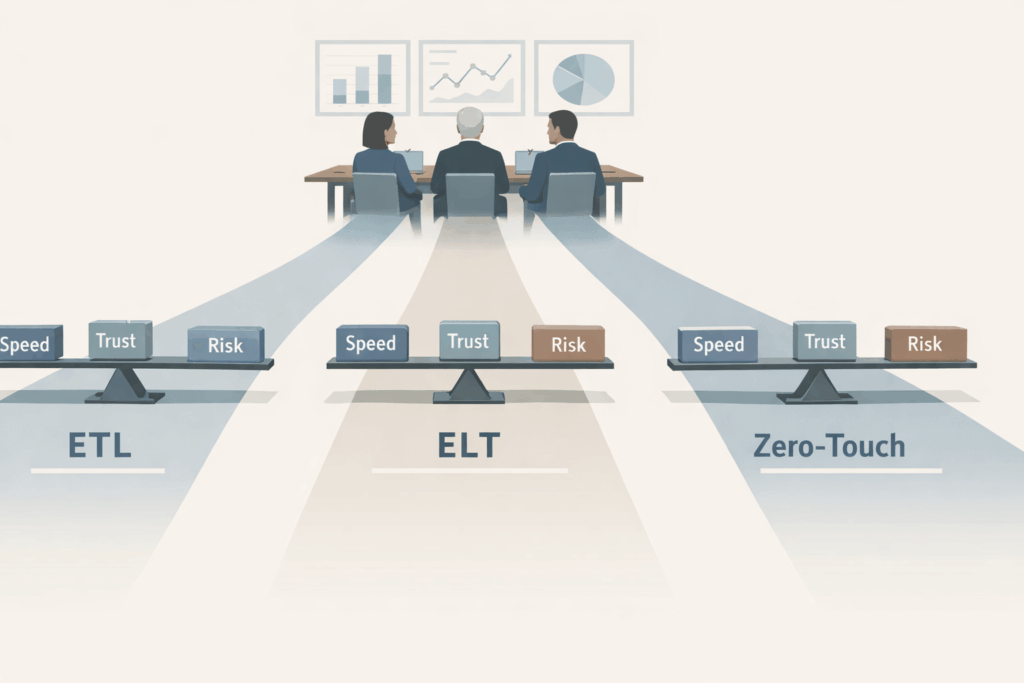
Why Pipeline Discussions So Often Miss the Executive Point
Pipeline debates are usually framed in technical terms: performance, cost, scalability, and tooling. Those factors matter, but they are not decisive at the leadership level.
From a CXO perspective, pipelines answer three more important questions:
- How quickly can the business see what just happened?
- How confidently can numbers be reused across functions?
- How risky is change?
When pipelines are chosen without these questions in mind, engineering optimizes locally while the business absorbs the consequences globally.
Explore our latest blog post, authored by Dipak Singh: Data Modeling Basics Every CXO Should Understand
ETL: Control First, Speed Second
ETL—extract, transform, then load—represents the most traditional pipeline pattern.
In ETL, data is cleaned, standardized, and shaped before it enters the analytical environment. This approach emphasizes control and predictability. Transformations are deliberate, reviewed, and often slower to change.
For many organizations, ETL feels reassuring. It produces stable, well-defined outputs. Finance and compliance teams often favor it because it reduces ambiguity.
The trade-off is speed and flexibility. Because transformations happen upstream, change takes time. New questions often require pipeline modification rather than analysis.
ETL works best when:
- Definitions are stable
- Reporting needs are well understood
- Decision cycles tolerate latency
It struggles when the business is still learning what it needs to ask.
ELT: Flexibility First, Discipline Required
ELT—extract, load, then transform—reverses the order.
Data is loaded into a central environment quickly, and transformations happen closer to consumption. This makes experimentation easier. Analysts can explore raw data, test logic, and iterate faster.
For fast-moving organizations, ELT feels empowering. Insight arrives sooner. New use cases can be explored without re-engineering pipelines.
But ELT carries a hidden risk. Without strong modeling and governance discipline, flexibility turns into fragmentation. Multiple interpretations emerge. Trust erodes quietly.
ELT succeeds when:
- Modeling standards are strong
- Ownership is clear
- Leadership tolerates some ambiguity during exploration
Without those conditions, ELT accelerates confusion rather than insight.

Zero-Touch Pipelines: Automation Without Attention
“Zero-touch” pipelines promise automation—data flows from source to dashboard with minimal human intervention.
In theory, this sounds ideal. In practice, it is often misunderstood.
Zero-touch does not eliminate design decisions. It merely hides them. Logic still exists. Assumptions still matter. When issues arise, they can be harder to diagnose because fewer people understand what is happening.
For CXOs, the risk is misplaced confidence. Automated pipelines can give the illusion of reliability while masking fragility underneath.
Zero-touch approaches work when:
- Data sources are highly standardized
- Changes are infrequent and predictable
- Observability is strong
They fail when the business is dynamic and assumptions change frequently.
The Real Trade-Off Is Not Technical; It Is Organizational
The choice between ETL, ELT, and zero-touch pipelines is ultimately a choice about how the organization wants to operate.
- ETL favors control over speed
- ELT favors learning over certainty
- Zero-touch favors efficiency over visibility
None is inherently superior. Problems arise when pipeline choices conflict with organizational behavior.
For example, choosing ELT in an environment that demands absolute consistency creates frustration. Choosing ETL in a rapidly evolving business creates bottlenecks. Choosing zero-touch without accountability creates blind spots.
Why “One Pipeline Strategy” Rarely Works
Many organizations search for a single, enterprise-wide pipeline approach. This is usually a mistake.
Different decisions require different trade-offs. Financial reporting demands rigor. Operational monitoring may demand speed. Strategic analysis may demand flexibility.
Mature organizations accept this nuance. They design pipelines intentionally rather than uniformly. They are explicit about where control matters and where exploration is allowed.
This clarity prevents endless debates later.
What CXOs Should Listen for in Pipeline Discussions
Senior leaders do not need to evaluate pipeline architectures, but they should listen for signals.
Are teams clear about which decisions each pipeline supports? Do discussions focus on business impact or tool capability? Is ownership of transformations explicit?
If pipeline conversations revolve around acronyms rather than outcomes, misalignment is likely.
The Core Takeaway
For CXOs, the essential insight is this:
- Pipeline choices define how the organization balances speed, trust, and risk
- There is no universally “best” approach—only better alignment
- Automation does not remove responsibility; it amplifies design decisions
When pipeline strategy aligns with decision needs and organizational behavior, data flows quietly and reliably. When it does not, friction appears everywhere else.
Understanding this allows leaders to ask better questions and avoid treating engineering choices as purely technical preferences.

Get in touch with Dipak Singh
Frequently Asked Questions
1. Is ELT always better for modern cloud data stacks?
No. While ELT aligns well with cloud scalability, it requires strong governance and modeling discipline. Without it, speed comes at the cost of trust.
2. Can an organization use ETL and ELT at the same time?
Yes—and many mature organizations do. The key is being explicit about which decisions each pipeline supports and why.
3. Are zero-touch pipelines realistic for fast-changing businesses?
Only in limited scenarios. When assumptions change frequently, fully automated pipelines can hide issues rather than prevent them.
4. How should CXOs evaluate pipeline decisions without technical depth?
By focusing on outcomes—decision speed, data consistency, ownership, and change risk—rather than tools or architectures.
5. What is the biggest pipeline mistake organizations make?
Choosing a pipeline approach based on trend or tooling instead of organizational behavior and decision-making needs.