Why most organizations automate too early, and regret it quietly
Dashboards made data visible.
Automation makes data consequential.
Many organizations attempt to move directly from dashboards to automated decisions, expecting speed and efficiency. Some succeed in narrow domains. Many stall. Others retreat quietly after early enthusiasm.
The difference is not technical capability. It is decision readiness. Automating decisions forces organizations to confront questions that dashboards allow them to avoid.
Why Dashboards Feel Safe and Automation Does Not
Dashboards inform without obligating. They present information and allow leaders to retain discretion. Ambiguity can be managed through discussion. Responsibility remains distributed. Automation removes that buffer.
Once decisions are automated, outcomes are no longer debatable in real time. Assumptions are executed. Trade-offs are enforced. Accountability becomes explicit. This is why dashboards are widely accepted and automation is not.
What Decision Automation Actually Requires
Decision automation is not about removing humans. It is about identifying decisions that:
- occur frequently,
- have limited variability,
- and benefit from consistency over discretion.
Automation replaces repeated judgment with codified logic. This requires agreement on objectives, thresholds, and acceptable risk, none of which are trivial.
Are you still relying on dashboards alone? Let our experts help you turn data into real decision intelligence.

Why Most Automation Efforts Fail Early
Automation fails when organizations mistake prediction for permission.
A model may predict outcomes accurately, but that does not mean the organization is ready to act on those predictions consistently.
When automated recommendations conflict with experience or intuition, they are overridden. Over time, trust erodes. Automation is bypassed. The system technically works. Institutionally, it fails.
The Missing Step: Decision Codification
Before automation, decisions must be codified.
This means making explicit:
- What action should occur under which conditions,
- What exceptions are allowed,
- Who can override the system,
- and how overrides are reviewed.
Most organizations have never formalized this logic. Decisions live in conversations, not rules. Automation exposes this gap.
The Recommended Progression
Successful organizations follow a disciplined progression.
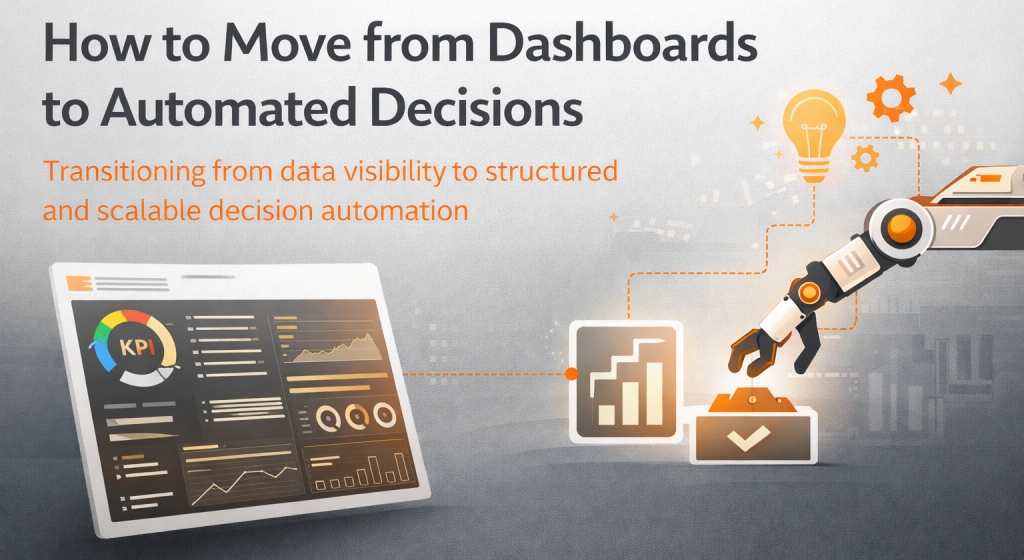
- First, visibility: dashboards show what is happening.
- Second, recommendation: systems suggest actions.
- Third, guided action: humans approve or reject.
- Finally, automation: actions execute within defined bounds.
Skipping stages increases resistance and failure risk.
Where Automation Creates Real Value
Automation works best in operational domains where speed and consistency matter more than nuance.
Examples include:
- fraud detection responses,
- inventory replenishment,
- routine credit decisions,
- dynamic pricing within limits.
In these areas, automation reduces latency and variability. Strategic and cross-functional decisions rarely belong here.
Why Governance Becomes Non-Negotiable
Automated decisions amplify impact. Errors propagate faster. Biases scale. Exceptions matter more. This makes governance essential, not as oversight, but as stewardship.
Clear ownership, monitoring, and review mechanisms are required. Without them, automation becomes a reputational risk.
A Question Every CXO Should Ask
Before approving automation, leaders should ask:
“Are we willing to let the system make the same decision the same way, every time, even when outcomes are uncomfortable?” If the answer is no, automation should wait. That is not caution, it is maturity.
The Executive Takeaway
For CXOs, the deeper truth is this:
- Dashboards create awareness.
- Automation creates commitment.
- Commitment requires clarity and accountability.
Organizations that automate deliberately build resilience and trust. Those that automate prematurely build complexity and retreat. Automation is not the future of analytics. It is the outcome of disciplined decision-making. Let’s Connect.
FAQs
Decision automation refers to systems that execute predefined actions automatically based on data insights, rules, and predictive models without requiring manual intervention each time.
Dashboards provide visibility but do not define decision rules. Automation requires clear objectives, thresholds, and governance, which many organizations have not formally established.
Organizations should progress gradually: dashboards for visibility, recommendation systems for guidance, guided decisions with human approval, and finally controlled automation.
High-volume, repeatable decisions with clear rules, such as fraud detection responses, inventory replenishment, routine credit approvals, and dynamic pricing adjustments, are ideal for automation.
Automation scales impact quickly, so strong governance ensures accountability, monitoring, and clear override mechanisms to prevent errors or unintended consequences.