
Executive Summary
Businesses scaling their digital operations often face a strategic question: should they start with cloud consulting or DevOps strategy? While both are critical, they solve different problems. Cloud consulting helps businesses choose, plan, and optimize their cloud environment. DevOps strategy improves how software is built, deployed, and maintained. The right priority depends on business maturity, infrastructure complexity, and growth goals.
- Cloud consulting builds the right technology foundation
- DevOps strategy improves speed, agility, and reliability
- Both deliver more value when aligned
- The best starting point depends on what is slowing the business down
What Are Cloud Consulting and DevOps Strategy?
Before deciding what to prioritize, it helps to define the difference clearly.
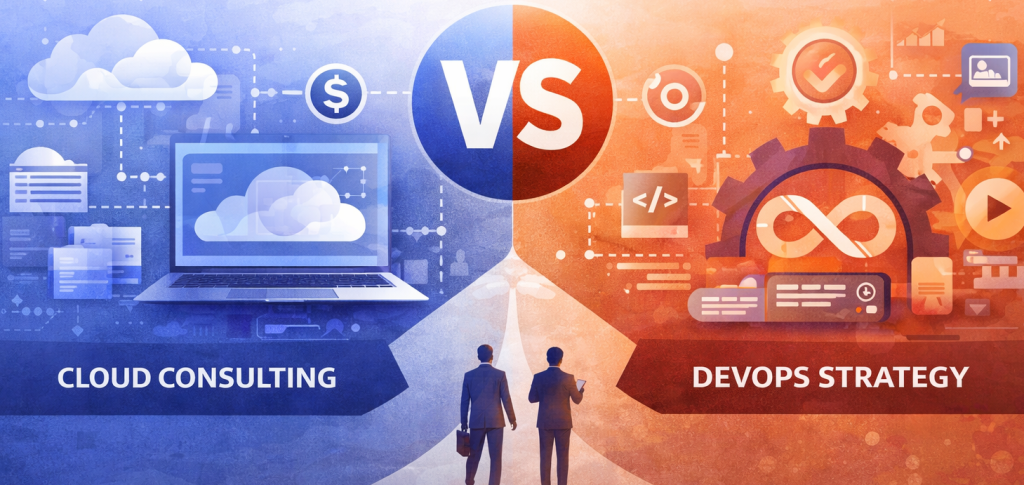
Cloud consulting focuses on infrastructure planning, migration, architecture, cost optimization, and cloud readiness. A cloud consulting service provider helps businesses choose the right cloud path and avoid expensive mistakes.
DevOps strategy focuses on how teams build, test, release, and manage software continuously. It improves collaboration between development and operations, reduces friction, and accelerates delivery.
One builds the foundation. The other improves how that foundation performs at scale.
Accelerate growth with the right foundation and delivery strategy; connect with our experts today.

Why Businesses Struggle to Choose
At first glance, cloud and DevOps seem closely connected. And they are. But they solve different pain points.
Businesses usually turn to cloud consulting when they face:
- Legacy systems that are slowing growth
- High infrastructure costs
- Poor scalability
- Unclear cloud migration plans
They turn to DevOps when they face:
- Slow release cycles
- Frequent deployment issues
- Siloed teams
- Limited automation
The question is not which one matters more. The question is: what problem needs to be solved first?
When Cloud Consulting Should Come First
If your infrastructure is outdated, fragmented, or not ready for scale, cloud consulting should usually be the first move.
A strong cloud foundation helps businesses:
- Modernize infrastructure
- Improve flexibility and resilience
- Optimize performance and costs
- Prepare systems for future growth
Without this foundation, DevOps efforts often run into avoidable bottlenecks. Faster deployment means little if the environment itself is unstable or poorly structured.
When DevOps Strategy Should Come First
If your teams already operate in the cloud but struggle with speed, quality, or release reliability, DevOps strategy may be the better starting point.
A mature DevOps approach improves:
- Deployment speed
- Collaboration across teams
- Automation and consistency
- Product quality and uptime
This is where devops services create measurable impact. They help businesses move from manual operations to streamlined delivery systems that support faster innovation.
Step-by-Step: How to Decide What to Prioritize First
- Assess Your Current Infrastructure
Identify whether your systems are stable, scalable, and cloud-ready - Review Delivery Bottlenecks
Look at release cycles, deployment delays, and team inefficiencies - Define Business Goals
Clarify whether the immediate need is modernization, speed, or both - Map Dependencies
Understand whether cloud limitations are affecting delivery performance - Choose the Starting Point Based on Friction
Prioritize the area causing the greatest business slowdown
This decision becomes easier when working with a trusted devops service provider that understands both infrastructure and delivery strategy.
Why the Best Answer Is Often Both
Cloud consulting and DevOps strategy create the most value when they work together.
Cloud enables scale. DevOps enables speed.
Cloud improves architecture. DevOps improves execution.
Businesses that align both can:
- Launch faster
- Improve system reliability
- Reduce operational inefficiencies
- Adapt more quickly to changing demands
The real advantage comes not from choosing one forever, but from sequencing them intelligently.
Key Takeaways
- Cloud consulting and DevOps strategy solve different business challenges
- Cloud should come first when infrastructure limits growth
- DevOps should come first when delivery speed and reliability are weak
- The strongest results come from aligning both over time
- Prioritization should depend on where friction is highest today
Conclusion
The choice between cloud consulting and DevOps strategy is not about picking a winner. It is about understanding what your business needs most right now.
If your environment is not ready for scale, start with the cloud. If your teams cannot deliver efficiently, start with DevOps. And if growth is your goal, plan for both.
Because successful digital transformation depends not just on technology choices, but on choosing the right sequence. Not sure where to start; cloud or DevOps? Let’s Connect and build the right strategy for your business.
FAQs
Cloud consulting focuses on infrastructure and cloud readiness, while DevOps strategy focuses on software delivery, automation, and operational efficiency.
If infrastructure is outdated or difficult to scale, cloud consulting often needs to come first before DevOps can create full value.
Businesses should prioritize DevOps when deployment speed, collaboration, and release reliability are limiting growth.
Yes. Cloud consulting builds the right foundation, and DevOps helps teams use that foundation efficiently and at scale.
They should assess infrastructure readiness, delivery bottlenecks, business goals, and where current friction is slowing growth the most.