Most CAS practices can clearly articulate where they started.
For many firms, CAS began with outsourced accounting, monthly close, and reliable reporting. Over time, dashboards improved, variance explanations became more refined, and conversations with clients grew more frequent and more thoughtful.
This evolution—from bookkeeping to insight—is well understood.
What is less clearly defined is the next phase.
Increasingly, CAS is being asked not just to explain the past or clarify the present, but to help clients anticipate what lies ahead. This marks a shift toward what many firms describe as CAS 3.0—a model centered on foresight rather than hindsight.
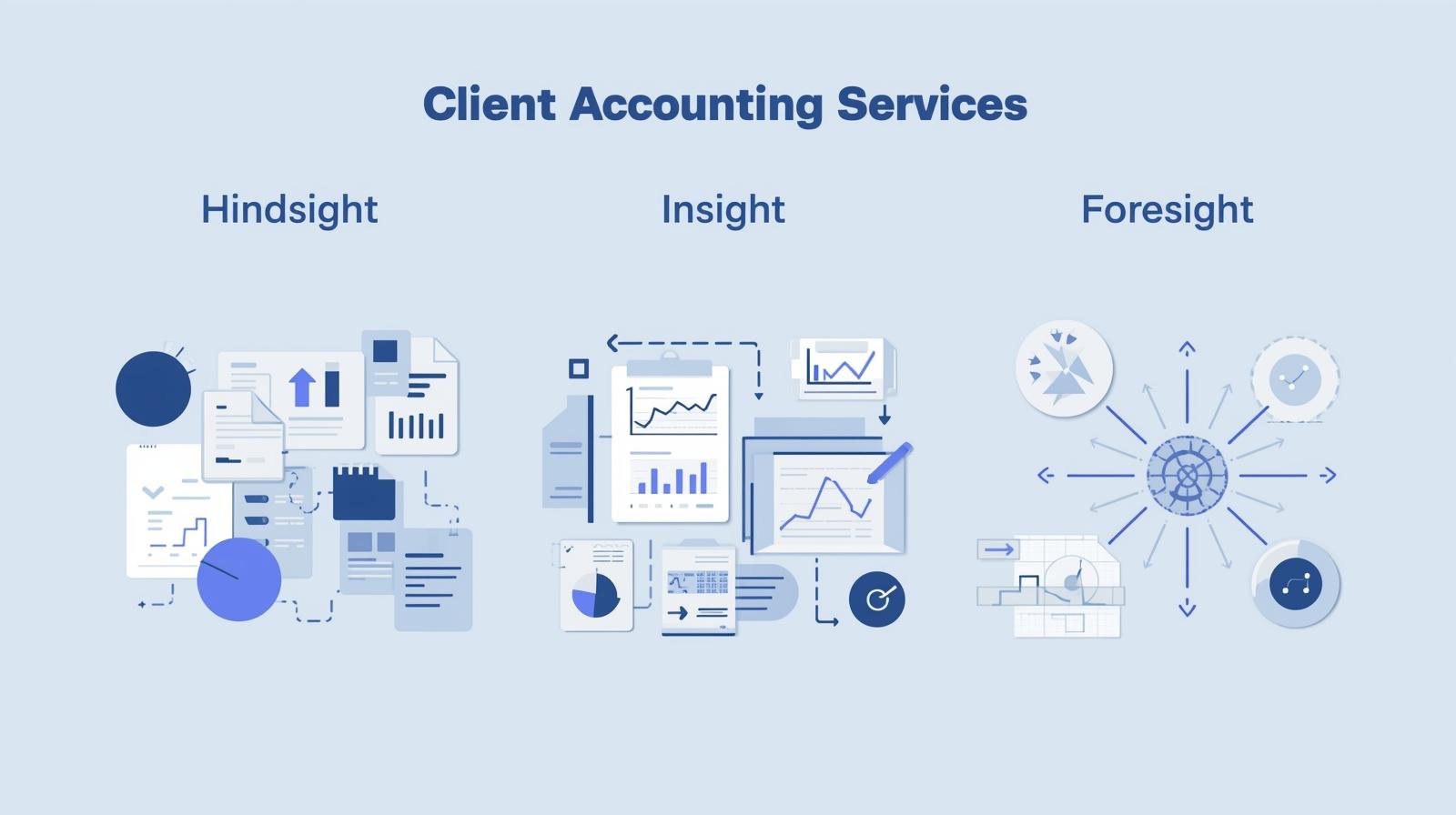
Hindsight, Insight, and Foresight
It is useful to think about CAS maturity as a progression:
-
Hindsight: What happened?
Accurate books, timely closes, and reliable reporting. -
Insight: Why did it happen?
Variance analysis, KPI interpretation, and performance discussions. -
Foresight: What is likely to happen next—and what should we do about it?
Forecasting, scenarios, and decision modeling.
Most CAS practices today operate confidently in the first two stages.
The third—foresight—is where ambition often outpaces capability.
Why Foresight Feels Harder Than It Sounds
On the surface, foresight seems like a natural extension of insight. If we understand the numbers well enough, shouldn’t looking ahead be straightforward?
In practice, foresight introduces an entirely different set of requirements.
Foresight depends on:
-
Clean and consistent historical data
-
Stable definitions of metrics over time
-
The ability to test assumptions
-
Models that can simulate change
Without these elements, forecasting becomes an exercise in educated guesswork. Scenarios are discussed conceptually but rarely quantified in a way that supports confident decisions.
This is why many CAS teams find foresight conversations more stressful than insightful ones. The work often has to be rebuilt each time, under time pressure, with limited margin for error.
CAS Maturity Is Analytics Maturity
One of the quieter realizations emerging across firms is that CAS maturity and analytics maturity are closely linked.
Hindsight can be delivered with transactional systems and reporting tools. Insight requires better structure and interpretation. Foresight, however, demands analytical capability that goes beyond traditional accounting workflows.

Here’s our recent blog on: Clients Don’t Pay for Reports—They Pay for Meaning
This does not necessarily mean complex algorithms or advanced data science. It means having:
-
Reliable historical datasets
-
Forecasting models that can be reused
-
Scenario frameworks that make trade-offs visible
-
The ability to update assumptions without starting over
Firms that lack these capabilities often find that foresight remains aspirational, even when client demand is strong.
Ready to Explore What CAS 3.0 Looks Like for Your Firm?
If your CAS team is being pulled toward forecasting, scenario planning, or decision support—but the underlying analytics feel fragile—you’re not alone.
Let’s talk through where your practice is today and what capabilities would make foresight practical, scalable, and defensible.
👉 Contact us to start the conversation
The Risk of “Advisory by Intuition”
In the absence of strong analytical foundations, foresight conversations tend to rely heavily on experience and intuition. Partners draw on pattern recognition built over years of practice, which can be immensely valuable.
But intuition-based advisory has limits:
-
It is difficult to scale
-
It varies by individual
-
It is harder to defend when decisions are challenged
-
It places significant cognitive load on partners
As CAS practices grow, this model becomes increasingly fragile. What works well for a small group of clients becomes difficult to replicate across a broader portfolio.
Analytics does not replace professional judgment—but it does anchor it.
What Foresight Actually Looks Like in Practice
In CAS practices that are moving toward foresight effectively, advisory conversations start to change in subtle but important ways.
Instead of:
-
“Revenue was down last quarter because of X”
The discussion shifts toward:
-
“If current trends continue, here’s what the next two quarters are likely to look like.”
-
“Here’s how outcomes change if pricing, volume, or costs move.”
-
“These are the decisions that have the biggest impact right now.”
The emphasis moves from explanation to preparation.
Clients begin to see CAS not as a retrospective exercise but as a planning function that supports leadership decisions.
Why Clean Historical Data Matters More Than Ever
A common misconception is that foresight is primarily about the future. In reality, it is deeply dependent on the past.
Forecasts, scenarios, and models are only as credible as the data they are built on.
Inconsistent classifications, shifting definitions, or incomplete histories quickly undermine confidence.
This is why firms often find that their biggest barrier to foresight is not client readiness but internal data readiness.
Foresight exposes weaknesses that hindsight can tolerate.
CAS 3.0 Is a Capability Shift, Not a Service Add-On
Many firms initially approach foresight by adding new services—forecasting engagements, planning sessions, or strategic reviews. While these offerings have value, they do not solve the underlying challenge on their own.
CAS 3.0 is less about adding services and more about redesigning capability.
It requires asking:
-
Are our data structures built for modeling or only for reporting?
-
Can we reuse analytics across periods and clients?
-
Does foresight rely on individuals or on systems?
Firms that answer these questions early tend to progress more smoothly. Firms that delay often find foresight remains episodic rather than embedded.
A Quiet Redefinition of Advisory Value
As CAS moves toward foresight, advisory value begins to change.
Value is no longer measured only by accuracy or responsiveness, but by:
-
How early risks are identified
-
How clearly options are framed
-
How confidently decisions can be made
This aligns closely with how CFOs define their own role—and why CAS is increasingly being compared to the Office of the CFO.
A Question for the Next Phase of CAS
As CAS leaders think about the future of their practices, one reflection may be particularly useful:
Is our CAS practice designed to explain the past—or to help clients prepare for what’s next?
The answer to that question often reveals whether foresight is a realistic next step or still an aspiration.
And it highlights where the real work of CAS 3.0 lies—not in conversation alone, but in the analytics foundation that supports it.
If you’re evaluating how to move your CAS practice from insight to foresight—and want to understand what capabilities, data structures, and analytics foundations actually make CAS 3.0 work—we’d be happy to help.
Schedule a call to discuss your current state and what a scalable foresight model could look like for your firm.
Get in touch with Dipak Singh: LinkedIn | Email
Frequently Asked Questions
1. What is CAS 3.0 in practical terms?
CAS 3.0 refers to a maturity stage where Client Accounting Services consistently support forward-looking decisions through forecasting, scenario modeling, and quantified trade-offs—not just historical reporting or variance explanations.
2. Do we need advanced data science to deliver foresight?
No. Most CAS foresight challenges are solved with structured data, reusable models, and disciplined assumptions—not complex algorithms or machine learning.
3. Why do our forecasts feel so time-consuming to produce?
In many firms, forecasting is rebuilt from scratch each cycle due to inconsistent data structures or one-off models. Reusable analytics dramatically reduce effort and stress.
4. Can foresight be standardized across clients?
Yes—at the framework and modeling level. While assumptions differ by client, consistent structures allow foresight to scale without relying solely on individual expertise.
5. How do we know if our firm is ready for CAS 3.0?
A good indicator is whether foresight currently depends on specific partners rather than systems. If outcomes vary by who leads the engagement, the opportunity is likely in analytics capability—not client readiness.