Nearly every CXO recognizes the tension
Business leaders feel data initiatives move too slowly, cost too much, and deliver insights that arrive late—or worse, feel disconnected from real business needs. IT leaders feel requirements are unclear, priorities shift constantly, and accountability is unfairly placed on platforms rather than outcomes.
Both perspectives are valid. Yet despite years of investment, tooling, and transformation efforts, the divide between business and IT in data initiatives remains one of the most persistent sources of friction in modern organizations.
This is not a relationship problem.
It is a structural design problem—one leadership often underestimates.
Why This Tension Is So Persistent
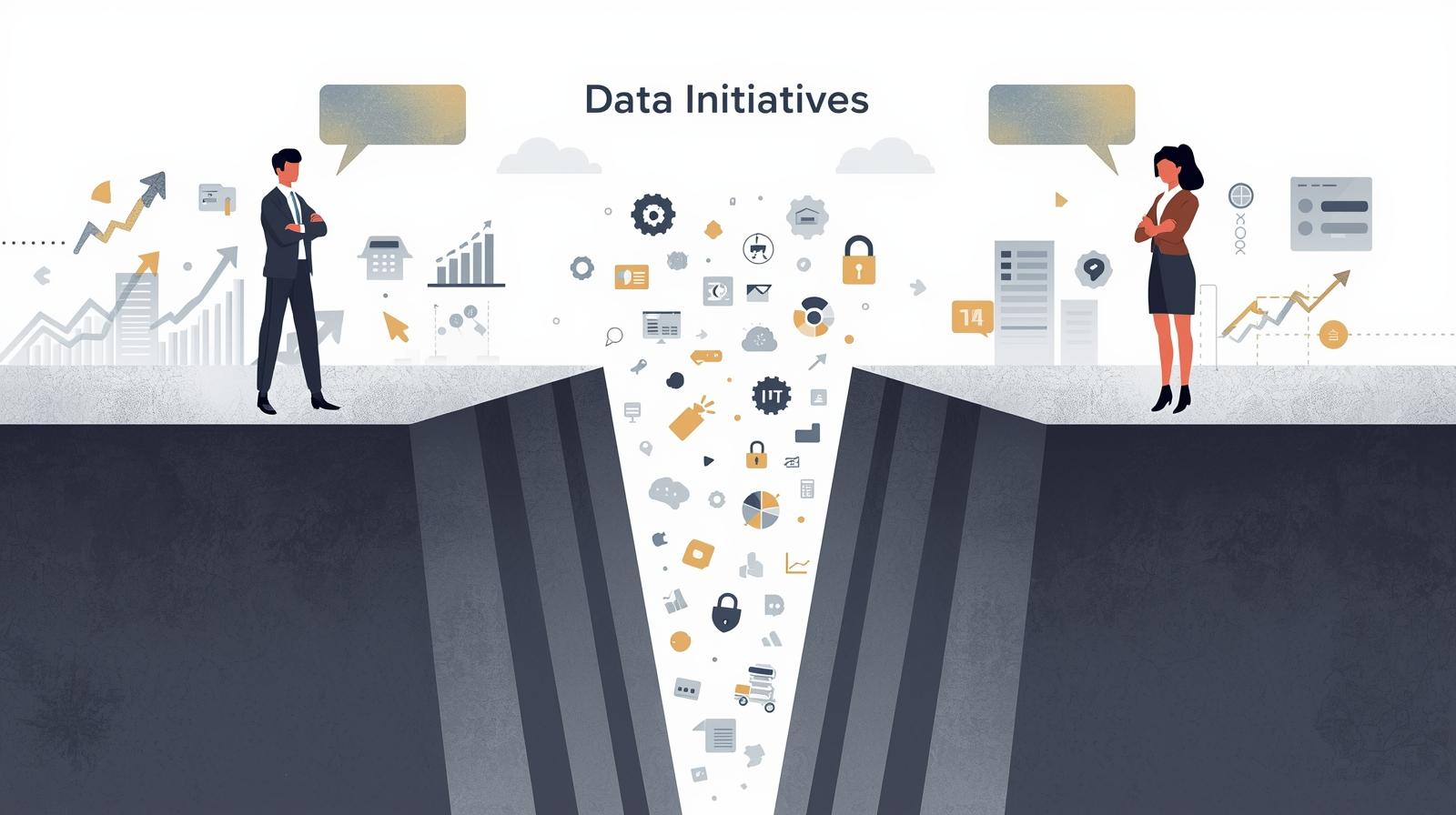
At its core, the conflict exists because business and IT optimize for fundamentally different risks.
Business leaders are rewarded for speed, responsiveness, and results. Delay is visible, costly, and often unforgivable.
IT leaders are rewarded for stability, security, and scalability. Failure is catastrophic, public, and difficult to recover from.
When data initiatives launch without explicitly reconciling these competing risk models, friction is inevitable.
- Business pushes for quick answers.
- IT pushes for robust solutions.
- Data sits uncomfortably in the middle—serving both, fully satisfying neither.
The result is a repeating cycle of frustration that spans projects, teams, and years.
Why Data Sits at the Center of the Divide
Unlike traditional IT systems, data initiatives are not purely transactional—they are interpretive.
A system is considered successful when it works. Data is only successful when it is understood, trusted, and used. Its value depends on context, definitions, and decision-making relevance. This makes ownership inherently ambiguous.
- Business assumes IT “owns the data” because it owns the systems.
- IT assumes business “owns the data” because it defines meaning and usage.
- Both assumptions are partially correct—and collectively ineffective.
Without clear joint ownership, data initiatives drift. Platforms are delivered. Dashboards are built. Adoption lags. Accountability dissolves into blame.
If your organization has invested heavily in data platforms but still debates numbers, struggles with adoption, or feels analytics never quite scales—this tension is likely structural, not executional.
Contact us to realign your data initiatives around the decisions that actually drive impact.
How This Divide Shows Up for CXOs
- For CEOs, the divide appears as stalled momentum—despite investment, analytics does not materially change how the organization decides.
- For CFOs, it surfaces as reconciliation fatigue and recurring debates over metrics that should already be settled.
- For COOs, analytics feels misaligned with operational reality—too slow, too generic, or too abstract to drive action.
- For CIOs, it manifests as a painful paradox: platforms delivered successfully, yet perceived as failures by the business.
These are not execution errors. They are symptoms of misaligned accountability.
The Hidden Flaw: Success Is Measured Differently
One of the least discussed reasons the gap persists is that business and IT define success differently.
- Business considers a data initiative successful when it changes decisions or improves outcomes.
- IT considers it successful when the solution is delivered, stable, secure, and scalable.
Both definitions are reasonable. Together, they create a gap.
- A dashboard can be technically flawless and operationally irrelevant.
- A rapid analysis can be insightful and operationally unsustainable.
Without a shared definition of success, dissatisfaction becomes inevitable.
Here’s our latest blog on how to Assess Your Organization’s Data Readiness in 30 Minutes
Why “Better Collaboration” Rarely Fixes the Problem
Organizations often respond by encouraging closer collaboration—more meetings, more workshops, and more alignment sessions.
While well-intentioned, this approach treats the issue as interpersonal. It is not.
- The problem is not communication.
- The problem is that data initiatives lack a shared decision anchor.
When initiatives are framed around reports, systems, or features, priorities remain subjective, and alignment becomes endless. When initiatives are anchored around specific decisions that must improve, alignment becomes concrete and measurable.

What Mature Organizations Do Differently
Organizations that successfully bridge the business–IT gap do not eliminate tension—they channel it productively.
- They start data initiatives by explicitly naming the decisions that must improve.
- Business owns the why.
- IT owns the how.
- Both are accountable for whether it worked.
They establish joint ownership models where critical metrics and data products have both a business steward and a technical steward. This resolves ambiguity without overburdening either side.
Most importantly, leadership stays visibly engaged until behaviors change—not just until systems go live. This signals that data is a business capability, not an IT service.
The Role Leadership Often Underplays
The business–IT divide cannot be solved at the middle-management level.
- CEOs must frame data as central to how the organization decides.
- CFOs must enforce consistency in metrics and definitions.
- COOs must ensure analytics reflects operational reality.
- CIOs must resist being positioned as sole owners of outcomes they do not fully control.
When leadership alignment is weak, the divide widens—regardless of team effort.
A Simple Diagnostic for CXOs
Leadership teams can assess the health of their business–IT dynamic by asking:
- Are data initiatives described in terms of decisions or deliverables?
- Is success discussed in business outcomes or system metrics?
- When adoption is low, do we revisit ownership or simply add more features?
- Do data initiatives feel easier—or harder—to execute over time?
If initiatives grow more complex and less impactful, the divide is structural, not situational.
The Executive Takeaway
For CXOs, the insight is uncomfortable—but liberating:
- Business vs IT is a false opposition
- Data initiatives fail in the space between ownership and accountability
- Shared decisions require shared stewardship
When leadership clarifies who owns meaning, who owns enablement, and who owns outcomes, the gap narrows naturally. Data stops oscillating between speed and safety—and starts delivering consistent value.
Bridging the divide is not about forcing alignment. It is about designing it.
If your data initiatives are technically sound but strategically underwhelming, it’s time to rethink how ownership, accountability, and success are defined.
Ready to turn data into decisions that drive real impact?
👉 Contact us to start designing initiatives that align leadership, execution, and measurable outcomes.
Get in touch with Dipak Singh: LinkedIn | Email
Frequently Asked Questions
1. Why does the business–IT gap persist despite modern data platforms?
Because platforms solve technical problems, not ownership and accountability misalignment. The gap is structural, not technological.
2. Is this primarily a cultural issue?
No. Culture amplifies the problem, but the root cause is unclear decision ownership and mismatched success definitions.
3. Who should ultimately own data initiatives?
Ownership must be shared: business owns meaning and decisions, IT owns enablement, and leadership owns outcomes.
4. How can CXOs intervene without micromanaging?
By defining decision anchors, enforcing shared success metrics, and staying engaged beyond system delivery.
5. What is the first practical step to close the gap?
Reframe active or upcoming data initiatives around the decisions they must improve—not the reports or tools they will deliver.