
Executive Summary
Businesses today are moving beyond automation toward systems that can think, learn, and act independently. This shift is driven by intelligent technologies that combine data, decision-making, and execution into a single flow. Instead of managing tasks manually, organizations are adopting systems that continuously optimize outcomes.
- Businesses are shifting from automation to intelligent systems
- Decision-making is becoming faster and data-driven
- Workflows are evolving into self-optimizing processes
- AI is enabling end-to-end execution, not just support
Introducing Vyom AI
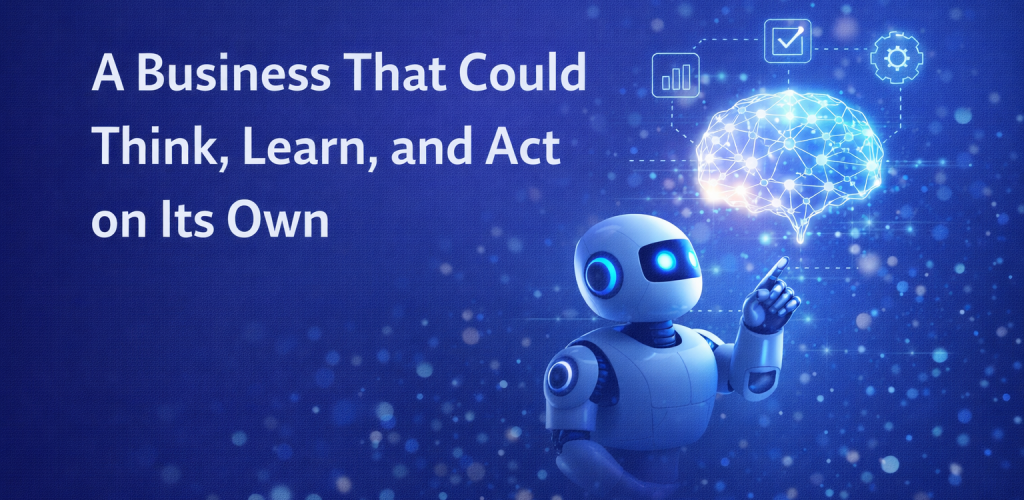
So what does it actually mean for a business to think, learn, and act on its own?
Vyom AI is an intelligent system designed to bring together data, decision-making, and execution into one unified flow. Unlike traditional tools that require constant input, Vyom AI enables businesses to operate with minimal friction by continuously learning from data and adapting in real time.
It doesn’t just support processes. It transforms how processes work.
The Shift from Automation to Intelligence
For years, businesses have tried to automate business workflow processes to improve efficiency. While automation reduced manual effort, it still depended on predefined rules.
Today, that approach is evolving.
With agentic AI in business, systems no longer just follow instructions. They:
- Analyze patterns
- Learn from outcomes
- Make decisions
- Execute actions without constant human intervention
This marks a shift from automation to intelligence.
Build a business that thinks, learns, and acts, and connect with our experts to unlock intelligent automation with Vyom AI.

Why Traditional Process Automation Falls Short
Most organizations rely on automated process management systems to handle repetitive tasks. These systems work well for predictable workflows but struggle when complexity increases.
Common limitations include:
- Rigid rule-based execution
- Lack of adaptability
- Delayed decision-making
- Heavy dependency on manual oversight
As businesses scale, these limitations become bottlenecks.
How Intelligent Systems Redefine Workflows
Modern enterprises are adopting process workflow management software that integrates intelligence directly into operations.
Instead of managing isolated tasks, these systems:
- Connect workflows across departments
- Enable real-time decision-making
- Reduce delays between actions
- Improve accuracy and consistency
This is where agentic AI in business becomes critical. It allows workflows to evolve dynamically based on real-time inputs.
Step-by-Step: How Intelligent Workflow Systems Operate
- Capture Data in Real Time: Systems collect data from multiple sources across the organization
- Analyze Patterns and Context: AI models interpret behavior, trends, and anomalies
- Make Informed Decisions: Decisions are generated based on predefined goals and real-time insights
- Execute Actions Automatically: Tasks are completed without manual intervention
- Continuously Learn and Improve: Systems refine outcomes based on feedback and results
This transforms a traditional business process automation workflow into a self-improving system.
From Workflow Automation to Autonomous Execution
The next stage of evolution is not just automation but orchestration.
With advanced workflow and process automation, businesses can:
- Eliminate repetitive manual tasks
- Improve operational efficiency
- Accelerate decision cycles
- Scale without increasing complexity
Instead of managing workflows, businesses begin to guide outcomes.
Key Takeaways
- Businesses are moving from automation to intelligent systems
- AI enables workflows to think, adapt, and act independently
- Traditional automation lacks flexibility at scale
- Intelligent systems improve speed, accuracy, and efficiency
- Unified platforms reduce operational complexity
Conclusion
The idea of a business that can think, learn, and act on its own is no longer futuristic. It is becoming a practical reality.
As organizations grow, the ability to integrate intelligence into workflows will define how effectively they scale. Systems like Vyom AI represent a shift from managing processes to enabling outcomes. The future of business isn’t just automated. It’s intelligent.
Ready to move from automation to intelligence? Discover how Vyom AI can transform your business workflows today. Let’s Connect
FAQs
Agentic AI refers to systems that can analyze data, make decisions, and execute actions autonomously without constant human input.
Traditional automation follows fixed rules, while intelligent systems adapt, learn, and improve workflows dynamically.
It involves using technology to streamline tasks, reduce manual effort, and improve efficiency across business operations.
They help organizations scale efficiently, improve decision-making, and reduce operational complexity.
Vyom AI integrates data, decision-making, and execution into a single system, enabling businesses to operate faster and more intelligently.