5 Levels of Data Maturity: Where Most Companies Actually Stand
Organizations talk a lot about being “data-driven,” but very few can prove it. This is where data maturity models come in. They offer a structured way to understand how well your company uses data today—and what needs to change if you want to unlock automation, predictive analytics, or AI at scale.
If you’re a CDO, CIO/CTO, or analytics leader, this guide breaks down the five levels of data maturity, how to assess your current state, and the milestones required to advance.
-
Most organizations are stuck between Level 1 (Ad Hoc) and Level 2 (Emerging) maturity, even if they believe they’re advanced.
-
A formal data maturity assessment evaluates people, processes, technology, governance, and data quality.
-
High maturity means trustworthy data, repeatable processes, governed analytics, and AI-enabled decision-making.
-
Improving your data maturity typically takes 12–36 months, depending on your baseline and investment level.
What Is a Data Maturity Model?
A data maturity model is a structured framework that evaluates how effectively an organization manages, governs, and uses data to drive decision-making. Typical assessments measure maturity across areas like:
-
Data governance
-
Data quality
-
Architecture & infrastructure
-
Culture & literacy
-
Operating model
What is the purpose of a data maturity model?
It helps organizations benchmark their current capabilities, identify gaps, and create a roadmap to improve data strategy, governance, and data analytics.
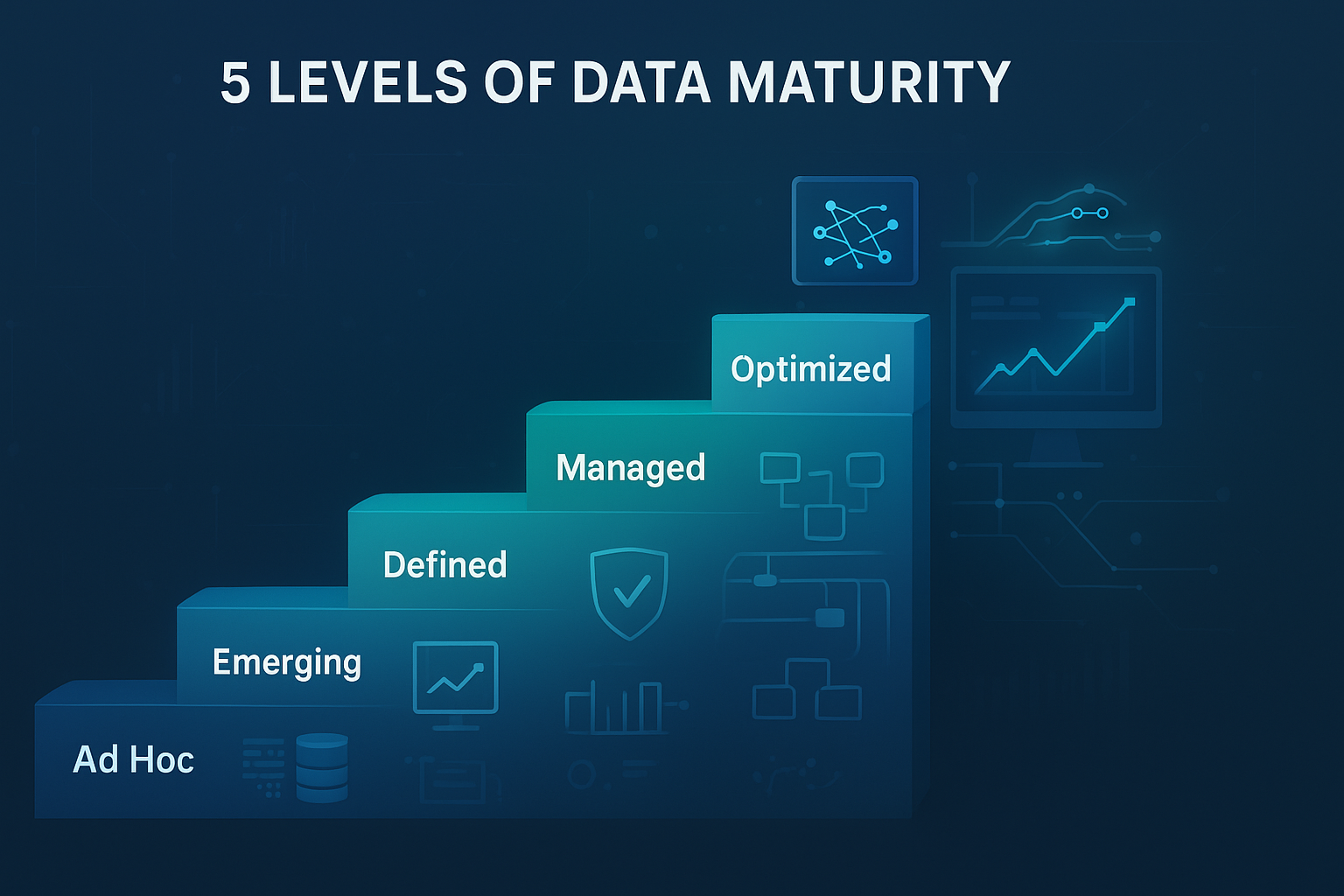
The 5 Levels of Data Maturity (And Where Most Companies Actually Stand)
Below is a blended model derived from widely used data analytics maturity models and data governance maturity models.
Level 1—Ad Hoc (Reactive)
Where 40–60% of companies sit today
Organizations at Level 1 rely heavily on spreadsheets, one-off reports, and tribal knowledge.
Characteristics
-
Data lives in silos and personal drives
-
Reporting is slow and manual
-
Little to no data governance
-
Low trust in data accuracy
-
No defined data strategy or ownership
Symptoms leadership notices
-
“We don’t trust our numbers.”
-
“We can’t answer simple questions quickly.”
-
“Every team reports something different.”
Risks
-
Compliance exposure
-
Inconsistent KPIs
-
Poor decision-making
-
High technical debt
Level 2 — Emerging (Foundational)
Where many companies believe they are—but usually aren’t truly past Level 1
Organizations start implementing basic data infrastructure, often as part of a modern data platform or BI initiative.
Characteristics
-
Some centralized reporting
-
Early BI tools (Tableau, Power BI, Looker)
-
Initial governance policies, but inconsistently applied
-
Data quality awareness, but no formal process
-
First data engineer or analytics team hired
What changes here
-
Dashboards exist but aren’t standardized
-
ETL pipelines reduce manual reporting
-
Business teams begin relying on BI, but not fully
Reality Check
Even if a company has dashboards and a data lake, it is not automatically a Level 3 organization.
Level 3 — Defined (Operational Analytics)
Where companies start seeing meaningful ROI
At Level 3, organizations define and operationalize data processes.
Characteristics
-
Centralized data warehouse or lake house
-
Repeatable ETL/ELT pipelines
-
Data governance council or stewardship roles
-
Documented definitions for KPIs and metrics
-
Data quality policies gaining traction
What this enables
-
Faster reporting cycles
-
Higher trust in data
-
Governance that’s “real,” not aspirational
-
A single source of truth becoming the norm
How do you know you’ve reached Level 3 data maturity?
When data becomes operationalized—reliable, accessible, and consistent enough for business users to depend on daily.
Level 4 — Managed (Predictive & Scalable)
The tipping point between traditional analytics and AI readiness
Organizations at Level 4 have automated most data workflows and are using advanced analytics.
Characteristics
-
Enterprise-wide governance program
-
Automated data quality monitoring
-
Standardized metric layer (semantic models)
-
ML models in production (forecasting, scoring, recommendations)
-
Mature data cataloging and lineage
What this looks like in practice
-
Finance runs accurate rolling forecasts
-
Operations relies on predictive maintenance
-
Marketing uses propensity modeling
-
Leadership receives real-time dashboards
Technical accelerators
-
Cloud-native architectures (Snowflake, Databricks, BigQuery)
-
Orchestration (Airflow, dbt Cloud)
-
Metadata-driven governance (Collibra, Alation)
Level 5 — Optimized (AI-Driven Organization)
Fewer than 10% of organizations reach this level
Data becomes woven into the fabric of every decision, workflow, and product. AI assists or automates major business processes.
Characteristics
-
Continuous data quality and governance automation
-
Advanced ML/AI for optimization
-
Real-time, event-driven decisioning
-
Data product mindset
-
Enterprise-wide data literacy
How this shows up
-
AI-driven supply chain optimization
-
Real-time customer personalization
-
Embedded analytics in every product/service
-
Self-service data access for almost all employees
At Level 5, organizations use data not just for insight—but to reshape business models.
How to Assess Your Company’s Data Maturity
Every data maturity assessment should evaluate the following domains:
1. People & Organizational Structure
-
Data literacy
-
Roles (CDO, Data Stewards, BI Leads)
-
Operating model (centralized vs federated)
2. Data Governance Maturity Model Criteria
-
Policies & standards
-
Stewardship
-
Metadata management
-
Data quality management
3. Technology & Architecture
-
Data platforms (warehouse, lake house, pipelines)
-
Tooling (catalogs, quality, lineage)
-
BI & analytics stack
-
Integration patterns
4. Processes & Delivery
-
Pipeline management
-
Governance workflows
-
Data lifecycle management
-
DevOps/Data Ops maturity
5. Culture & Adoption
-
Cross-functional trust
-
Decision-making behavior
-
Self-service usage metrics
How do I run a formal data maturity assessment?
Use a structured framework, conduct interviews, evaluate artifacts (dashboards, pipelines, documentation), and score each domain on a 1–5 maturity scale.
Want a full data maturity assessment tailored to your organization?
We offer a comprehensive 5-domain evaluation, including governance, architecture, BI capabilities, and strategic roadmap.
Request a Data Maturity Assessment
Low vs High Data Maturity: What It Actually Looks Like
Low Maturity Indicators
-
Frequent data firefighting
-
Manual reports dominate
-
Conflicting KPIs across teams
-
“Shadow IT” workarounds
-
Analytics teams overwhelmed with ad-hoc requests
High Maturity Indicators
-
Trusted enterprise metrics
-
Automated data quality checks
-
Governed semantic layers
-
Predictive or prescriptive analytics
-
Empowered data teams
A high-maturity organization doesn’t just have better tools—it has better alignment, better processes, and faster outcomes.
How Long Does It Take to Improve Data Maturity?
Most organizations move 1–2 maturity levels in 12–36 months, depending on:
-
Starting state
-
Budget & headcount
-
Platform modernization
-
Leadership alignment
-
Governance adoption
Typical timelines:
|
Starting Level |
Expected Time to Raise Maturity |
|
Level 1 → Level 2 |
6–12 months |
|
Level 2 → Level 3 |
12–18 months |
|
Level 3 → Level 4 |
18–36 months |
|
Level 4 → Level 5 |
Multi-year, ongoing optimization |
Ready to mature your data capabilities?
We help organizations build scalable data architecture, governance programs, and analytics strategies.
Talk to a Data Strategy Expert
Frequently Asked Questions
1. What are the main data maturity levels?
Most models include five stages: Ad Hoc, Emerging, Defined, Managed, and Optimized. These measure capability across governance, infrastructure, analytics, and culture.
2. How do I know if my company has low data maturity?
Low maturity shows up as siloed data, manual reporting, unclear KPIs, governance gaps, and low trust in data quality.
3. What tools help improve data maturity?
Common tools include cloud data warehouses (Snowflake, BigQuery), transformation tools (dbt), orchestration (Airflow), governance platforms (Collibra, Alation), and BI tools (Power BI, Tableau, Looker).
4. Can you reach high data maturity without AI?
You can reach Level 3 or early Level 4 without AI, but fully optimized maturity (Level 5) requires ML/AI integration.
5. What is the best data governance maturity model?
Popular options include DAMA-DMBOK and Gartner, though many organizations adopt hybrid or custom models suited to their operating environment.