Why most analytics confusion is designed in long before it appears in dashboards
When CXOs encounter inconsistent metrics, confusing dashboards, or endless debates over definitions, the issue is often blamed on reporting or data quality.
In reality, the root cause usually sits deeper—inside the data model.
Data modeling is one of the least visible yet most influential decisions an organization makes about its data. It rarely appears in board discussions. It is seldom questioned explicitly. And yet it quietly shapes how the business understands itself.
This article explains data modeling at a leadership level—not to turn CXOs into architects, but to help them recognize why certain questions are easy to answer while others seem impossibly hard.
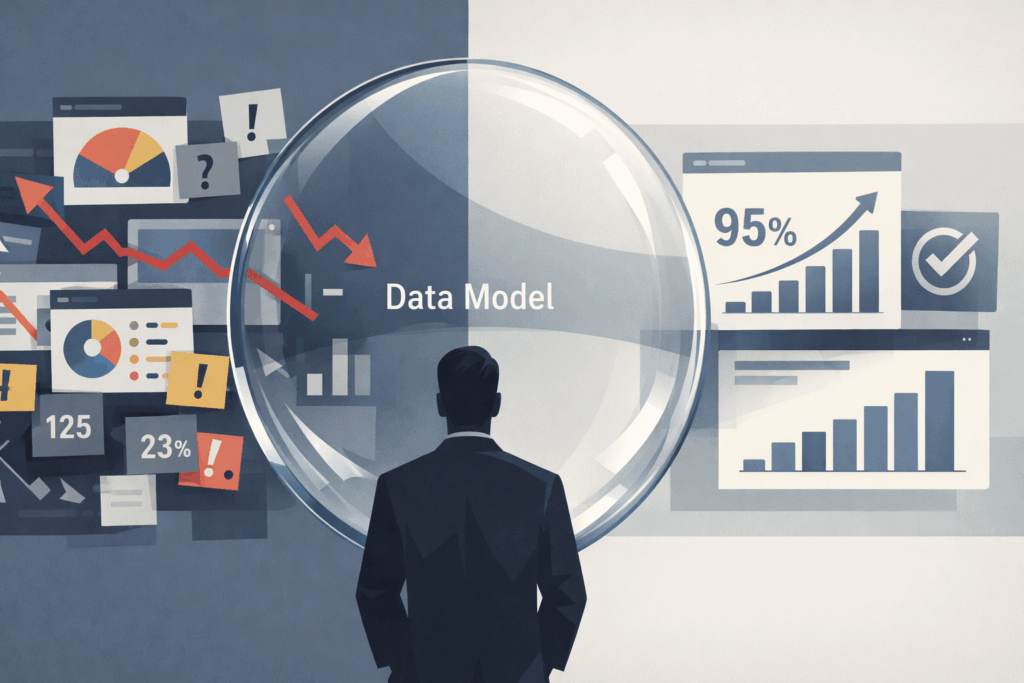
Why Data Modeling Is So Poorly Understood at the Executive Level
From a senior leadership perspective, data modeling feels abstract and technical. It is often delegated to specialists and discussed only when something breaks.
That delegation is understandable—but costly.
Data models are not just storage structures. They are interpretations of the business, frozen into logic. Once in place, they influence every KPI, every dashboard, and every analysis downstream.
When models are weak or misaligned, analytics struggle no matter how advanced the tools appear.
Explore our latest blog post, authored by Dipak Singh: Data Quality Starts in Data Engineering
What a Data Model Really Is (Without the Jargon)
At its simplest, a data model is a set of decisions about:
- What entities matter (customers, orders, products, locations)
- How those entities relate to one another
- How activity is measured over time
These decisions determine what the organization can see easily, what requires workarounds, and what remains invisible.
In that sense, data models are lenses. They do not just represent reality—they actively shape perception.
How Poor Modeling Creates Executive-Level Pain
When data models are poorly designed, symptoms emerge that CXOs recognize immediately.
KPIs appear correct in isolation but conflict across functions. Simple questions require complex explanations. Analysts spend more time reconciling than analyzing. Leaders lose patience with dashboards that feel unintuitive.
None of this is accidental. It reflects models that were built around systems rather than decisions.
For example, when models mirror transactional systems too closely, they preserve operational detail but obscure business meaning. When models evolve piecemeal, consistency erodes over time.
The result is analytics that feels busy—but unhelpful.
Why Modeling Is a Business Decision, Not a Technical One
A common misconception is that data modeling is a purely technical task. In reality, it is deeply business-driven.
Every model answers implicit questions:
- What constitutes revenue?
- When does an order “exist”?
- Who is the customer of record?
- How should performance be aggregated?
If these questions are not resolved at a leadership level, models encode assumptions by default. Those assumptions later surface as “data issues.”
This is why organizations with sophisticated tools still struggle with basic alignment. Technology executes the model faithfully—even when the model itself is wrong.
The Link Between Data Models and KPI Confusion
Most KPI confusion is not caused by calculation errors. It is caused by structural ambiguity.
When the same concept is represented differently across models, metrics diverge naturally. Teams debate which version is correct, when the real issue is that the model allows multiple interpretations to coexist.
For CXOs, this explains why governance forums often feel unproductive. Without a stable modeling foundation, governance becomes arbitration rather than alignment.
Strong models reduce the need for governance by making correct interpretation the default.
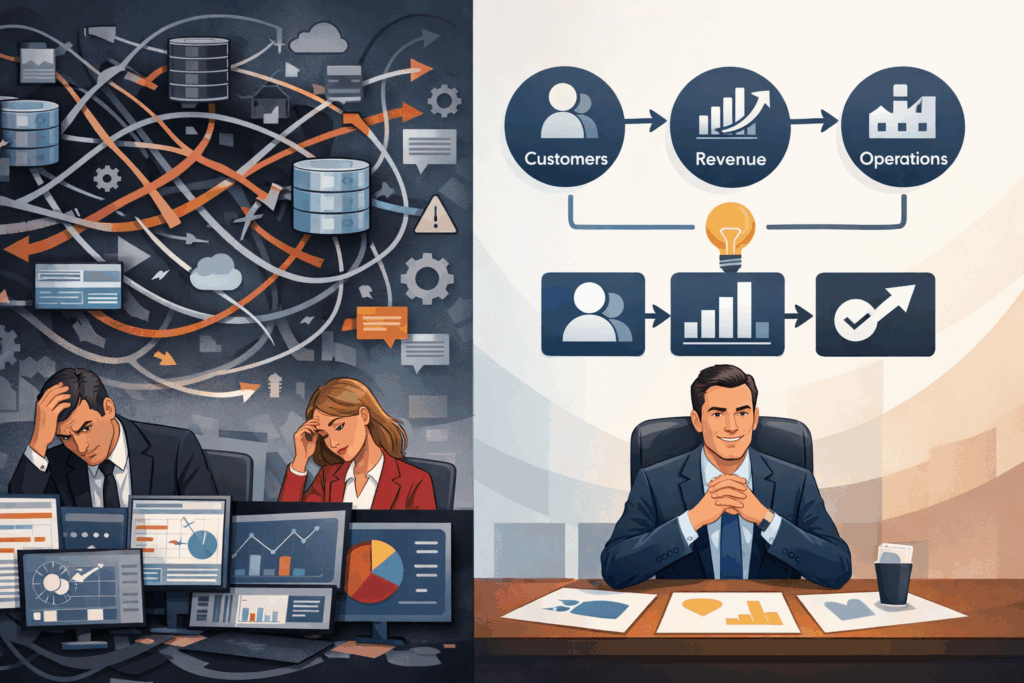
How Good Models Change the Executive Experience
In organizations with strong data models, analytics feels fundamentally different.
Dashboards align naturally across functions. KPIs are intuitive. Questions lead quickly to insight rather than explanation. Analysts spend more time exploring drivers than defending numbers.
This experience is not the result of better visuals or more data. It is the result of clear, decision-aligned modeling.
When models reflect how leaders think about the business, analytics stops feeling foreign.
What CXOs Should Look for (Without Getting Technical)
Senior leaders do not need to design data models, but they should be able to sense when modeling is weak.
Practical signals include:
- Do the same metrics mean different things in different forums?
- Do analysts rebuild similar logic repeatedly?
- Do explanations rely heavily on caveats and exceptions?
- Do simple questions trigger complex data exercises?
If the answer is yes, modeling—not reporting—is likely the issue.
The Role of Leadership in Modeling Decisions
Data models rarely improve through incremental fixes. They improve when leadership is willing to confront foundational questions.
- CEOs ensure shared definitions of value and performance
- CFOs anchor models in economic logic
- COOs ensure models reflect operational reality
- CIOs protect modeling discipline from short-term pressures
When leadership engagement is absent, models drift. When it is present, clarity compounds.
A Subtle but Powerful Shift
One of the most effective changes organizations make is moving from system-centric models to decision-centric models.
Instead of asking, “How is the data stored?” teams ask, “What decision does this model need to support?”
That question changes priorities immediately. Models become simpler. Logic becomes reusable. Alignment improves.
The shift is quiet—but its impact is profound.
The Core Takeaway
For CXOs, the essential insight is this:
- Data models decide what the business can see
- Poor models create endless debate; good models create quiet alignment
- Most analytics problems are modeling problems in disguise
Understanding this does not require technical expertise. It requires recognizing that data models are strategic assets, not back-office artifacts.
When models reflect how leaders think, analytics becomes a natural extension of decision-making rather than a source of friction.
Get in touch with Dipak Singh
Frequently Asked Questions
1. How is data modeling different from data architecture?
Data architecture focuses on systems, platforms, and data movement. Data modeling focuses on meaning—how business concepts are defined, related, and measured. Architecture supports modeling, but modeling defines insight.
2. Can poor data modeling exist even with modern BI tools?
Yes. BI tools visualize what the model allows. If the model is misaligned, even the most advanced tools will surface confusing or conflicting insights.
3. How long does it take to fix a weak data model?
Improvement depends on scope and alignment. However, organizations often see meaningful gains quickly once leadership clarifies definitions and decision priorities.
4. Who should own data modeling decisions in an organization?
Ownership should be shared. Business leaders define meaning and intent; data leaders translate that into structure. Successful models are co-owned, not delegated.
5. Is data modeling relevant for organizations early in their data journey?
Yes—arguably more so. Early modeling decisions compound over time. Getting them right early prevents years of downstream confusion.