In every growing enterprise, especially in regulated industries like finance and payments, there comes a point when what once worked stops working.
Processes begin to diverge. Infrastructure becomes tribal. Release velocity slows, while risk quietly rises.
This is the story of one such transformation, where a national-scale payment infrastructure provider moved from inconsistency and invisible risk to governance, speed, and operational clarity. It’s a case study in how DevOps, done right, can be a business enabler, not just an engineering improvement.
The Context: Stability at the Cost of Velocity
The organization in question is a national payment network operating in a tightly regulated financial environment. It connects banks, credit unions, and third-party payment processors and processes millions of transactions every day.
For years, the systems were reliable. The teams were committed. Releases happened. Systems ran.
But behind that surface-level calm, deeper issues had started to emerge:
-
Different teams had built their own CI/CD pipelines.
-
Infrastructure provisioning was still manual in many places.
-
Rollback processes were inconsistent, sometimes undocumented.
-
Governance existed, but outside the delivery process.
-
Cloud costs were rising faster than the pace of delivery.
-
Visibility across environments was fragmented and reactive.
It wasn’t a crisis. But it was unsustainable.
As one of their senior leaders put it:
“We’ve grown fast, but we’ve accumulated too many ways of doing the same thing and too many gaps that only individuals remember to close.”
The Problem: Lack of Systemic Trust
From a CXO’s perspective, the issue wasn’t tooling or talent. It was the absence of systemic trust.
-
Trust that every environment was consistent.
-
Trust that every release has passed the same tests and validations.
-
Trust that compliance wasn’t a separate checklist but built into the process.
-
Trust that rollbacks were available and wouldn’t require heroics.
In short, the systems weren’t broken, but they couldn’t scale. And in regulated environments, anything that can’t scale safely becomes a liability.
The Mandate: Rebuild Delivery with Control and Confidence
The brief was clear:
“Create a delivery foundation where speed, compliance, rollback safety, and traceability coexist, without slowing teams down.”
We approached this not as a tooling upgrade but as a systems realignment. The recommendation was to establish a DevOps Center of Excellence (CoE), not as a team, but as a framework for how delivery should operate across the enterprise.
The DevOps CoE focused on six transformation pillars:
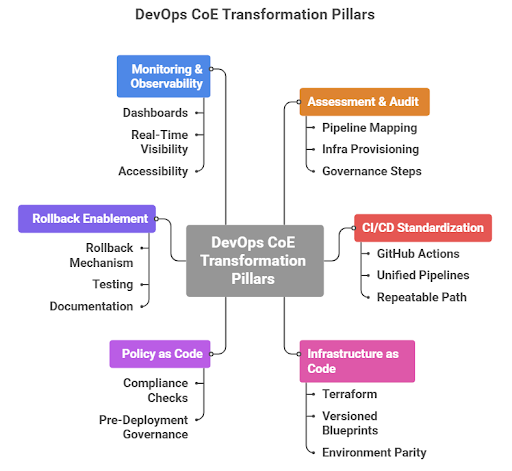
1. Assessment & Audit
We mapped existing pipelines, infra provisioning methods, and governance steps. This revealed a patchwork of custom logic, manual interventions, and undocumented assumptions.
2. CI/CD Standardization
Using GitHub Actions, we established unified pipelines across dev, staging, and production. Every deployment now followed a common, observable, and repeatable path.
3. Infrastructure as Code
We shifted provisioning to Terraform, introduced versioned blueprints, and enforced parity across environments.
4. Policy as Code
Instead of relying on external approvals or documentation, we embedded compliance checks directly into the CI/CD process. Governance moved from post-deployment to pre-deployment.
5. Rollback Enablement
Every deployment had an associated rollback mechanism, tested and documented. Failures became manageable events, not overnight firefights.
6. Monitoring & Observability
Dashboards now offered real-time visibility into environment health, deployment status, and system changes, accessible to both engineering and audit teams.
This wasn’t about automation for its own sake. It was about creating calm, predictable systems in a complex, regulated environment.
The Outcomes: Faster Releases, Fewer Incidents, Greater Visibility
Within months, the impact was measurable and meaningful:
|
Metric |
Result |
|
Release Time |
Reduced by 55% |
|
Rollback Incidents |
Dropped by 61% |
|
Developer Autonomy |
Increased significantly |
|
Audit Preparation Time |
Reduced to near zero |
|
Cloud Cost Predictability |
Improved via consistent IaC |
|
Governance Confidence |
Embedded and observable |
But the real outcome wasn’t just in the numbers. It was in the culture shift.
Releases became quiet. Recoveries became simple.
What once required a chain of approvals, escalations, and anxiety, now just worked.
Strategic Takeaways for CXOs
For leaders in regulated enterprises, this story offers key insights:
1. Governance should be a system, not a process.
When compliance is embedded into the CI/CD pipeline, it becomes consistent, enforceable, and invisible.
2. Speed without safety is a risk. But safety without speed is costly.
Standardized DevOps helps you avoid both extremes and operate with confidence.
3. Infrastructure isn’t back-office. It’s a business lever.
When infrastructure is codified, observable, and auditable, it reduces cost, risk, and friction.
4. Rollbacks are not optional.
A resilient system isn’t one that never fails; it’s one that recovers quickly and cleanly.
Closing Thought
This transformation wasn’t driven by a breakdown, but by foresight.
The leadership team understood that clarity scales, while chaos compounds.
And they chose to act before it became urgent.
In doing so, they didn’t just modernize DevOps.
They made delivery consistent, auditable, and ready for growth at scale.
Ready to explore this for your enterprise?
Whether you’re in financial services, insurance, or any regulated domain, the ability to deliver secure, governed, and repeatable releases is critical.
We help enterprise technology leaders build DevOps systems that are engineered for trust, speed, and compliance.
👉 Talk to our team, and let’s build your delivery foundation for the next phase of growth.
Frequently Asked Questions
1. What problem was this organization facing?
The organization was experiencing growing inconsistency across its delivery processes. While systems were stable, CI/CD pipelines, infrastructure provisioning, and rollback mechanisms varied by team, creating hidden risk, slowing delivery, and making governance difficult to scale in a regulated environment.
2. Why wasn’t this considered a crisis?
There were no major outages or failures. Systems were functioning, and releases were happening. However, the lack of standardization and visibility meant risk was accumulating quietly, making the operating model unsustainable as the organization continued to grow.
3. What made this a business issue rather than just a technical one?
From a leadership perspective, the core issue was the absence of systemic trust. Executives couldn’t consistently guarantee that releases were compliant, environments were identical, or rollbacks were reliable. In regulated industries, that uncertainty becomes a business liability.
4. What was the primary goal of the transformation?
The goal was to create a delivery foundation where speed, compliance, rollback safety, and traceability could coexist—without slowing teams down or adding bureaucratic overhead.
5. Why did the organization choose a DevOps Center of Excellence (CoE)?
The DevOps CoE was established as a framework, not a centralized team. Its purpose was to define consistent standards, guardrails, and practices that all delivery teams could follow, ensuring governance and autonomy could scale together.