How to Build a Practical Data Roadmap Without Big Budgets
Many organizations know they need a data strategy roadmap, but few have the budget for expensive transformation programs or consulting giants. The good news? You can build a high-impact, realistic data roadmap with limited resources—if you follow a structured, outcome-driven approach.
This guide provides a practical, budget-friendly framework used by modern CDOs and data leaders to roadmap capabilities, prioritize investments, and drive incremental wins. This guide provides a practical, budget-friendly framework used by modern CDOs and data leaders to roadmap capabilities, prioritize investments, and drive incremental wins. A data roadmap should start with business outcomes—not technology.
-
A data roadmap should start with business outcomes—not technology.
-
Focus on must-have capabilities across governance, architecture, analytics, and culture.
-
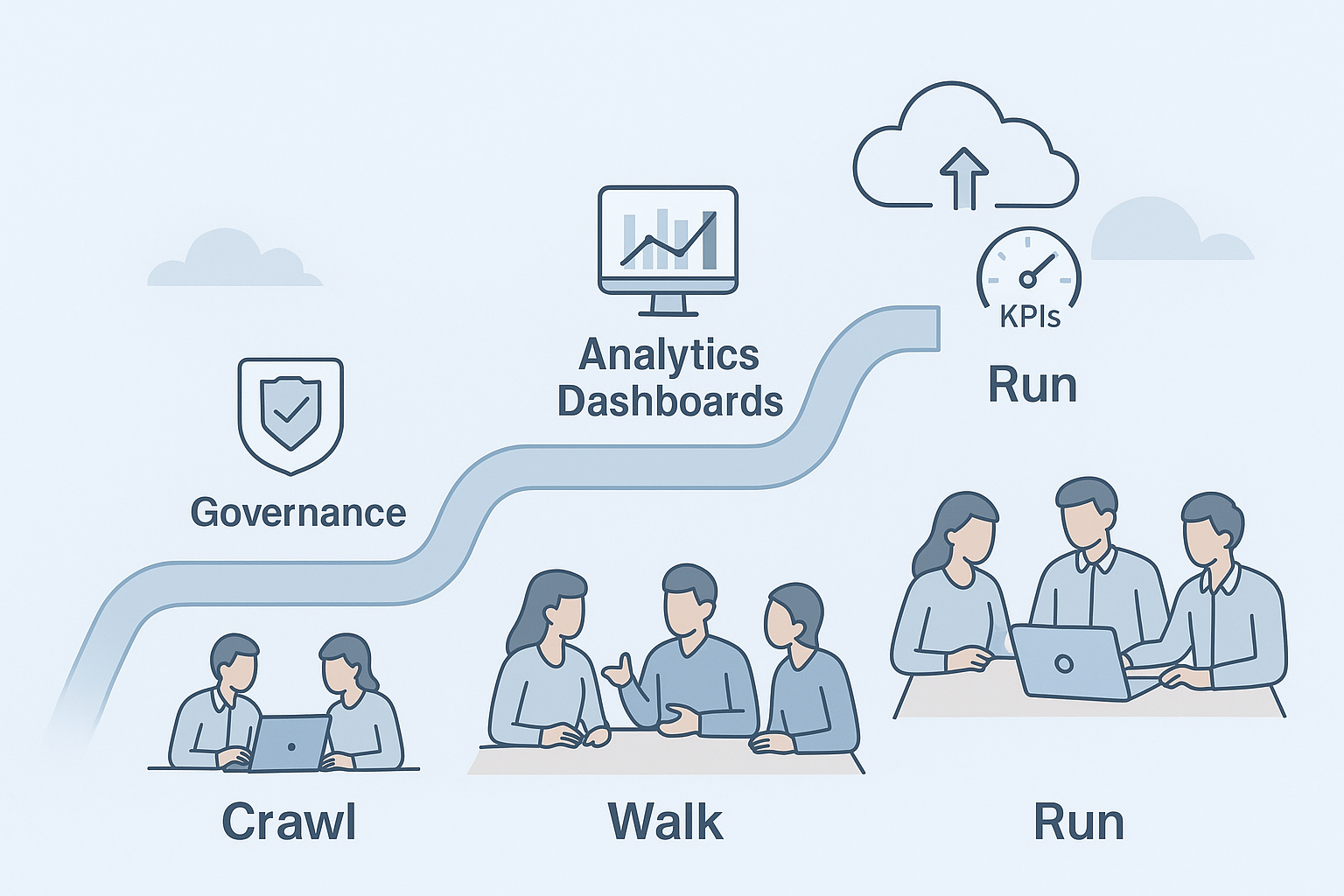
Use a “crawl → walk → run” maturity model to sequence realistic initiatives.
-
A strong roadmap can be built internally using lean tools and small cross-functional teams.
The Role of a Data Strategy Roadmap (and Why It Doesn’t Require a Huge Budget)
A data strategy roadmap translates your data goals into a sequenced, 12–24 month plan. But contrary to popular belief, you do not need large budgets or enterprise-scale consulting projects to create one.
At its core, a roadmap answers:
-
What problems are we solving?
-
What capabilities do we need?
-
What is the order of investments?
-
Who owns what?
Most of these answers require clarity and alignment—not money.
Who owns the data strategy roadmap?
Typically, the roadmap is owned by the Chief Data Officer (CDO) or Head of Data but must be co-created with:
-
CIO/CTO
-
Business unit leaders
-
Data governance leads
-
Enterprise architects
Ownership ≠ execution. A good roadmap defines cross-functional responsibility.
What Should Be Included in a Data Strategy Roadmap?
A strong roadmap—whether built internally or with data strategy consulting services—typically covers five pillars:
1. Business Outcomes & Use Cases
Every roadmap should start by identifying:
-
Revenue-driving use cases
-
Cost-saving opportunities
-
Risk reduction or compliance needs
Aligning with business outcomes ensures you invest wisely—even with limited budgets.
2. Data Governance & Quality Foundations
Include low-cost, high-impact governance steps such as:
-
A lightweight data glossary
-
Assigned data owners & stewards
-
A basic data quality measurement process
-
Initial policies & access controls
3. Data Architecture Needs (Current State → Future State)
Your roadmap should outline:
-
Current data landscape (tools, databases, pipelines)
-
Pain points (manual processes, silos, quality gaps)
-
Essential modernizations (standardization, cloud alignment, ELT automation)
These upgrades can be staged across multiple phases.
4. Analytics & BI Capabilities
This includes:
5. People, Skills & Operating Model
Most data strategies fail due to people, not technology. Include:
-
RACI matrix
-
Data literacy programs
-
Career paths for data roles
-
Change management
|
Stage |
Focus Areas |
Typical Outcomes |
|
Crawl |
Governance, KPIs, basic pipelines |
Consistency & alignment |
|
Walk |
Cloud, modeling, automation |
Efficiency & reliability |
|
Run |
AI, predictive analytics |
Competitive differentiation |
How Do You Create a Data Strategy Roadmap?
This section is structured as a How-To schema block, suitable for AEO and featured snippet targeting
How to Create a Data Roadmap
Step 1: Conduct a Mini Data Maturity Assessment
Even a lightweight assessment helps you understand gaps across:
-
Architecture
-
Skills
-
Culture
Step 2: Identify Your High-Value Use Cases
Map use cases across three value lenses:
-
Grow: predictive insights, personalization, monetization
-
Optimize: automation, forecasting, efficiency
-
Protect: compliance, security, lineage
This ensures your roadmap is outcome-driven.
Step 3: Define Capabilities Needed to Support Those Use Cases
Use capability blocks such as:
-
Data ingestion
-
Master data management
-
Data governance
-
BI modernization
-
Metadata management
These capabilities form your roadmap “building blocks.”
Step 4: Prioritize Using a Simple Framework
For limited budgets, use a lightweight scoring method:
-
Impact
-
Cost
-
Complexity
-
Dependencies
Plot these on a 2×2 prioritization matrix.
Step 5: Sequence Initiatives by Maturity Stages
Use a crawl → walk → run model:
-
Crawl: foundational governance, basic pipelines, KPI alignment
-
Walk: cloud migration, data modeling, automated ELT, curated datasets
-
Run: AI enablement, predictive analytics, real-time insights
Read our Maturity Model Guide for detailed stage descriptions.
Step 6: Build the 12–24 Month Roadmap
Organize initiatives across three horizons:
-
Near-term (0–6 months): foundational governance, quick wins
-
Mid-term (6–12 months): platform modernization, BI improvements
-
Long-term (12–24 months): advanced analytics, ML operationalization
Step 7: Assign Owners & KPIs
Each roadmap topic should have:
-
A clear owner (business + technical)
-
Dependencies
-
Success metrics
-
Resource requirements
This increases accountability and prevents roadmap drift.
How long should a data strategy roadmap be?
Most organizations plan a 12–24 month horizon, with quarterly checkpoints to adapt to changing conditions.
How to Build a Data Roadmap on a Small Budget
Not every organization has a seven-figure budget. Here’s a “lean roadmap” approach for smaller teams or earlier-stage data organizations.
1. Prioritize High-Value, Low-Cost Initiatives
Examples:
-
Build a KPI dictionary
-
Stand up a lightweight data catalog (open-source options exist)
-
Automate one manual data preparation workflow
-
Consolidate duplicate dashboards
These create fast business value.
2. Optimize What You Already Have
Before spending on new technology, evaluate:
-
Existing BI tools
-
Existing warehouses or databases
-
Existing cloud credits
-
Existing vendor licensing that can be repurposed
Many organizations overspend because of tool duplication.
3. Use Internal Teams to Co-Create the Strategy
Use short working sessions with stakeholders to define:
-
Data pain points
-
Requirements
-
Data ownership
-
Prioritization
This increases alignment and reduces the need for external strategy consultants.
Want a done-with-you roadmap in 4 weeks or less?
Our Data Strategy Consulting Services help you build a roadmap that aligns with your budget, tools, and business goals.
Get a 12–24 month data roadmap in 4 weeks—tailored to your budget, tools, and maturity.
Do I need consultants for a data strategy roadmap?
Not always. You can develop a roadmap internally—but consultants can accelerate the process, validate decisions, and provide industry benchmarks.
Example: A 12-Month Data Roadmap on a Lean Budget
Below is a sample roadmap based on common needs of mid-size organizations.
Quarter 1 (0–3 months): Establish Foundations
-
Data ownership model
-
Glossary + KPI standardization
-
Identify top 3 analytics use cases
-
Initial data quality metrics
-
BI inventory cleanup
Quarter 2 (3–6 months): Build Core Capabilities
-
Ingest critical datasets using open-source or existing tools
-
Build a small curated semantic layer
-
Launch data literacy training
-
Create 3–5 reusable dashboards
Quarter 3 (6–9 months): Platform & Governance Improvements
-
Introduce ELT automation where feasible
-
Expand metadata and governance workflows
-
Introduce role-based access controls
-
Use-case driven modeling improvements
Quarter 4 (9–12 months): AI-Readiness & Optimization
-
Evaluate ML use cases
-
Begin predictive modeling pilot
-
Implement cost monitoring & data product lifecycle controls
-
Success metrics evaluation and roadmap refresh
What is the difference between a data strategy and a data roadmap?
-
Data Strategy = vision, goals, capabilities, and principles
-
Data Roadmap = plan, sequence, timelines, and actions
The strategy defines the “why.” The roadmap defines the “how.”
Building a robust and practical data roadmap does not require massive budgets. With a clear maturity baseline, prioritized use cases, and a capability-driven plan, organizations can build high-value data foundations and accelerate insights.
A roadmap done right creates:
-
Business alignment
-
Faster time-to-insight
-
Clear ownership
-
Scalable architecture
-
Predictable investment planning
If you want expert guidance developing or validating your data roadmap, our Data Strategy Consultants can help you design a practical, budget-friendly roadmap tailored to your business goals.
Book a Free Strategy Call
Frequently Asked Questions
1. What should a data roadmap include?
It should include business use cases, capability requirements, governance, data architecture, analytics needs, and people/skills components.
2. How long does it take to build a data strategy roadmap?
Typical timelines range from 4 to 8 weeks depending on organizational complexity, stakeholder availability, and current data maturity.
3. Who is responsible for executing the roadmap?
Execution is shared across IT, data teams, business units, and governance roles. The CDO, or Head of Data, usually owns coordination.
4. How often should a data roadmap be updated?
Refresh the roadmap every 6–12 months or when business priorities shift.
5. What tools help with data roadmapping?
Tools like Miro, Lucidchart, Jira, ServiceNow, and data catalogs can help maintain and communicate the roadmap.