Tag: RetailTech

The Rise of Smart Stores: How Retail Tech is Transforming the In-Store Experience

From Traditional to Smart: The Evolution of Retail Stores

Smart stores are poised to usher in a mega revolution for the global retail industry. There will be a complete transformation of in-store experiences for shoppers shortly with smart retail solutions. Let us take stores like Amazon Go as examples to decode the biggest ways in which retail tech is already revamping the future of retail stores.  How Amazon Go is a Glimpse of Things to Come  Amazon Go already offers shopping experiences without cashiers. These smart stores come with several advantages for customers and retailers alike, enabling time and monetary savings along with lower errors and more contactless shopping experiences. “In-store technology is transforming the smart retail market by enabling personalized, data-driven customer experiences.” These stores deploy cutting-edge retail tech, including artificial intelligence, computer vision, and sensors, for enabling smoother shopping experiences. The aim here is to do away with time-consuming physical checkouts and lines at stores along with the tedious procedure of scanning items. A network of sensors and cameras are deployed throughout the store which track items picked up by customers from shelves and those put back by them. When customers complete shopping, they can walk out of the premises without going in for traditional checkout.  At Amazon, for instance, customers have to download the Amazon Go app and link the same with their Amazon account to get this option. Once they enter, there is full tracking of items chosen and movements. Shoppers can easily add items to virtual carts which are updated instantly. When they exit, the account is charged for the items bought, with receipts dispatched to their accounts. Technologies like door trackers also detect departure automatically. Each item picked up is recorded more accurately and linked to customer accounts. They can also review receipts on the mobile app before leaving. This helps verify the charges and items. Amazon Go is a glimpse into the future of retail stores throughout the world. This will boost customer convenience and overall efficiencies greatly. Here are some of the advanced technologies that will soon play a vital part in the creation and running of smart stores. Smart Store Technologies for the Future When it comes to enhancing the in-store experience for customers with smart retail solutions, here are some technologies that will soon gain ground throughout the sector.  The future of retail stores appears to be in embracing more advanced technologies that will boost in-store experiences and enable greater personalisation and convenience for customers. Smart stores will steadily be in vogue with the popularity of Amazon Go being an indicator of things to come.  FAQs What specific technologies are driving the evolution of smart stores and enhancing the in-store shopping journey?  Several technologies are enabling the evolution of smart stores and boosting in-store shopping experiences. These include easy mobile app-based and contactless payments, automated tracking and verification of customer items, and of course, technologies like AR, VR, AI, ML, robotics, and more.  In what ways do smart stores improve customer engagement and satisfaction through retail technology? Smart stores have a crucial role to play in enhancing customer engagement and satisfaction levels. Customers can easily walk in and walk out of stores and pick up items without waiting in lines or needing any cashier. They can simply pay online with receipts delivered to their accounts. Automated support and service will also help them find their chosen items with ease. These are some of the innovations that will help them save time and energy while contributing greatly towards the overall experience. 
Read More »
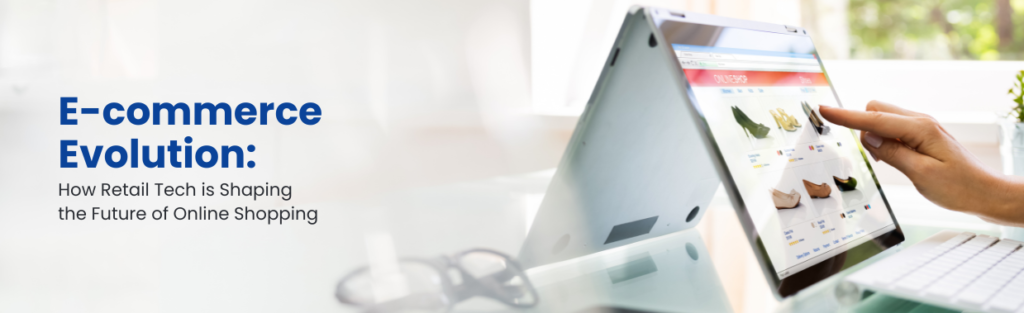
E-commerce Evolution: How Retail Tech is Shaping the Future of Online Shopping

E-commerce Evolution: How Retail Tech is Shaping the Future of Online Shopping

There has been a rapid e-commerce evolution in recent years, completely transforming the industry as we know it. Retail tech solutions are going mainstream and are already revolutionising experiences for customers. From AI and machine learning to IoT devices and more personalised experiences with recommendations and one-click checkouts, several new trends are reshaping the future of online shopping.  The future of the retail industry is also set to be defined by not just technological advancements, but also influencer marketing and social media in a bigger way than before. Retail tech encompasses innovative digital tools that are used by online and brick-and-mortar retailers to enhance the overall shopping experience. This covers the whole spectrum from simpler POS (point-of-sale) systems to more complex automation and AI tools. Mobile technologies, RFID and QR codes, AR, automation, generative AI, and ML are all future retail tech trends that should be taken into account in this regard.  Some reports estimate how the transformative future potential of AI (artificial intelligence) can ensure an annual value of a staggering USD 400-800 billion for the industry. In today’s times, mobile commerce and other trends are finding favour as more customers prioritise flexibility and personalisation along with higher efficiency overall. Retailers now have to adopt newer technologies not just flourishing, but also surpassing their rivals. Here are some trends that should be noted carefully in this regard.  Top Retail Tech Trends that May Transform Online Shopping  Here are some of the leading retail tech trends that may spur e-commerce evolution shortly.  Machine learning will help analyse various variable sets to offer suggestions based on individual consumer preferences, interests, and habits. This will help the algorithms build more sophisticated and relevant shopping profiles that enable improved offers over some time. This will also encompass more intelligent assistants and Chatbots for ensuring enhanced customer support and service throughout websites and e-commerce platforms.  AR can help brands offer customers more immersive and realistic ways of viewing and evaluating products. Apps will help customers view products in their environments. The entire retail environment will be synced both offline and online and visitors can easily complete transactions at almost every touch point. Customer profiling will improve due to a combination of online and offline channel-based data along with better inventory tracking throughout the entire system. This integration will ensure superior advantages for both retailers and customers. Cashier-less stores will soon become a reality as done already by Amazon Go. People can pick up their items and leave without interacting anywhere. The store has deep learning algorithms and sensors to scan each product that is picked up and to add them to virtual carts linked to Amazon accounts. Upon the customer leaving the store, the list is closed with the total charged to these accounts.  Customers in physical stores will thus have enhanced comfort levels since they do not have to carry any cards or cash with them. They do not have to wait in line for the cash register as well. Apps that read QR codes or barcodes can be further integrated into this system which means that people do not even have to pick up products to learn more about their features and other details. More people are embracing Alexa, Siri, Google Home, and other virtual assistants for various purposes including listening to music, checking weather conditions, and so on. Voice shopping will enable customers to communicate with virtual assistants and search for products to be added to virtual carts later. Once this is completed, customers have to place their orders and wait for retailers to deliver the items in question. This is another method in which technology can contribute greatly towards enhanced customer comfort and convenience.  Hence, as can be seen, retail tech will play a huge role in completely transforming the future of the retail industry.  FAQs How is retail technology driving the evolution of e-commerce and shaping the future of online shopping?  Retail technology has a vital role to play in driving e-commerce evolution and in shaping the future of online shopping. It will offer customers more personalised recommendations and shopping experiences along with cashless payments, better omnichannel integration, immersive AR-based journeys, and a lot more.  What specific technologies are contributing to the evolution of e-commerce platforms and enhancing the online shopping process?  Several advanced technologies are contributing immensely towards the evolution of online shopping platforms these days. These include augmented and virtual reality (AR and VR), artificial intelligence, machine learning, data analytics, IoT (Internet of Things), and more.  How are emerging technologies like augmented reality and virtual try-ons changing the way consumers interact with online shopping platforms?  These technologies will undoubtedly change the way that customers interact with e-commerce platforms. The lines will increasingly be blurred between virtual and physical environments. Customers can easily try on products or view them up close and that too in their environments. This will help them make better purchase decisions while enhancing their immersive experiences greatly as a result.  What role do data analytics and customer insights play in shaping the strategies of e-commerce businesses for the future? Customer insights and data analytics have a crucial role to play in shaping e-commerce business strategies for the future. They enable access to customer data in terms of shopping habits, preferences, and seasonal requirements. At the same time, they help forecast demand with an evaluation of market patterns and trends. 

Read More »
Winning the Inventory Game: Strategies for B&M and E-commerce Fashion Retail

Winning the Inventory Game: Strategies for B&M and E-commerce Fashion Retail

Both e-commerce fashion retail and brick-and-mortar players require advanced and efficient inventory management. This not only ensures that they have suitable items in the right volumes when the customer needs them, but also makes sure that they can lower costs, scale sales figures, and boost customer satisfaction levels simultaneously. The inventory management game becomes even more challenging and critical if you consider the fashion sector which is characterized by rapidly changing trends and consumer preferences, along with seasonal movements.  How it Stacks Up for Both Fashion Segments If you take a closer look at the inventory management game for both the brick-and-mortar and e-commerce sectors, these are the insights that emerge.  There are numerous technology solutions today that enable better and smoother inventory management for companies in both these segments. Let us take a look at some of them below.  Tech Solutions for B&M and E-Commerce Players Here are some of the most effective technological solutions that cater to both these categories in the fashion retail space.  Along with these systems, there are several retail technology solutions that are enabling dedicated improvements for fashion retailers across multiple categories. Let us take a closer look at them below.  Retail Technology Solutions for Better Outcomes Here are some of the ways in which cutting-edge retail technology solutions will completely transform the segment in the future.  Predicting future customer preferences will become more viable with advanced AI and ML algorithms along with data analytics. This will enable brands to offer products that customers will appreciate, while balancing sustainability and diversity alike. AI-based pricing strategies will also help scale up sales figures in relation to demand and supply levels. Gauging or sensing market demand with advanced tools will enable companies to take better strategic decisions as well.  Several companies are already working on demand sensing engines and newer demand forecasting methods for retail players. Some companies are also looking at omnichannel solutions for various brands in order to streamline inventory management. RFID should be another major game-changer in the near future, enabling companies to enhance their rates of conversion and boost consumer experiences simultaneously. RFID may enhance the rate of adoption while enabling higher brand security and inventory accuracy alike. These technologies are already being used by leading fashion brands like Zara, H&M, Tommy Hilfiger, Ralph Lauren, and Levi Strauss & Co. They are managing inventory better and tracking stocks in real-time while finding products swiftly at the same time. As a pre-requisite for better inventory management, companies are also looking at technological solutions that can streamline their supply chain processes and leverage opportunities through omnichannel businesses. Emerging consumer delivery models like online purchase and store pick-up, shipping from store, curbside order pickup, and same-day delivery are also gaining traction. This will further put the spotlight on efficient and accurate inventory management solutions in future years.  Add to that touch-less POS checkouts (boosting visibility into losses), interactive aspects like NFC tags and QR codes (for enabling special experiences and interactions with consumers), and other emerging trends and you get the picture. Better inventory management is the need of the hour, driven by advanced technological solutions for smoother sales, customer satisfaction, and business growth. Both brick and mortar and e-commerce fashion retailers have embraced these new-age needs with elan and this particular trend should continue for quite some time now. 

Read More »
Retail News Wrap Int.

Retail News Wrap | Weekly Snippets

✅ ASOS has taken personalisation in the retail landscape to the next level by joining forces with Rokt for post-purchase promotions. ✅ Fashinza’s brand-new design lab in Gurugram aims to build and empower robust product development and research infrastructure in the retail sector. https://www.indianretailer.com/news/retail-india-news-fashinza-launches-state-art-design-lab-gurugram ✅ Publicis Groupe’s Profitero unveils AI-Powered retail analytics. With this technology, retailers can now make data-driven decisions, analyse competition, and optimise pricing like never before. https://adage.com/article/digital-marketing-ad-tech-news/profitero-launches-ai-powered-retail-analytics/2508196 ✅Fujitsu’s AI customer service solution heads to supermarkets in Japan for field trials. This will transform the shopping experience and offer customised product recommendations and personalised support.https://indiatechnologynews.in/fujitsu-deploys-ai-customer-service-solution-for-field-trials-at-supermarket-chain-in-japan/

Read More »
Digital Transformation In Retail Sector

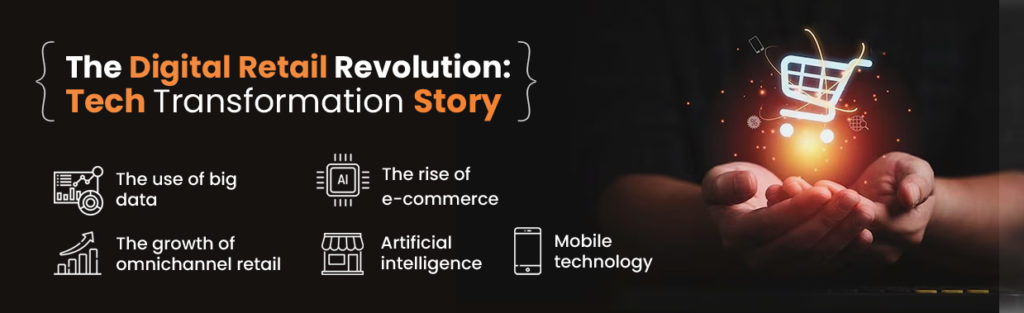
The Digital Retail Revolution: Tech Transformation Story

Digital retail is a buzzword that rings a bell in recent times. Tech transformation has reshaped the retail industry, particularly with the growth of e-commerce. Tools like machine learning and artificial intelligence have only fueled these trends. Here’s delving deeper into this transformational journey of the global retail industry. The Rise of E-Commerce E-commerce has been a game-changer for the retail industry over the last decade. Here are a few aspects worth noting: · Digital retail has been a direct result of tech transformation in the industry. This helps enhance customer experiences and drives future growth. · Personalisation in marketing and communications is possible via technology. There are also custom offers and recommendations for customers today. People can also expect swifter responses to queries and better experiences. The Impact of Technology on Retail Now how has tech transformation affected the retail industry? Here are some points that you should not miss: The Success Stories of Digital Transformation There are countless success stories of the tech transformation in the retail industry. Here are a few of them: Target’s cutting-edge digital transformation- IKEA’s virtual foray- FAQs 1.What are the key drivers of the digital retail revolution? Some of the biggest drivers of the digital retail revolution include changing consumer habits, and higher smartphone/mobile device usage and access. Other drivers include the growing need for personalisation and targeted marketing and the need to understand continually evolving consumer preferences. Another key driver is the desire to enhance customer experiences all throughout their journeys. 2.How is the digital retail revolution improving the customer shopping experience? The digital retail revolution is rapidly enhancing shopping experiences for customers. They can enjoy better in-store navigation and personalised recommendations in some cases. At the same time, they can get swifter responses to their queries and higher personalisation in case of their shopping experiences. 3.What are the benefits of embracing technology in retail? The benefits of embracing technology in retail include better customer engagement, higher customer retention and enhanced customer satisfaction. Some other advantages include personalised and targeted marketing and eventual growth driven by valuable customer insights. 4.What challenges do retailers face during the tech transformation process? There are several challenges faced by retailers at the time of tech transformation. These include integration with existing or legacy systems, digital literacy challenges and data privacy or security.

Read More »

Top 10 Technologies Poised To Transform the Retail Industry In 2018

Contrast the experience of the shoppers until just a few years ago to the kind of experience some brands manage to offer today: quick, intuitive tech has replaced the tedium of standing in long checkout lines, complicated online checkout processes, and erratic online shopping experiences. Today technology has made the buying experience, streamlined, fast, stressfree and user-friendly. Technologies such as RFID to read barcodes, beacon-based functionalities to locate stores and intuitive tools to help people find exactly what they are looking for, have transformed shopping into that which, until some years ago, we could have envisaged only in Sci-Fi fiction! In the near future, cashierless stores, driverless cars, and 3D manufacturing are also going to become realities and transform the way we shop! We predict that 2018 is going to be transformative for retail buyers thanks to some or all of these technologies, which either are already in use or are being refined for wider and more effective application: Artificial Intelligence– Embedded into online stores, AI helps personalize shopper experiences, generates search results with precise accuracy. AI can also help reduce costs by obviating the need for models, photographers, and a studio to create quality product images. AI can help retailers and brands make accurate predictions to help with merchandising and capacity planning. One instance of effective AI application is the outdoor wear brand North Face’s use of IBM’s Watson’s Cognitive Computing tech that helped refine the shopping experience. Data collected from 55,000 users indicated a 60% click-through rate and 75% total sales conversions due to the computing tech that initiated a customer conversation to help determine exact product requirements. Augmented reality– Helping create a real-world atmosphere is another aspect that augments shopping experience. Cosmetic brands such as L’Oreal have most effectively adapted this tech to the online store experience. The Makeup Genius app brought the AR experience to shoppers; permitting them ‘try out’ makeup on their handheld devices to make a better choice. In times to come, more brands and varied products will tap the potential of this tech. Facial recognition– The obvious uses for retail are many here: stores can help personalize the shopping experience based on collected data about the shopper’s gender, age, ethnicity and other details. There are diverse ways to apply facial recognition into the retail space; one example being an FR based system called ‘Smile to Pay’ installed in a KFC outlet in China; which was used to measure user satisfaction. While cultural and privacy concerns remain, tech refinement may be able to address these concerns effectively in times to come. Blockchain– The ever-growing ‘blocks’ of records employing cryptography are predicted to find their place in 2018, according to Forbes. Blockchain tech is already moving the needle for product manufacturers and sellers in terms of increasing transparency, penetrating emerging markets, maintaining virtual warranty wallets and enhancing global supply chains. In the insurance space, for instance, blockchain application can assist in parametric insurance, peer-to-peer insurance, and microinsurance. Wearable tech–Smartglasses, smartwatches, wearable scanners, wearable cameras and ‘hearables’ are transforming retail, and have the potential to further revolutionize the space and customer behaviors. At a time when e-commerce is diverting customers from bricks and mortar stores, wearable tech holds the potential to redirect buyers to physical stores. Data relating to location, body temperature and motion can also help refine decision-making and the overall user experience. The GoInStore’s application lets customers ‘browse’ without having to go into a store; while still receiving any personal assistance required. The Pinnacle Response wearable camera helps with crime detection and control while wearables such as Onyx by Orion labs helps workers communicate and deal with customer requests effectively. RFID – Radio frequency identification, which has been the default system for billing at checkout counters for many years, also helps address security concerns by offering elegant solutions against shoplifting. It helps track inventory and is a hugely important tool for consumer research. Brands such as Amazon Go have already incorporated the use of RFID in the way that they permitted customers to make purchases off shelves and leave without actually checking out of the store. Purchases are charged to the buyer’s Amazon account, who receives a digital receipt of payment. Such examples of practical use of RFID to ease the shopping experience are only going to increase in times to come. Virtual /Digital assistants– The use of this tech to enhance buyer experience is at a nascent stage but presents exciting possibilities particularly when leveraged by AI.The expected demand for these automated software apps and platforms will double in2018 and possibly garner 1.6 billion active users by the year 2020. Features such as natural language interface, the ability to personalize and fine-tune product offerings to individual buyer preferences and access to a wide spectrum of data make this almost inevitable. Refinements in Apple’s Siri, a new device for Microsoft’s Cortana, and new features for Amazon’s Alexa seem to indicate the use of virtual /digital assistants is only set to rise. Drone delivery –The concept of unmanned vehicles or drones to transport packages, deliver food and so on still sounds rather fantastical, but this is closer to reality than we think. Forbes thinks that drone deliveries will play a huge role in the next decade or so. A JLL (Jones Lang LaSalle) report predicts that drone products will start out being used in the store my retailers, then perhaps for boosting the security of store perimeters and warehouses as well as for construction management. Convenience store 7-Eleven has already tested out drone delivery systems by successfully delivering chicken salad, coffee, ‘Slurpees’ and Donuts to a Reno, Nevada family. In the future, the possible applications are only poised to increase, given crowded roads and difficult to navigate traffic. Robotics retail – Robots as shop assistants and robots functioning autonomously in manufacturing and packing seemed far-fetched a while ago, but today Amazon uses a 45,000 strong robot ‘fleet’ to help fulfill warehouse orders. Robotics in retail opens up some exciting possibilities in terms of warehouse

Read More »
MENU
CONTACT US

Let’s connect!

Loading form…

Almost there!

Download the report

    Privacy Policy.