Tag: Remote Work

Remote Renaissance

Remote Renaissance: How Offshore Developers Are Redefining Marketing Operations for Modern Enterprises

The current business landscape is going through rapid transformation, and businesses all around the world are continuously looking for new ways to surpass limitations and pace up ahead of competitors. One strategy that has gained significant traction is the utilisation of offshore development teams. While offshore development was once seen as an effort to reduce costs, it has evolved into a strategic move for enterprises looking to develop and scale their marketing operations. Companies are able to access immensely skilled developers from anywhere around the globe to radically change the way marketing campaigns are conceptualised, implemented, and optimised. The Rise of Remote Collaboration The COVID-19 pandemic made many companies switch to remote work, and soon the business adapted to this new norm. Enhancing Marketing Automation Marketing automation has become a cornerstone of modern marketing operations, enabling enterprises to streamline processes, improve lead management, and enhance customer engagement. Data-Driven Marketing Strategies In the age of big data, marketing decisions can no longer be based solely on intuition. Agile Development for Rapid Innovation Cybersecurity and Data Protection As marketing operations become increasingly data-driven, concerns over data security and privacy are paramount. Best Practices and Considerations While the advantages of offshore development are evident, enterprises must adopt best practices to ensure successful collaboration and maximise the potential of these partnerships. The Future of Offshore Development in Marketing As technological advancements continue to shape the marketing landscape, offshore development teams will play an increasingly vital role in enabling enterprises to stay ahead of the curve. Signing Off The remote renaissance is here, and offshore developers are at the forefront of redefining marketing operations for modern enterprises. By leveraging the global talent pool, companies can access highly skilled professionals who bring a wealth of expertise and innovative approaches to marketing automation, data-driven strategies, agile development, and Cybersecurity. As the business landscape continues to evolve, enterprises that embrace offshore development will gain a competitive advantage, enabling them to stay agile, responsive, and adaptive in the face of changing market demands. The future of marketing operations lies in the seamless integration of cutting-edge technologies, data-driven insights, and a global mindset – all of which can be facilitated by offshore development teams. By fostering successful partnerships with reputable offshore development companies, enterprises can unlock the full potential of their marketing initiatives, drive innovation, and ultimately, achieve sustainable growth in an increasingly competitive global marketplace.

Read More »
Remote work to hybrid

How to Adapt to New Work Arrangements Post-Pandemic

The pandemic has completely transformed our lives and this has naturally extended into the way we work. Multiple companies are already transitioning to a combination of on-site and remote working through the virtual and hybrid model. This will naturally enable higher access to skilled talent and productivity along with lower costs, smaller teams, enhanced flexibility, and better experiences for employees. However, it is easier said than done. Even Yahoo! CEO Marissa Mayer concluded an experiment in remote working once, stating how the company had to become one Yahoo! once more. Even HP Inc. did the same thing for various reasons. Let us look at adaptation to newer working arrangements after the pandemic that deserve careful attention. Remapping the Work Arrangement Paradigm There has been a lot of talk about the downsides of remote work, including how it hinders the development of a company culture, shared trust, and of course, common values. It may also lead to the emergence of dual organizational cultures, majorly influenced by managers and in-person employees who profit from the positive collaboration and face-to-face brainstorming sessions, while remote workers may end up feeling ore isolated and unhappy as a result. A common sense of belonging and purpose may also be hindered due to hybrid models or completely remote ways of working. So, as an organization/leader, how do you adapt to new work arrangements? This requires a careful remapping of the entire paradigm with a view towards carefully bypassing these downsides, while ensuring better interactions for improved social cohesion. The first step depends on selecting a suitable work model before you implement the same throughout the organization. The decision should depend not only on costs, but also optimizing talent access, employee experiences, productivity, and so on. Here are a few ways in which you can ensure the maximum possible utilization of your work model. New Work Arrangement Adaptation- Things Worth Noting Here are a few aspects that you should consider while carefully switching to new post-pandemic work arrangements. 1. Completely Virtual Models- 2. Staying Hybrid- 3. Work Speed and Higher Productivity- 4. Transitioning Smartly- 5. Leadership Management- 6. Informal Interactions Work Best- 7. Emphasis on Leadership Stance- 8. Virtual Interactions are Not the Only Solution- 9. Building Safer Spaces- Signing Off As can be seen, there should be a lot of thought and effort put into designing hybrid work models that actually keep teams close, while helping organizations enjoy the productivity benefits alongside. Always keep time-zone gaps in mind and build teams with a minimum of four hours of overlap to enable collaborations while emphasizing virtual meetings across the entire team whenever possible. Based on a report by the Economic Times, a top work-from-home researcher and Stanford professor Nick Bloom, mentioned how typical global employees desire moderate hybrid systems. Hence, instead of going full throttle with the back to work model, focus on building proper infrastructure and support systems for employees. Embrace flexibility since ultimately it is all about staying in sync with the evolving world and getting the job done successfully. That’s what matters eventually. FAQs How much flexibility will I have in choosing when and where I work under a hybrid model? It all depends on the organizational policy adopted by your company. If it has a supportive approach towards flexi-working and hybrid models, then you may have more flexibility in choosing your work hours which are not necessarily official business hours in many cases, and also your location. How can we effectively measure and evaluate employee performance in a hybrid work environment? An outcome-based tracking/measurement model is more effective in tracking employee performance in hybrid work environments. This is more effective than tracking work volumes or inputs. What are the primary benefits of implementing a hybrid work model for both employees and employers? Some of the primary advantages of executing hybrid work models including better flexibility and work-life balance for employees, along with higher productivity due to zero commutes, and better quality of life. Employers benefit from lower costs overall in terms of office space and associated amenities along with time and productivity lags. They can also track employees instantly via digital channels. Can a hybrid model stifle in-person brainstorming and collaboration, potentially hindering innovation? Hybrid models may sometimes pose challenges to brainstorming and collaborating in person, thereby hindering overall innovation. However, while it cannot be a substitute for real-world communication, employers can integrate a suitable approach and use the right infrastructure to help people regularly catch up and ideate digitally. Can a hybrid model with a reduced office footprint contribute to a company’s sustainability goals by lowering its carbon footprint? Yes, hybrid models with lower footprints in office will naturally contribute towards a reduced carbon footprint and overall sustainability objectives of employers. This will lead to lower consumption of resources, thereby instilling more environment-friendliness into the workplace.

Read More »

Migrating 600+ team members to Work-From-Home in three days!

Around a month back, we were conducting a “Dreamweaving” session for Indus Net Technologies. This is a session where INTians come to weave a dream for INT of the future. One dream was “INT to become a 100% remote work company in FIVE years”. Point taken, and a valid suggestion given that remote working is a rising trend. But not easy, as there is a momentum, habit, and dependency of working from the office, among people, discussing things face-to-face. However, as luck would have it, within weeks, we are facing a BLACK SWAN event of GIGANTIC proportion, which has changed the world forever. And, things that we thought will take FIVE YEARS to achieve was implemented in less than FIVE DAYS. These FIVE DAYS last week were very stressful. We took decisions by minutes, everyone came together, everybody cooperated, worked without watching the clock, and ganged up together to beat the challenge that stood in front of us. Innovative solution sprang up from nowhere, people stepped up and went beyond their area-of-expertise and within days, we prepared 600+ people for Work-From-Home. And, we prepared such that we can continue this for months if required. This is just the start – we will need to create strong methodologies so that none of us slack off, we can collaborate better and we can move fast when our old habit wants to pull us back. We will learn many things in this process, and we will become a stronger and more mature organization. Few learnings: – We always underestimate our ability to bring change. We estimated five years, though we could have actually done in five days! – We can achieve the most difficult task if the team is aligned with the goal. Everybody wanted business continuity for the interest of INT and to safeguard our collective interest. – Solutions can come from the most unexpected corners – If put in chaos, people will self organize themselves to achieve the goal, as long as the goals are communicated – The barrier is in our minds. And these barriers fall apart when you have to think outside the box to survive. And new ideas/methodologies surface. We were not able to do an all-company all-hands for years due to a lack of space. However, now, we are already thinking of doing so using a webinar. We could have done it earlier, but we were always constrained by thoughts and limitations that we made up in our minds. I have no doubt, that as a company, Indus Net Technologies will evolve much stronger, much agile and much-improved company from this crisis. And, we will tide through the imminent recession – after all, we have a history of surviving and thriving in recessions.

Read More »
3 Powerful Tactics of Managing a Remote Team

3 Powerful Tactics of Managing a Remote Team

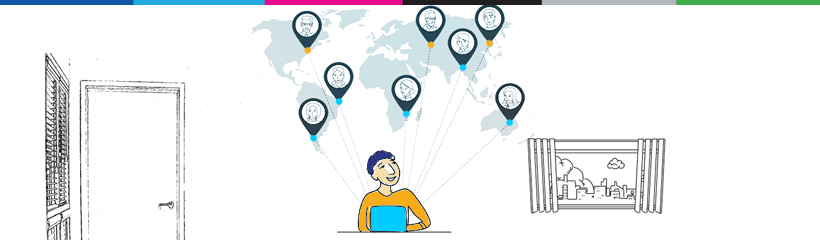
It is 2019 and we all know that “Remote Work is here to stay”. Professionals & organizations around the world are getting ready to embrace this trend. While you are reading this, you must have considered it as the future of work and not just a fad. Communication, communication and communication! A remote team’s efficacy is completely dependent on the mode, method and process of communication. It is often perceived as the most challenging part as people have questions like, How can I communicate freely with a person from different zone? How will I collaborate with him? Will she/he understand my lingo? All these situations can easily be addressed, if we use Emails for communicating lengthy ideas, crucial announcements Real time chat applications like WhatsApp, Skype, Telegram, Send and Line can be used for informal or frequent updates Slack, one of the most successful collaborative platform for messaging, tools, files for agile teams However, a number of you will debate if this is sufficient as 55% of human communication is based on body language. The answer is NO! The major rise in acceptance of remote work has been by leveraging voice and video calls.  The shift from 4th to 5th generation of cellular technology, enhanced mobility is expected to make it easier for employers to understand body language, expressions and intonations. We have addressed how meeting rooms can be used for managing agile teams in past. Do have a read! Respect time differences and use it to an advantage In a world where “Time is money” remote work outsourcing is a boon. In the last 2 decades of operation we have seen a number of our clients using it to their advantage by planning schedules based on their team. However, with agility becoming the way of working time zone difference can well act to its advantage. For instance, a little back when he heard two teams working at two different zone which are more or less 12 hours apart. A number of us often said, remote team won’t work because Team 1 will finish working and is prepared to leave for home while Team 2 is getting ready to come for work Change requests will take more than 24 hours to be addressed Both teams are always on separate pages However, the answer today is completely opposite. The world is a talent pool and using it wisely to your requirement is what needs to be done. Let us take the Zapier marketing team, for example. They work from Bangkok, Kuala Lumpur, Minneapolis, Omaha, Austin, Raleigh, New York, Toronto, San Francisco, Portland, and other cities. That makes scheduling meetings difficult, but they hand off work to keep the wheels turning 24/7. Alex writes an article during the day in Bangkok, and his teammate Melanie in New York can edit it while he is asleep. By the time Alex wakes up, he got corrections to work on. At the same time, Danny in Omaha can begin working with a new partner during the day, and Alex can pick up the remaining tasks as soon as he quits work at 5 p.m. his time. What we need today is to assign a remote manager(s) at our end who can work hours that overlap both teams. Simple! Be aware of cultural differences With world becoming your office, knowing your employees can often become challenging. We recommend doing research around cultural differences, expectations, behaviors and language. Working in a virtual setting brings no communal break room or water cooler moments that help to build relationships with your workers. You have to make this accidental chatter happen by intentionally setting aside a few minutes a day and having a genuine conversation with someone in your team. Make it a habit, we must say! For instance, Zoho is a strong supporter of this practice. They always recommend going beyond the weather and how ‘crazy’ the time difference is. Instead, non-work conversations should be brought up like their national holidays, music playlists, views of your office spaces, latest movies or the game last weekend. Whatever it is, make them feel natural and show genuine interest in their answers. The point here is to find a non-work connection that will build trust and loyalty between you and your multi-cultural employees. Who’s not in the room? Remote working brings with it its own set of challenges, yet we love it. The knowledge we’ve gained so far is helping us work productively for clients across the globe. The diversity in our team gives us extra points of view on what’s best for our customers. Not just us, but the one of World’s fastest growing enterprise feels its the reason which has made the difference. Ruth Scott, regional HR Director of Middle East and Africa at OLX, the company behind UAE-based classifieds platform dubizzle, says that engaging in a remote working programme has strengthened her organisation’s entrepreneurial culture, and encouraged staff to become more productive, creative and disciplined. A solid remote working practice relies on communication. Remember to be available, inclusive and culturally mindful. Keep an eye on the clock, have fun out there and enjoy wherever you are. Don’t forget to keep an eye on our website because we are coming up with an entire research report on remote work which might have answers to all your queries. In case you have one now, shoot at info@indusnet.co.in.

Read More »
Deep Work Is The New Secret Of Enhanced Productivity Among Remote Workers

Deep Work Is The New Secret Of Enhanced Productivity Among Remote Workers

Imagine sitting on your office desk, trying to concentrate on your work and suddenly the phone rings. Well, you are not only distracted but also diverted from the thoughts you were initiating. You might have seen a number of managers around the world getting excited the moment they come across a new way to improve the productivity of teams/individuals. They dream of that one ideal day with zero error tasks delivered on time. Deep Work can be a solution to this dream. What is Deep Work?  Deep Work is a concept coined by Cal Newport, a Computer Science professor at Georgetown University. He defines Deep Work as the ability to critically focus on activities which are highly important without any distractions. By doing this, you can avoid “shallow” work. Let us help you understand this better. Rewind your life and imagine a day where you had strict deadlines to meet. Calculate how many times you were forced to go through your email because someone wanted something urgently.  You will debate and see that if things were prioritized it would not have happened, but often a number of things are not in your control. Deep Work is a philosophy, not an initiative  Well, to initiate the process of Deep Work, Newport advices on developing an agile task list which has all tasks listed and is shared with your co-workers so that they are well- informed about their schedule and know when to approach you and for what. With remote colleagues, this philosophy continues as they can follow the same as per their time zones. With remote workers, the biggest advantage is that they can follow their own schedule and every information exchanged is well thought of. Why is Deep Work important for you as well as your team?  Deep Work helps to improve the core abilities for thriving in this competitive environment. It allows developers and designers to work on complex projects in a strict deadline with complete accountability. At Indus Net, we have created an ecosystem which fosters deep work from the onset. Teams based on the client’s needs and not skill sets are set up to ensure minimum distraction and maximum return. Some real-life instances In a survey of 450 remote workers, TalentLMS found that around 90% of survey participants get work done properly and adequately when working remotely. They have highlighted why concentration level is high if people work remotely and where they create a zero distraction zone. At Crossover, managers use Deep Work, productivity and work habits using a number of customized tools to know how effective their culture is. At Toyota, managers often go for short walks through the factory floor to have a look at the work of the team members. They use tools to find out the blocks of time wasted and use these insights to create a rectification plan and provide training sessions correspondingly. So how can you start? Create an agile methodology of work with well-defined tasks and responsibilities for 2 weeks Hire a remote worker and treat all colleagues as remote workers Define your and your team’s work schedule Ensure zero distraction during working hours Measure productivity using smart tools like Worksmart or develop one yourself Understand trends and improve Today, deep work needs discipline, efficient planning along with a change of mindset to understand why remote working can yield maximum results. Just imagine what you can do outside work with all those extra hours!

Read More »
MENU
CONTACT US

Let’s connect!

Loading form…

Almost there!

Download the report

    Privacy Policy.