Tag: language

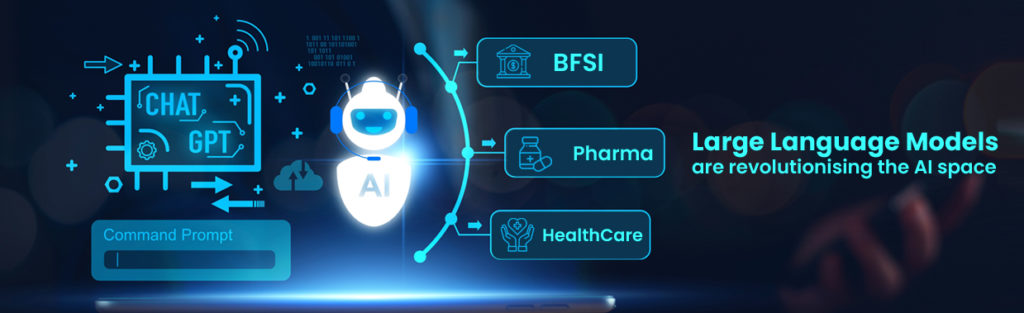
How the Large Language Models like GPT are revolutionising the AI space in all domains (BFSI, Pharma, and HealthCare)

How the Large Language Models like GPT are revolutionising the AI space in all domains (BFSI, Pharma, and HealthCare)

Large language models or LLMs are ushering in a widespread AI revolution throughout multiple business and industry domains. DALL-E-2 set the cat amongst the pigeons in the AI segment in July 2022, developed by OpenAI, before ChatGPT came into the picture. This has put the spotlight firmly on the invaluable role increasingly played by LLMs (large language models) across diverse sectors. Here’s examining the phenomenon in greater detail.  LLMs make a sizeable impact worldwide With natural language processing, machine learning, deep learning, and predictive analytics among other advanced tools, LLM neural networks are steadily widening the scope of impact of AI across the BFSI (banking, financial services, and insurance), pharma, healthcare, robotics, and gaming sectors among others.  Large language models are learning-based algorithms which can identify, summarise, predict, translate, and generate languages with the help of massive text-based datasets with negligible supervision and training. They are also taking care of varied tasks including answering queries, identifying and generating images, sounds, and text with accuracy, and also taking care of things like text-to-text, text-to-video, text-to-3D, and digital biology. LLMs are highly flexible while being able to successfully provide deep domain queries along with translating languages, understanding and summarising documents, writing text, and also computing various programs as per experts.  ChatGPT heralded a major shift in LLM usage since it works as a foundation of transformer neural networks and generative AI. It is now disrupting several enterprise applications simultaneously. These models are now combining scalable and easy architectures with AI hardware, customisable systems, frameworks, and automation with AI-based specialised infrastructure, making it possible to deploy and scale up the usage of LLMs throughout several mainstream enterprise and commercial applications via private and public clouds, and also through APIs.  How LLMs are disrupting sectors like healthcare, pharma, BFSI, and more Large language models are increasingly being hailed as massive disruptors throughout multiple sectors. Here are some aspects worth noting in this regard:  Pharma and Life Sciences:  Healthcare:  The impact of ChatGPT and other tools in healthcare becomes even more important when you consider how close to 1/3rd of adults in the U.S. alone, looking for medical advice online for self-diagnosis, with just 50% of them subsequently taking advice from physicians.  BFS:  Insurance:  The future should witness higher LLM adoption throughout varied business sectors. AI will be a never-ending blank canvas on which businesses will function more efficiently and smartly towards future growth and customer satisfaction alike. The practical value and potential of LLMs go far beyond image and text generation. They can be major new-gen disruptors in almost every space.  FAQs What are large language models? Large language models or LLMs are specialised language frameworks that have neural networks with multiple parameters that are trained on vast amounts of unlabelled text with the usage of self-supervised learning.  How are they limited and what are the challenges they encounter? LLMs have to be contextual and relevant to various industries, which necessitates better training. Personal data security risks, inconsistencies in accuracy, limited levels of controllability, and lack of proper training data are limitations and challenges that need to be overcome.  How cost-effective are the Large Language Models? While building an LLM does require sizeable costs, the end-savings for the organisation are considerable, right from saving costs on human resources and functions to automating diverse tasks.  What are some potential ethical concerns surrounding the use of large language models in various industries? Some concerns include data privacy, security, consent management, and so on. At the same time, there are concerns regarding these models replicating several stereotypes and biases since they are trained using vast datasets. This may lead to discriminatory or inaccurate results at times in their language. 

Read More »

The Most Valuable Programming Languages to Learn for IoT

With more objects becoming ‘smart’ and with more products being able to communicate with users with the help of Internet, it is becoming increasingly clear that programming for things is a new reality. Internet of Things, or IoT as it is popularly known, is spurring a new set of demands and targets for programmers. Developers are often left mystified about the nature of programming that is required for IoT and also the languages that are specifically required to program IoT applications. In the coming future, more objects and products will be connected to the internet to make interaction with users and data seamless and easy. With this in mind, it makes sense to look at some of the most important and useful programming languages that may help developers to develop applications and software for smart objects. What we need to remember is that while Internet of Things is a reality, it is still in a nascent stage. Most objects do not have the processing capacity that regular computers do. The computers or chips that are installed in these objects are quite basic, and they need very basic programming skills. What is C? C is a structured and procedural programming language widely used by programmers. C was originally developed by Dennis Ritchie between 1969 and 1973 at Bell Labs. It was first used to develop UNIX operating system. Today, it is used for developing operating system, compiler, network devices, assemblers, application software like database/ spreadsheets; computer and mobile games etc. Why C for IoT? Many IoT devices are embedded and have limitations like low computing power, low RAM and storage. Most embedded operating systems like Contiki, mbed, TinyOS etc support C.  C is highly efficient and you can tweak every part of the code to get the best performance out from an underpowered device. Therefore, it remains the first choice for constrained IoT devices and can be used to write the lowest layer of software, the layer closest to the hardware. It is simpler to complete complex tasks in C.  Moreover, many popular programming languages use C syntax. Finding developers with extensive experience in C is easy. The only limitation of C is its inadequate support to Graphical User Interface.  Nonetheless, its proximity to machine language makes it impressively fast.   Difficulty level C is a basic programming language and has been a reference point for many other languages. It is easy to learn, can create efficient programs, handle low-level activities and can be compiled on a variety of computer platforms.   C++ What is C++? C++ is an enhanced version of C language typically used for object-oriented programming.  It was designed to run large-scale applications, a limitation in C. C++ is widely used in embedded systems, GUI based applications, web browsers, operating systems with application across industries like healthcare, finance, defense etc. Why C++ for IoT? If IoT devices are expected to do complex tasks, C++ is chosen over C.  C++ comes with added abilities like data abstraction, classes and objects. C++ creates compact and faster runtime code. Line of code can be compiled into a couple of instructions leading to high runtime speeds and low energy consumption and is therefore suitable for writing IoT and embedded system code. According to C++ developer, Bjarne Stroustrup, there is still no other language that makes it better than C++ when it comes to specialized hardware to be used for Internet of Things. C++ is designed to handle both hardware and complexity simultaneously. It has apparent advantage of running seamlessly with systems with a few hundred kilobytes of memory. And there are not many languages that can work within such a framework. Difficulty level C++ is a relatively complex language to learn because it is designed to accomplish big and complex tasks. It may take years to master it. If you transition from learning C to C++, adaptability is faster.   Java What is Java? Java is a powerful programming language that enforces object-oriented programming model. It was developed by Sun Microsystems on the same lines as C/ C++, however it is simpler to run than C++. It can used to create applications run on single computer or distributed among servers. Java has wide-ranging applications including development of Android apps, server-side apps, Java web applications, software tools, trading applications, J2ME apps, big data technologies etc. Why Java for IoT? Java codes are portable and it is easy to move them to the smallest devices with the help of Java Virtual Machine. There is a lot of focus on Java SE Embedded today where classes can be eliminated leading to computing resource savings. Consequently, all communication goes through the network. Apart from that, Java has in-built capabilities like hardware support libraries thereby requiring bare minimum hardware dependency. Therefore, it is easy to control a device with a Java-written code. Java has huge potential for consumer IoT as well as industrial IoT.  It is not surprising that many experts consider Java to be the best language for IoT devices.   Difficulty level Java is one of the easiest languages to learn and is good for beginners. Once you understand its syntax, packages and frameworks, it is swift to learn.   Python What is Python? Python is a high level, object-oriented programming language. A general purpose language, Python works perfectly for backend web development, data analysis, artificial intelligence and scientific computing.  Developers also use it to build productivity tools, games and desktop apps. It is one of the fastest growing languages for embedded computing.   Why Python for IoT? Python is well-known for its writability, error reduction and readability. It is easily decipherable and its design is in line with today’s agile environment. With embedded algorithms becoming complex with the use of neural network and other heavily-involved processes, Python is just the right language for IoT projects.   Python can easily aggregate data coming from microcontrollers like Adruino, pass on commands, and display/log results in IoT projects. It is being used to interface with high-performance

Read More »
MENU
CONTACT US

Let’s connect!

Loading form…

CONTACT US

Let’s connect!

    Privacy Policy.

    Almost there!

    Download the report

      Privacy Policy.