
Tag: Digital Transformation

QA in digital transformation: role, strategy, and scalable delivery.

QA in Digital Transformation: Role, Strategy & Scalable Delivery

Role of QA in Digital Transformation & Scalable Software Delivery Digital transformation isn’t just about adopting new technologies—it’s about creating systems that can scale, adapt, and perform flawlessly in real time. And at the heart of every successful transformation initiative lies Quality Assurance (QA). Modern QA is no longer a gatekeeping function at the end of development—it’s a continuous, integrated enabler of digital acceleration. In this guide, we’ll break down the evolving role of QA in digital transformation journeys, how it supports agile and DevOps initiatives, and best practices for scalable QA delivery. QA in Digital Transformation: The Highlights 🧪 QA is critical in reducing risk and accelerating innovation during digital transformation. 🔄 QA practices are evolving with Agile, DevOps, CI/CD, and cloud-native architectures. 📈 Scalable QA strategies require test automation, continuous feedback, and team integration. 💡 QA drives business value by ensuring product reliability, speed, and user experience. Why QA Matters in Digital Transformation As companies move toward cloud-native platforms, microservices, and digital-first business models, QA ensures these changes don’t break critical systems or user trust. The Stakes Are High: One bad release = lost users One missed bug = security vulnerability One untested scenario = broken integrations QA’s Strategic Role in Digital Transformation: Validates business logic across legacy and modern systems Ensures release confidence across multiple devices and environments Enables faster, high-quality iterations via test automation and CI/CD How QA Supports Agile, DevOps & Modern SDLCs Digital transformation goes hand-in-hand with agile methodologies and DevOps pipelines, which demand speed, collaboration, and quality at every stage. 🔁 QA in Agile: Participates in daily standups and sprint planning Helps define acceptance criteria and testable stories Conducts exploratory and regression testing within sprints 🔄 QA in DevOps: Builds automation suites integrated into CI/CD Enables “shift-left” testing—catching defects earlier Tracks quality metrics like test coverage, flakiness, and defect density How is QA integrated into DevOps and Agile? QA collaborates closely with developers, product managers, and DevOps to write, run, and automate tests within the SDLC—often in real time. Building Scalable QA for Digital Delivery Scaling your QA function means ensuring quality across: Multiple product lines High-velocity releases Diverse platforms (web, mobile, API, cloud) Best Practices for Scalable QA: Test Automation at Scale: Use frameworks like Selenium, Cypress, Playwright Automate UI, regression, and smoke tests Continuous Testing in CI/CD: Integrate testing into Jenkins, GitHub Actions, GitLab pipelines Test Environment Management: Use containerized environments (Docker/K8s) Maintain parity across dev, staging, and prod Real-Time Reporting: Use dashboards, alerts, and defect analytics for visibility Cloud Testing Infrastructure: Use platforms like BrowserStack and Sauce Labs for cross-browser/mobile testing 🚀 Need to scale QA for your digital transformation roadmap? Explore INT Global’s QA Consulting Services for flexible, automation-first solutions tailored to your growth needs. QA as a Business Enabler, Not Just a Gatekeeper Modern QA delivers more than defect detection—it delivers business value. Business Outcomes from Strong QA: 💰 Lower Cost of Failure: Early bug detection reduces production rework 📱 Superior User Experience: Fewer crashes, faster apps, better usability ⚙️ Operational Efficiency: Devs spend less time fixing bugs, more on building 🚀 Faster Time to Market: Releases are tested, stable, and production-ready Case Study: QA in Action During Digital Transformation A global logistics provider migrated its legacy ERP to a cloud-native SaaS solution. QA played a central role: Automated over 3,000 test cases across modules Built CI/CD pipelines for daily builds Cut release cycle from 6 weeks to 1 week Reduced post-release defects by 70% 🔧 Transforming digitally? QA is your safety net. Talk to our QA transformation experts and see how we can help you implement scalable QA for faster, safer delivery. 📚 Frequently Asked Questions ❓ How does QA support digital transformation? QA ensures that new technologies, platforms, and features are tested, reliable, and secure—critical for successful transformation outcomes. ❓ What is scalable QA? Scalable QA refers to practices and infrastructure that can grow with your product—supporting larger user bases, frequent releases, and broader testing needs. ❓ Why is automation important in digital QA? Automation reduces testing time, increases coverage, and ensures repeatability—essential in CI/CD-driven development. ❓ What challenges do teams face with QA in transformation? Legacy systems Tool integration Team silos Inconsistent environments ❓ What QA tools are used in digital transformation? Common tools include Selenium, TestRail, Jenkins, Cypress, Postman, JMeter, BrowserStack, and cloud-based test labs.


Read More »
Website blog banner

Your Website Has 3 Seconds to Impress — Or It’s Over

Stop. Look at your website. No, really — open it on your phone. Scroll through. Click around.Now ask yourself: does this experience feel like your brand in 2025? Or does it feel like a relic from a more forgiving digital era? In today’s ultra-fast, hyper-competitive landscape, your website isn’t just your storefront — it’s your elevator pitch, your first impression, your lead generator, your reputation manager, and your 24/7 salesperson. And here’s the uncomfortable truth:If it doesn’t impress in 3 seconds, it’s game over. People are moving faster, clicking faster, and abandoning faster than ever.You don’t get second chances. You barely get seconds. Every day you delay a redesign is a day you’re bleeding potential revenue. Welcome to 2025. The Rules Have Changed. Let’s be clear:Your 2020-era website might’ve done the job then, but it wasn’t built for now. Back then, users tolerated slow load times, clunky navigation, and desktop-first design. But in 2025? That just won’t fly. Today’s users are unforgiving, impatient, and spoiled by digital excellence. Their expectations are sky high. Their attention spans? Non-existent. If your website isn’t stunning, stupidly fast, and obsessively user-friendly — you’re invisible. So What’s Changed? 1. AI Is the New UX Your competitors are using AI to personalize digital experiences in real-time.Think smart search. Dynamic content. Predictive suggestions. Chatbots that actually solve problems. Still using static menus and one-size-fits-all calls-to-action? You’re not just behind. You’re invisible. 2. Google’s Algorithm Is Brutal In 2025, search rankings are a digital battleground — and your website is either a warrior or a casualty. Google now rewards sites that are lightning-fast, mobile-first, ADA-compliant, and fine-tuned for user intent. If your site takes longer than 2.5 seconds to load, or fails to meet Core Web Vitals benchmarks, don’t expect to be found — by anyone. 3. Mobile Isn’t King Anymore. It’s the Emperor. Over 80% of users are browsing, shopping, and making decisions on their phones.If your mobile experience isn’t fluid, intuitive, and lightning-fast, you’re out of the race. That pinch-to-zoom interface from 2019? It’s not charming. It’s repelling business. 4. Design Isn’t Subjective Anymore — It’s Scientific Modern design isn’t about pretty colors or flashy animations. It’s about psychology, behavior, and conversions. Your website needs to guide action, build trust, and sell — fast.If your layout confuses people or your CTA buttons hide beneath clutter, you’re losing sales by the second. And yes — your rainbow-colored buttons and five different headline fonts are costing you real money. Still Debating a Redesign? Here’s What You’re Competing Against They’ve evolved. They’ve invested. And they’re stealing your market share — one visitor at a time. You can’t compete with that using a Wix template from 2018. Let’s Talk About the Real Cost of Delay Imagine this: A potential client hears about your brand. They search for you. They land on your site. It feels slow. Dated. Off brand. They click away. In less than 10 seconds, they’ve decided: “No thanks.” They’ll never come back. You’ll never know. Your website made the first impression — and killed the sale. Now multiply that by every lost visitor, every missed opportunity, every time your site failed to convert. The cost of not redesigning? Now Imagine the Opposite Picture a site that loads instantly. Looks sharp across all devices. Speak directly to your customer. Guides them with purpose. Delivers a seamless, intuitive experience. A site that doesn’t just exist — it performs. It works for you while you sleep. That’s not a luxury anymore. That’s the standard. This Isn’t a Redesign. It’s a Rebirth. And in 2025, the brands that win aren’t the ones with the best ideas. They’re the ones with the best execution, experience, and web presence. The bar is higher than ever — but so are the rewards for brands bold enough to meet it. So here’s the million-dollar question: Are you ready to stop bleeding customers? Redesign Your Website Now Not because it’s trendy. Not because your competitor just did. Because it’s do or die. Don’t wait another month. FAQs

Read More »
5 healthcare companies that have transformed digitally

5 Healthcare Companies that have Transformed Digitally

As the world seeks more efficient, patient-centric, and accessible healthcare solutions, companies have emerged as pioneers, pushing the boundaries of what’s possible in this critical sector. In this blog, we will explore 5 healthcare companies that have explored the power of digital transformation to reimagine the way we approach medical care, manage health data, and deliver life-saving treatments. From telemedicine breakthroughs to cutting-edge health data analytics, these organisations are at the forefront of a digital healthcare revolution that is changing lives, improving patient outcomes, and shaping the future of the industry. Join us as we delve into their inspiring stories and discover how they’re leading the charge towards a healthier and more connected world. Grail: Grail, a cancer detection company developed a blood test that can detect over 50 types of cancer early, when they are most treatable. The company’s test uses ML to analyse DNA fragments circulating in the blood, known as circulating tumour DNA (ctDNA). Grail’s test is still in the early stages of development, but it has the potential to transform cancer detection and treatment. Tempus: Tempus, a data-driven precision medicine company, helps clinicians make better decisions for their patients with cancer. The company’s platform collects and analyses genomic and clinical data from millions of patients to identify new patterns and insights. It then uses this data to develop personalised treatment plans for each patient. The platform is used by clinicians at over 800 cancer centres around the world. Meddo: Meddo, a digital healthcare platform, provides telemedicine services and other healthcare solutions to hospitals and clinics. The company’s platform offers a variety of features, including online doctor consultations, patient record management, and e-pharmacy services. Meddo’s platform is used by over 1,000 hospitals and clinics in India. Practo: Practo, a digital healthcare platform, connects patients with doctors and other healthcare providers. The company’s platform offers a variety of services, including online doctor consultations, appointment booking, and medical record management. Practo has over 150,000 doctors and 20,000 clinics on its platform, and it serves over 100 million patients each year. PharmEasy: PharmEasy, an online pharmacy delivers medicines and other healthcare products to customers’ doorsteps. The company’s platform offers a wide range of products, including prescription medicines, over-the-counter medications, and personal care products. PharmEasy also offers a variety of services, such as online doctor consultations and diagnostic testing. The digital transformation of the healthcare industry is rapidly changing the way that healthcare is delivered and consumed. The healthcare companies listed above and many more like them are leading the way in this transformation, and they are making a significant impact on the health and well-being of people in India and all across the world.

Read More »
Digital Transformation In Retail Sector

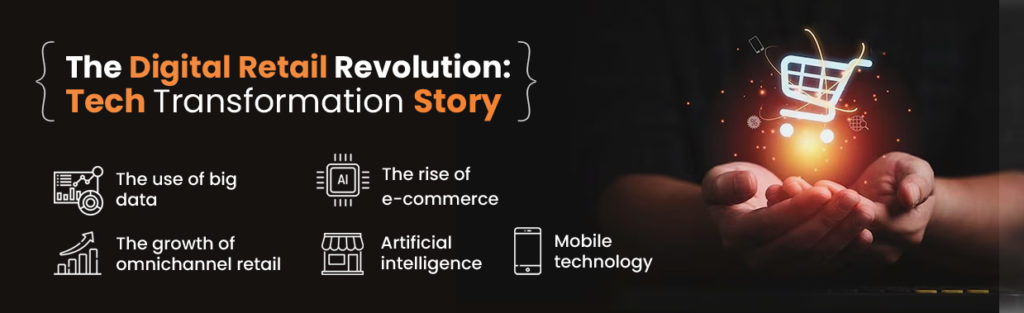
The Digital Retail Revolution: Tech Transformation Story

Digital retail is a buzzword that rings a bell in recent times. Tech transformation has reshaped the retail industry, particularly with the growth of e-commerce. Tools like machine learning and artificial intelligence have only fueled these trends. Here’s delving deeper into this transformational journey of the global retail industry. The Rise of E-Commerce E-commerce has been a game-changer for the retail industry over the last decade. Here are a few aspects worth noting: · Digital retail has been a direct result of tech transformation in the industry. This helps enhance customer experiences and drives future growth. · Personalisation in marketing and communications is possible via technology. There are also custom offers and recommendations for customers today. People can also expect swifter responses to queries and better experiences. The Impact of Technology on Retail Now how has tech transformation affected the retail industry? Here are some points that you should not miss: The Success Stories of Digital Transformation There are countless success stories of the tech transformation in the retail industry. Here are a few of them: Target’s cutting-edge digital transformation- IKEA’s virtual foray- FAQs 1.What are the key drivers of the digital retail revolution? Some of the biggest drivers of the digital retail revolution include changing consumer habits, and higher smartphone/mobile device usage and access. Other drivers include the growing need for personalisation and targeted marketing and the need to understand continually evolving consumer preferences. Another key driver is the desire to enhance customer experiences all throughout their journeys. 2.How is the digital retail revolution improving the customer shopping experience? The digital retail revolution is rapidly enhancing shopping experiences for customers. They can enjoy better in-store navigation and personalised recommendations in some cases. At the same time, they can get swifter responses to their queries and higher personalisation in case of their shopping experiences. 3.What are the benefits of embracing technology in retail? The benefits of embracing technology in retail include better customer engagement, higher customer retention and enhanced customer satisfaction. Some other advantages include personalised and targeted marketing and eventual growth driven by valuable customer insights. 4.What challenges do retailers face during the tech transformation process? There are several challenges faced by retailers at the time of tech transformation. These include integration with existing or legacy systems, digital literacy challenges and data privacy or security.

Read More »
Challenger Bank Is The New Coopetitive Competitor

Challenger Bank Is The New Coopetitive Competitor

Challenger banks have witnessed phenomenal growth over the last few years, becoming marshals of the global fintech space. These banks have set the cat amongst the pigeons in conventional banking globally with more innovation, digital-led offerings and unique and multi-dimensional customer service.  With a customer is king template and the spirit of coopetition or positive collaborations in the space, challenger banks could well be the fast-growing Davids amidst banking Goliaths today. A Little About Challenger Banks Challenger banks are intrinsically technology companies, tapping their expertise and software to streamline and digitize conventional retail banking. These entities are strongly leveraging digital channels for distribution (usually mobile-based) to provide highly competitive services in the retail banking segment. These include savings and checking accounts, credit cards, insurance and even loans. How Do They Differ From Their Regular Peers? Retail banking has always emphasized the presence of a branch and in-person experiences, while challenger banks are always tech-driven, depending on desktop/mobile platforms. They harp on customer experiences and continual improvement, targeting those desirous of online banking without visiting any retail point. Challenger banks are gaining ground among customers who are shying away from conventional bankers and institutional players post the worldwide financial crisis. They are posing a literal challenge (true to their name) to the business models of retail bankers. This is being done through low and transparent fees charged to customers, faster service offerings and superior user experiences via 24-7 agile digital platforms, which can give legacy banking software a run for its money. Challenger banks are also reaching out to under-served or un-served demographics (for conventional retail banks), including those in lower-income groups or without credit histories, for instance. The Digital Banking Revolution And What It Means Reports highlight 240,000 bank branches throughout Europe in 2019 when digital banking was still in its nascent stages. Yet, challenger banks are expanding with the premise of people moving completely towards mobile and digital banking in the future. Digital banking has broken records ever since, with branch counts in Europe reducing to 165,000. It could well go down even more over the next few years, per domain experts. Some reports forecast how 3.6 billion global citizens (almost 1 out of 2 adult individuals) will use digital banking by 2024, across desktop and mobile channels. The United Kingdom (UK) has already embraced the Digi-banking wave and more countries in the continent are in the queue. The coronavirus outbreak added fuel to the fire, leading to the closures of several retail banking branches and accelerating the adoption of digital banking platforms. Global usage of mobile payment and banking apps went up by 26% in H1 2020, per surveys. Challenger banks are feeding off this digital shift, while conventional bankers continue maintaining branch-based models, developing their online offerings simultaneously. How Coopetition Is The New Mantra For Challenger Banks? What is this new keyword coopetition that is being widely discussed at a global level? What has it got to do with worldwide fintech and challenger banks? The word fuses the terms competition and cooperation. This means that challenger banks are partnering with conventional banking institutions for building new services, products and industry solutions. Many industry stakeholders feel that this is the best future pathway for the banking and financial services sector in terms of innovation. They highlight collaboration and teamwork as necessary virtues for creating a future ecosystem that serves customers even better and in more innovative ways. Key Schools Of Thought And Developments  The collaboration will ultimately unearth higher consumer benefits, and feel industry veterans. Fintech players/challenger banks and conventional banks may not always be competing in the same segments. They may have different customer sectors and demographics. This may help in building newer avenues for feeding off each other, stimulating a spirit of continual learning and growth. Coopetition may not only encompass teaming up to build new products and services but also knowledge exchange via webinars, forums, industry conferences and best practices. Some feel that competition and coopetition represent similar ideals. Businesses will always have goals putting them directly against other entities in the same industry. However, this does not hinder collaborative work in areas beyond the competition. Some of these areas highlighted by experts include enhancing overall financial inclusion for instance. Several challenger banks are already partnering with conventional peers for enhancing outcomes for consumers, including more people who would not normally fit into traditional lenders’ profiles. Some Other Things Worth Noting Some industry experts also opine that almost 1/3rd of the millennial generation may have already switched to digital banks as primary providers of checking accounts. Hence, they claim that digital entities are not challenger banks anymore but are a part of the mainstream. Some claim that this indicates how digital banks have already won the battle against their traditional counterparts while some indicate this as a natural response to the shifting demands of consumers. Some feel that banks and institutions should sync their future goals digitally with building experiences for consumers. More than 50% of people will only work with institutions offering digital account opening in the future according to these experts. Many flags the role played by legacy vendors in the global banking sector with outdated technological expertise and acquisition-driven approaches toward future innovation. The Core Takeaway The whole world is closely following the next phase of the ever-evolving relationship between conventional lenders and fintech players (challenger banks).  How will it pan out? Can conventional lenders adopt a more agile mechanism towards shifting consumer preferences, teaming up with challenger entities to speed up their procedures, include more people into the portfolio and build innovative experiences for customers? Can coopetition work in such a hotly contested space? Will this become a successful operational model for the BFSI sector globally?  An insular way of doing business is no longer possible technologically at least. If you keep that aspect in mind, think how Apple offers Google apps in its App Store or how Microsoft has gone ahead to include not just the Windows OS for

Read More »
API Driven Digital Transformation Can Be A Great Answer For The World Post COVID

API Driven Digital Transformation Can Be A Great Answer For The World Post COVID

The Covid-19 epidemic has forced the business and the political world leaders to conclude the same thing – digital transformation is the need of the hour. In a matter of just a few months, Covid-19 has caused a paradigm shift in the way we interact with our outside world. Containment measures, quarantines, lockdowns and travel bans have forced people all over the world to resort to social media, e-learning and online shopping. Simultaneously, as a response to strenuous social distancing measures, educational institutions and companies are adopting digital technology at break-neck speeds. According to a study by Deloitte and Institute of International Finance, insurers and banks have been able to withstand the onslaught of Covid-19 thanks to their investments in digital technology in the past decade. Employees can now work from any location, thanks to cloud computing. Data centres can now be linked across multiple sites. This has enabled financial institutions to reduce risks more efficiently. No longer do organisations have to depend upon any single venue for all their resources, lest it becomes a hotspot for coronavirus. Emerging technologies which were gradually finding their pace., have suddenly out to compete with the existing robust technologies. In a recent interview, Satya Nadella , CEO of Microsoft highlighted how he just saw two years’ worth of digital transformation in just two months. The evolution of businesses now lies in building long-term, cloud-based, digital infrastructures that drive future-of-work, future-of-experiences, data management and connected innovations. APIs can be a great way to answer this evolution. Building An API First Economy Is Imperative Today, companies are building their technology in a way so that they are good for repeat use. Corporate history is witness to the fact that modularity and interoperability have led to competitive advantage, time and again. In the world of IT, application programming interfaces or APIs are key to supporting design modularity and interoperability. As architectural techniques go, APIs are as old as computer science itself. They facilitate the way solutions and systems execute transactions, invoke business logic and exchange information. Today, APIs play a critical role in system modernisation, innovation and architecture. According to Deloitte, the number of public APIs that were available in early 2017 was more than 18,000. To be sure, private APIs across conglomerates are expected to be in the millions today. As of today, the customer, a human being is craving for a connection and comfort right now. The most important question that any company can ask itself is how to add value to his or her life in a relevant, human and meaningful way without doing much to their existing systems. For instance, the global epicentre of the coronavirus, China, had shut down all retail businesses. People were unable to partake in one of the most communal comforts across Chinese restaurants, hot pot dining. So that people do not miss out on one of their most enjoyable local cuisines, restaurant chains began to deliver the ingredients to the individual residences of the customers. Even when the restaurants were shut, the patrons could still enjoy their favourite meal all because they could collaborate in a single platform quickly. Onboarding your employees and customers is a must have now. It is easily referred to as Digital onboarding, a series of activities which companies use for getting new employees/customers and making them familiar with the policies/products of the organisation via digital platforms. According to the Inside Magazine Issue 16 Deloitte research, around 38 percent of all customers drop out of the onboarding process. This is due to the tediousness surrounding paperwork &multiple touchpoints. A number of organizations are using it aggressively for their new recruits. With the platform’s capability to be accessed from anywhere, new recruits can begin the digital onboarding even before they join the physical premises. Since all the forms, modules and forms are generated from a single database, there will not be any lack of consistency with the onboarding process across locations. The electronic interface ensures that management has a firm grasp on the status and progress of the onboarding process for each new recruit. Any new employee can complete the onboarding process from a location of their choice. Employees can complete the onboarding at a speed of their choice. Nothing ever gets missed because the online platform ensures complete compliance. In the movie Apollo 13, Gene Kranz, played by Ed Harris, overhears a director comment that the Apollo 13 debacle is the worst disaster that NASA has ever experienced. He replies that, with due respect to the director, he believed that it was going to be their finest hour. The Covid-19 pandemic has wreaked untold havoc on the global business and economy. Yet, companies all over the world are rediscovering themselves through digital transformation. Thanks to innovations such as API & digital onboarding, organisations are successfully turning the tide in their fight against the Coronavirus.

Read More »
MENU
CONTACT US

Let’s connect!

Loading form…

Almost there!

Download the report

    Privacy Policy.