Tag: customer segmentation

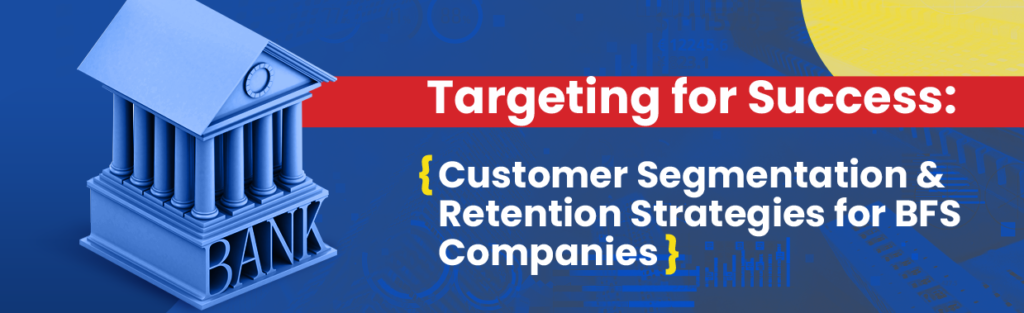
Targeting for Success: Customer Segmentation and Retention Strategies for BFS Companies

Targeting for Success: Customer Segmentation and Retention Strategies for BFS Companies

The importance of proper customer retention and customer segmentation is unparalleled in the banking and financial services sector. Retention is crucial since it is always more beneficial to retain more customers who not only add to the BFS company’s revenues and recommend it to others, but are also not as costly to retain in comparison to the acquisition of newer customers. Satisfied and long-term customers are not only more amenable towards price or other fluctuations, but are also more likely to engage in word of mouth recommendations. With proper segmentation, BFS firms can target customers better, depending on their specific needs. Customer retention strategies for BFS companies Here are a few customer retention strategies that BFS firms can use: Customer segmentation and how it is essential for BFS firms Customer segmentation is crucial for banking and financial services firms. Before venturing into data analytics, you should undertake segmentation on the basis of behavioral patterns. This will be influenced by things like preferences for rewards/loyal programs/promotions/deals and also buying patterns, overall frequencies for purchases, and other parameters. This will help you roll out targeted marketing and recommendation campaigns for various segments/groups based on these insights. Customer segmentation involves tailoring your content for ensuring the delivery of more relevant and useful marketing campaigns for specific customer groups in place of choosing generic messaging for everyone. Here are some segmentation strategies that you should follow: Segment-wise communication and engagement strategies, along with tailoring messaging for every segment will help you create better personas of your targeted customers. You can then leverage insights to come up with the best marketing campaigns tailored to customer requirements. FAQs 1. How can BFS companies effectively identify and define their target customer segments? BFS firms can more effectively identify their targeted customer segments and define them better through proper segmentation. They can do this on the basis of data analysis, helping them classify customers on the basis of parameters such as age group, buying habits, patterns, products/services most required, life stage or life cycle in the customer journey, and so on. 2. What are the key benefits of customer segmentation for BFS companies? Customer segmentation helps BFS companies in several ways, enabling them to target specific groups better with tailored marketing campaigns, recommendations, and products and services. BFS firms can know which target groups require specific solutions and offer the same accordingly. 3. What challenges or obstacles do BFS companies face when implementing customer segmentation and retention strategies? BFS companies face a few obstacles in the implementation of customer retention and segmentation strategies. These include the absence of technological expertise, compatibility and integration issues along with the inability to leverage data analytics for enhancing customer experiences and satisfaction alike. 4. How can BFS companies measure the effectiveness and ROI of their customer segmentation and retention initiatives? BFS companies can track the ROI and effectiveness of customer retention and segmentation initiatives by undertaking data analytics relating to parameters such as sales growth across segments, changes in consumer patterns, customer feedback trends, churn rates, and so on.

Read More »
FinOps bridging Cloud gap

Customer Segmentation: How To Do Market Segmentation To Acquire New Customers In The Insurance Sector

It is no secret that the global insurance industry is characterized by cut-throat competition and aggressive marketing outreaches to onboard more new customers. At the same time, despite adopting aggressive sales-funnel strategies, insurance fails to build that fabled consumer connect.  Our project focuses on insurance segmentation and insurance customer segmentation to better understand and target different customer groups effectively.“Market segmentation for insurance helps companies understand consumer behaviour in the insurance sector, enabling them to design targeted products and marketing strategies.” Insurance companies use insurance market segmentation and financial and insurance segmentation to identify customer groups and tailor products that meet their specific needs more effectively. “Market segmentation for insurance companies often relies on effective customer segmentation in the insurance industry to tailor products and marketing strategies to different client groups.” Customers mostly remain confused about choosing the rightinsurance company and plan amidst a thousand options. Most companies also focus on lower prices as their key selling points. This leads to a scenario where insurance companies emphasize more managing costs/prices, lowering customer engagement and service quality, and enhancing their customer churn simultaneously. What is the best way for the insurance sector to acquire more new customers without adopting a price-first approach? What is the best solution for building better customer engagement strategies and relationships throughout the process? The answer lies in customer segmentation in insurance.  Without suitable customer segmentation datasets, it is near impossible to tailor services/offerings to suit particular customer types or demographics. This is needed for ensuring that personalized touch and a broader service range to attract and retain consumers while understanding what they require in terms of assistance. What Is Customer Segmentation? By customer segmentation, we mean the practice of sub-dividing customers into multiple groups. Each group shares its own set of features, attributes, objectives, and requirements.  This is the ideal way for insurance companies to come up with tailored products, services, and solutions for each group, ensuring better engagement for a wider range of customer groups. Types Of Customer Segmentation The conventional segmentation formula includes categorizing consumers based on parameters like gender, age, employment nature, income, and life stage among others.  However, in a hotly contested insurance sector, there is a need to revamp the entire perspective towards segmentation with a customer-centric operational model, one that continually finds out newer parameters and keeps changing the framework likewise.  Sounds confusing?  While a specific consumer group may have some similar traits or attributes, it does not always equate to the same objectives, needs, and perspectives amongst individuals. Today’s customer is a smarter one, looking for hyper-personalization as per his/her specific requirements and stage of life. This is only possible with dedicated market research and ever-evolving segmentation. Why It’s A Win-Win Proposition Is customer segmentation in insurance worth it? It does have long-term advantages for insurers. Once segments are built, they can help in generating hyper-personalized solutions for a wider number of consumers. Segmentation makes it more convenient to build marketing material and insurance products alike. Insurance companies benefit from putting a vast chunk of consumers into more manageable and operational groups which helps them launch campaigns directed at specific audiences on time.  This fosters better engagement, leading to superior product branding and higher customer satisfaction at the same time. It also helps insurance companies up-sell products or get more renewals into the door. Marketing campaigns may also be automated for tapping specific consumer segments with suitable solutions, based on the achievement of newer and bigger landmarks/milestones.  And that is only the tip of the iceberg; segmentation helps insurers identify more prospects who share similar needs, traits, and features. Hence, many un-leveraged segments may be unearthed as a result. They can also focus on products that have a specific need/demand in the market, avoiding the expenditure of more energy/resources on those that do not cater to any specific segment/group. Segmentation can help in finding trends in the market while stimulating better strategies to cater to existing demand.  Insurers can come up with segment-wise offers for enhanced retention and higher customer satisfaction, chalk out segment-wise pricing strategies and get more people to recommend their businesses to like-minded people. Behaviour-related consumer data (group-wise) also help insurers identify possibilities of risks or opportunities and come up with timely responses. For example, suppose a consumer group is identified through data, which has a bad experience with getting their claims processed, and in this case, the insurer can follow up with a timely message which states that these consumers can call the helpline for getting future claims resolved quickly or coming up with any other mechanism that nips potential issues in the bud before customers switch to other companies.  This is only one out of several such possibilities and case studies that may arise in this regard. Data-driven segmentation results in what we call actionable insights, leading to higher customer acquisition, retention, and better marketing for insurance companies.  Many technological tools and frameworks can enable evolving segmentation of consumers and they are being used by insurance companies today. However, that is a story for another day. About the author: Dipak Singh is a thought leader and data cruncher, currently, he heads the Analytics Wings at INT. To know more do check out his LinkedIn profile here.

Read More »
MENU
CONTACT US

Let’s connect!

Loading form…

Almost there!

Download the report

    Privacy Policy.