Category: BFSI

INT. Pulse

 Close shave – Thank your asteroids.

Dear Colleague, we woke up today with a bit of a ‘dinosaur feeling’. 🦖 How Come? The Jurassic emotion was a direct result of finding out that a house-sized asteroid is making a very close pass of our planet today.  Fyi, when faced with the wrath of such a rogue rock, the dinosaurs were not so lucky, and that’s evident because these days you are filling up their remains in your car’s fuel tank.  🦖 + ☄️ = ⛽ What’s On The Rocks? As you read this, Asteroid 2018 BG5, a space rock from the Apollo group of near-Earth asteroids, will fly by earth (July 27,2023) at a speed of 30,094 kays an hour, per NASA’s Center for Near-Earth Object Studies (CNEOS).  The asteroid will come as close as 4.1 million kilometers to us – a distance which may seem large, but it is relatively small in astronomical terms, considering the vastness of space and the size of the asteroid. Should You Withdraw All Your Savings? No. No. NASA’s best have assured that there is no risk of impact with Earth today or in the foreseeable future. ⚠️ However, even a small asteroid can cause significant damage if it enters the Earth’s atmosphere, as shown by the Chelyabinsk meteor event in 2013, when a 59 feet asteroid exploded over Russia, injuring over 1000 people and damaging nearly 8000 buildings. STATS: Sorry, The Doctor Isn’t Available Life sciences leaders, heads up. Are your sales reps getting the cold shoulder/elbow nudge from doctors more often these days? Turns out, they are not trying to hoodwink your system while catching up on Oppenheimer during office hours. Yeah? How Is That? A new CMI Media Group survey of physicians across countries is providing fresh evidence that face to face meetings with doctors is becoming a rare commodity since COVID-19. When asked, 25% of the doctors reported reducing face-to-face interactions. With another 10% of doctors permanently closing their doors for reps, the survey suggests pharmaceutical companies will find it increasingly tough to put their drugs in front of ~35% of physicians via the traditional in-person route. Aha. What Could Work Then? To start, how doctors utilise their time roughly maps onto the value they place on each touchpoint. Print and online journals are on top, with 79% finding them very or extremely useful. Pharma reps on the other hand, are pretty much down on the attention radar. Only 33% doctors find reps very or extremely useful, placing them below resources like medical websites and unbranded disease education from biopharma. Bonus Data Points 🍎 99% doctors engage with print/online journals or medical websites at least once a month. 🍎 75% also engage with search engines and email, online drug references, direct mailers, medical apps, professional online communities, brand emails, medical videos on YouTube, and medical podcasts. The doctors’ world is clearly leaning towards an omnichannel approach. If you need to explore such a strategy, chat up with Anindya, our resident Life Sciences man. Psst, he curates the most amazing conversations over ☕️. Ai & ANALYTICS: The Chatbot Will See You Now Unlike physicians who are reducing their face time with med reps, did you know chatbots have no pressing personal issues (yet) and are doing mankind some sterling service?  I Do  This blurb refers to securing consent from humans for stuff like clinical trials and other life sciences related studies, where, hold our battery pack, chatbots are doing very well.  Seriously? Yo! Results from a study of the use of a chatbot in the consent process show that it encourages inclusivity, and leads to faster completion of the process with high levels of understanding.  On the flip side, the traditional method of securing consent lacks a mechanism to verify understanding objectively, just like all the web forms we give consent to without understanding zilch of the fine print.  Comparatively, the chat-based method can test comprehension, disqualifying users who do not show understanding to give consent; rather, it puts them in touch with a genetic counsellor to figure out why knowledge transmission did not occur.  Pretty dang smart for a piece of software, talking of which, we have a whole bunch of AI-powered chat bots held in a big steel vault behind Dipak’s office desk. Get in touch with him to deploy one for your business.  BFSI: A Single Source of Truth We’ve been swamped with news, stories, videos, and you-name-it, all revolving around artificial intelligence, once prompting OpenAI’s CEO to say, people are ‘begging to be disappointed’ about GPT4, meaning let’s water down the hype, please.  But amid all the speculation and noise, what are the most achievable, real world uses of AI?  The BFSI Space Is A Great Start, We Say The BFSI sector is flourishing with AI tech integrating with many functions, from the digital KYC verification process to evaluating credit scores.  However, to quench the thirst of the customer base accustomed to the convenience of digital tools, the industry needs to deploy more AI tech, the first among them could be;  Customised Experience: Because of the very nature of the trade, BFSI players have always had a finger on consumer pulse. Time to take that to the er, bank. Their spending patterns and investment portfolios can assist BFSI businesses to build relevant, personalised messages, enabling them to better present their products and services across various platforms, improving acquisition and loyalty.  This is where AI and data analytics shine, delivering value by creating a single source of truth from an ocean of data from within and outside the business.  Fraud Detection: While the original BFSI fraud detection model is focused on detecting fraudulent transactions – an area where generative AI has added a powerful weapon to the fraud detection arms depot – a gap remains.  You guessed right, detecting fraudulent human behaviour. Fraud does not happen in vacuum or underwater. People commit fraud.  AI can also be deployed to comb through the field of behavioural indicators. It’s time to task AI with sifting through the subtleties of human communications — written


Read More »
Banking & Finance News Wrap

Banking & Finance News Wrap | Weekly Snippets

✅ AI and machine learning join forces with financial crime programs to take security to new heights. It’s time to stay one step ahead of fraudsters and safeguard your assets. https://www.securitymagazine.com/articles/99596-ai-and-machine-learning-have-been-added-to-financial-crime-programs ✅ Emirates NBD and Microsoft are reshaping the banking industry, making it more seamless, secure, and customer-centric with the use of new age tech. https://ibsintelligence.com/ibsi-news/group-chief-operating-officer-emirates-nbd/ ✅ Mastercard’s latest AI-powered fraud risk solution is teaming up with nine UK banks to stay one step ahead of fraudsters.  https://www.fintechfutures.com/2023/07/nine-uk-banks-tap-mastercard-ai-to-fight-payment-fraud/ ✅ Elon Musk takes us on a journey into the uncharted territories of artificial intelligence with his new AI startup. Led by a team of handpicked experts, Elon’s AI startup holds the potential to transform various industries.  https://finance.yahoo.com/news/elon-musk-unveils-ai-startup-211512549.html

Read More »
Transforming Banking Experiences with Generative AI

Transforming Banking Experiences with Generative AI

Digital transformation is the cornerstone of almost every industry today and banking is no exception. Generative AI and machine learning are technological innovations that are fast revamping the entire banking landscape in the recent scenario, redefining automation for financial services, personalisation and customer engagement and overall operations including risk management. Generative AI is a specialised category of AI (artificial intelligence) which helps in the generation of fresh ideas and content along with pattern-based solutions that are gleaned from pre-existing information. It is thus suitable for diverse applications throughout the banking sector. It can enable intelligent decision-making along with better risk management, fraud detection, and real-time decisions. Here is a deeper look at the same.   How is generative AI used in banking? Generative AI and machine learning can enable the analysis of huge volumes of data sets and then generate responses accordingly. Trends and patterns can be easily identified and the information leveraged to take informed decisions accordingly. Here are some of the core aspects worth noting in this regard:  Customer service with generative AI Customer engagement and service can be radically transformed with the help of generative AI. Here are some points worth noting:  Risk management with generative AI Generative AI will be a huge game-changer and harbinger of digital transformation in the near future. Chatbots and virtual assistants will steadily take over the customer support space with human resources focusing on more crucial duties. Loan processing and other duties will be streamlined and customer experiences will be more personalized and fulfilling. FAQs 1.How can banks effectively adopt generative AI technologies? Banks can adopt generative AI technologies for identifying potential frauds, managing risks, predicting future risks, and also automating customer evaluation including credit and financial history checks. Banks can also use these technologies for improving customer service and enabling higher personalization. 2.Are there any challenges or risks associated with implementing generative AI in banking? There are challenges like data privacy and the need to use synthetic data in the right manner for avoiding breaches and security hassles. Generative AI models may sometimes have higher complexity and interpretation may be tough in some cases. Maintaining transparency and adhering to legal/regulatory mechanisms are other challenges in this regard. 3.How can generative AI help banks make better financial decisions? Generative AI can enable banks to take better decisions through analyzing customer data and offering insights in real-time. Naturally, banks can take more accurate and informed decisions about sanctioning loans and other customer-facing aspects. 4.Can generative AI replace human bankers in the future? While generative AI will automate and streamline repetitive tasks in the future and possibly take care of customer communication and support, it will not be a full replacement for human beings. It will help in policy-building, decision-making, fraud detection, risk management, and personalization. However, human bankers will always be required for taking care of more crucial and complex tasks

Read More »
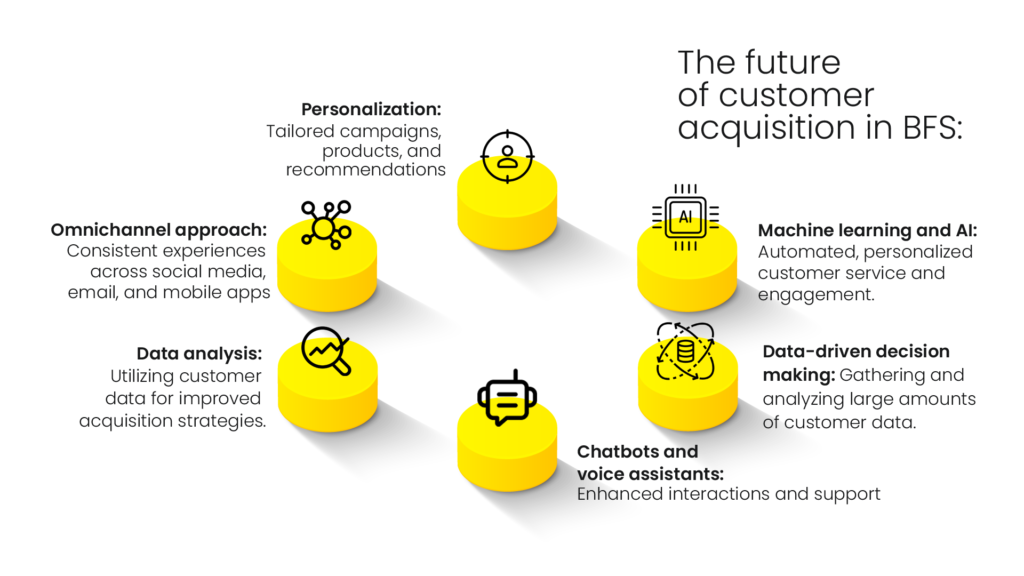
future of customer acquisition in banking and finance (bfs)

Expanding Horizons: Enhancing Customer Acquisition with External Data in BFS

Customer acquisition is a vital aspect for any BFS entity. There are instances where tapping external data for the same has proved to be a bigger value proposition for these companies. Here’s taking a closer look at the same. How to Use External Data for Customer Acquisition in BFS As is evident, external data is increasingly proving to be a game-changer for banking and financial services entities. It is helping them get a better profile and view of the customer. This is naturally enhancing customer acquisition efforts greatly, helping personalise products/services along with interactions. It is naturally leading to higher customer loyalty and retention. The Benefits of Using External Data for Customer Acquisition Customer acquisition will increasingly be driven by the need to gather sufficient data about customers and then personalise their journeys. This will be the guiding principle for banking and financial services companies in the future. FAQs 1.What types of external data are commonly used to enhance customer acquisition in the BFS sector? Some external data types include geopolitical and economic data, historical data, weather data, satellite imagery, demographic data and so on. 2.What are some specific examples of how external data has been successfully utilised to enhance customer acquisition in BFS? External data can help companies understand customers better in relation to external events and factors. It helps predict market and consumer behavioral patterns and other dynamics. 3.What privacy and data protection measures are in place when using external data for customer acquisition in the BFS industry? Companies should follow strict data privacy protocols including informed consumer consent while gathering data, encryption, multi-factor authentication, transparent privacy and usage policies, and so on. 4.What are the challenges or considerations when integrating external data into customer acquisition strategies in BFS? Some challenges include data quality and delivery issues along with privacy and security risks. The absence of actionability may be another challenge, in addition to resourcing-related constraints.

Read More »

Securing Data Ownership in Indian Banking: A Blockchain Revolution

Data ownership in Indian banking is a prickly aspect that most BFS players are slowly coming to terms with. When it comes to data security and data privacy, banks and financial institutions are learning to depend on the Blockchain in recent times. They are integrating this advanced technology into their Cybersecurity initiatives on a bigger scale. But does Blockchain revolutionise data ownership and its security in Indian banking? Here are a few aspects that should be closely examined in this regard. How important is data security for the financial industry? Data privacy or security is one of the biggest concerns for the global financial industry in recent times. Institutions now have to maintain stringent data security standards in order to safeguard their customers and businesses. Here are some points that highlight the importance of data security for the financial industry: Technology is continually in a state of flux. With more updates and integrations, there are increasingly evolving cyber threats to deal with. The importance of data privacy and security is unparalleled today for the financial industry. Hence, widespread reliance on Blockchain technology, subject to governing protocols, may help them maintain stringent data ownership and security controls. This will automatically enhance brand reputation and safeguard consumers from data thefts. FAQs 1.What are the advantages of decentralisation in securing data ownership in Indian banking? Decentralisation does away with third parties, thereby eliminating risks of data loss or leaks. At the same time, users have more control over their data once they record the same on the Blockchain. They can control access to the same, while the data cannot be changed or modified. 2. Is blockchain the future of data ownership and monetisation? Blockchain seems to be the future of data monetisation and ownership with verified and immutable transactions along with higher user control over data. 3.What are the advantages of decentralisation in securing data ownership in Indian banking? Decentralisation means that third parties are not required for transactions. Hence, there are no third party risks or data misuse concerns for banks. At the same time, transactions are verified and authentic. Data ownership is higher for users, with full access control and blockchain data cannot be changed or modified in any manner. 4.What are the potential risks and challenges associated with data ownership in the Indian banking industry? Data ownership risks and challenges for the Indian banking industry include leaks and misuse of data by third parties, tampering of data by cyber-criminals, continual threats of malware, hacking and other attacks and so on.

Read More »

Strengthening Cyber security in BFS: Addressing the Challenges and Risks for a Secure Future

Boosting cyber security in the BFS (banking and financial services) sector is of the utmost importance. With the increasing cyber-attacks on these institutions and their widespread shift towards digitized financial services, caution is the name of the game at this juncture. It is a reality that the BFS industry is under higher threats these days, becoming arguably the highest-targeted sector for cyber crooks. There is always a need for prompt threat detection along with robust network security to combat risks like data breaches and digital banking threats. Credit-card threats are also on the rise in recent years. Malware as a service or MaaS is another unfortunate and problematic trend of launching malware attacks. DDoS (distributed denial of service) attacks are also issues for BFS players, where a compromised PC network is leveraged for creating a huge number of false requests to the systems of the platform or bank, thereby leading to a disruption in operations and leaving them unable to respond to consumer requests of a legitimate nature. This naturally makes cyber security a necessity for the BFS industry. Cyber security in the banking and financial services sector and associated aspects Cyber security is the collection of protocols, technologies, and other methods which help guard against damages, attacks, viruses, malware, data thefts, hacking, and unauthorized access to devices, networks, data, and programs. Safeguarding user assets is the key objective in this case, while upholding data privacy and adhering to data safety regulations simultaneously. Digital payments, debit and credit card usage, wallets, and other cashless means of transactions necessitate cyber security measures. Data breaches are not only damaging for customers, but also costly for financial institutions. Cyber frauds or attacks also lead to a huge amount of time and energy being spent in recovering from the same. Inappropriate usage of private data may also be damaging in a larger context, since user information is usually sensitive. Cyber security measures are necessary to prevent issues like phishing attacks, Trojans, spoofing, ransomware, and more. Here are some applications that are worth noting: Network tracking is continually scanning networks for signs of any intrusive or dangerous behaviour. It is frequently used in tandem with other security measures like IDS (intrusion detection system), antivirus software, and firewalls. This software enables either automatic or manual tracking of network security. The application security guards applications which are vital for business functions. This come with features like code signing and listing, while enabling synchronization of the security policies with requisite file-sharing permissions and also multi-factor authentication. AI is now playing a vital role in cyber security, enabling better authentication or verification protocols. Financial cyber security involves data integrity, risk management, risk analysis, and security awareness training. Some other core aspects include evaluation of risks and prevention of harm from the same. Data security also takes care of ensuring the security of sensitive data. Wide-area connections enable prevention of attacks for huge systems, while adhering to rigorous safety protocols. It continually tracks all vital programs and undertakes security checks for servers, users, and networks. Challenges while implementing cyber security in BFS frameworksHere are some of the hurdles that have to be overcome, while implementing cyber security measures in the BFS industry: FAQs

Read More »
Navigating Risk in Digital Lending

Navigating Risk in Digital Lending

Digital lending risks abound in the current scenario, which require careful navigation. The need for suitable risk management in lending is increasing by the day. Here is a snapshot of the biggest online lending risks and how financial institutions can navigate the same. 1. Higher consumer risks in digital lending– Banks are facing higher operational risks in online lending. They are streamlining the process through the adoption of paperless loan approvals, while using automation to enhance overall quality and time alike. There is a concern regarding risks of customer data safety, since they share account and personal details, credit history and a lot more on applications. Banks and financial institutions are now looking at increasing cyber security in lending and measures to implement mechanisms for data privacy in lending. Dedicated security prevention is possible with the right technological framework and solutions which BFS players are steadily opting for.  2. Credit risks– There is a need for proper credit risk assessment in digital lending, considering how customers with poor or low credit may lead to growing NPAs and hassles for BFS players At the same time, there is always a risk of defaults in the future. Hence, these companies need to use data analytics and advanced credit evaluation systems for ascertaining the creditworthiness of borrowers. There is also a need for swift assessment and proper credit evaluation models can help address the same digitally. 3. Compliance and regulatory risks- BFS players have to increasingly factor in compliance risks in fintech lending. The RBI and other authorities are coming up with evolving guidelines and regulatory mechanisms that have to be adhered to in a strict manner without lapses. Usage of artificial intelligence, insights, and regulatory mechanisms is the solution to navigate these challenges. 4. Market risks in digital lending– There are always risks of market changes, volatility, and fluctuations that may turn out to be problematic for digital lenders. Hence, using advanced AI-based forecasting models and analytics could help gauge market patterns, trends, and consumer preferences. This will aid the creation of products and services, while boosting strategic decision-making simultaneously. 5.Operational risks- Digital lending often works through a transaction process that has multiple layers. Many services are often outsourced to several entities. It sometimes becomes complicated, in terms of redressing grievances, taking care of customer complaints, and ensure effective and prompt service. This can be navigated with the use of advanced AI-based Chatbots for resolving most customer queries and prompt engagement with customers. From algorithms that personalise customer journeys and recommend products to those that quickly resolve issues or take care of complaints, automation can work wonders in this case. 6.Fraud risks– There are always risks pertaining to fraudulent applications, transactions, and breach of trust within the ecosystem. BFS players can ensure better fraud prevention in digital lending with advanced automation. Historical data analytics can help gauge patterns of a fraudulent nature. This can help detect and combat frauds in a better manner. NBFCs and banks should endeavour to periodically get security audits done, while implementing robust Cyber security measures at the same time. From firewalls and advanced encryption protocols to multi-factor authentication, there are several options available. Identity verification can be scaled up with biometric authentication, digital KYC, and quick credit bureau checks. Data analytics can be used to analyse credit histories and verify income and debt-to-income ratios. Diversifying lending portfolios is also recommended for combating market risks more effectively. FAQs 1.What are the different risk associated with lending? There are several risks associated with lending. These include data privacy, operational, credit, regulatory, market and fraud risks. 2.What are the risks associated with digital finance? Digital finance faces risks linked to the privacy of consumer data, breaches in security frameworks, preventing frauds, credit risks, and compliance/regulatory risks. 3.How do market and economic factors impact digital lending risks? Fluctuations in the market on account of geopolitical and economic factors can impact consumer behaviour and also lending rates. The effect on these variables may lead to business risks for the institution. 4.What measures can be taken to address the risk of borrower default in digital lending? Borrower default risks can be minimised with proper data analytics for evaluating historical borrower data, credit histories, debt-to-income ratios, track records, and other vital information. This helps establish the creditworthiness of individual buyers, while flagging risky customers in advance.

Read More »
INT. Pulse

INT. PULSE

Dear Colleague, each month, all of us at INT. Marketing dive into a dizzying research gig to write the best opening section of this newsletter (Fyi, Pulse has 35K+ monthly subscribers now 😎). Here’s this month’s winner – the Forrest Gump of tech, aka, Yahoo! And Why Is That? Sample this – Yahoo had a peak dotcom-days valuation of USD125 billion but ultimately – hold our coffees – was sold to Verison for USD4.8 billion in 2016. Here are five 🤯 Yahoo moments: In 1998 Yahoo refused to buy Google for USD1 million. 4 years later, in 2002, Google said it would sell to Yahoo for USD5 billion (but Yahoo only offered USD3 billion, meaning – no deal, sir.) ⏩ to 2006, Yahoo offered USD1 billion for Facebook but Zuckerberg turned it down. Sources said, if Yahoo had increased their bid to USD1.1 billion, Facebook’s board may have pushed for sale, but Yahoo didn’t budge. Come 2008, Microsoft offered to buy Yahoo for USD46 billion, but Yahoo said ‘Noooooo Wayyyyy!’ And finally, in 2013, Yahoo bought Tumblr for USD1.1 billion, writing it down to USD230 million just 3 years later. Psst: Also, instead of Tumblr, it considered buying Netflix for USD4 billion, now worth USD140 billion. STATS: Fastest Finger Hand First In a world where acronyms like DAU and MAU rule the roost, your mother-in-law will tell you that it would be wise to know the number of years it took each of the following to gain 50 million users, per the World of Statistics: Airlines: 68 yearsCars: 62 yearsTelephones: 50 yearsCredit Cards: 28 yearsTV: 22 yearsComputers: 14 yearsThe Internet: 7 yearsPayPal: 5 yearsYouTube: 4 yearsFacebook: 3 yearsTwitter: 2 yearsWeChat: 1 year ChatGPT: A little less than 30 days, and……🏆 PornHub: 19 days AI/ML: How Big Tech Effed Up (Major Time) ­All of us are in the know about tech layoffs, triggered by the arrival of generative AI. However, while dishing out pink slips may have made investors happy, there is another side to the story. Yeah? And What Is That? The AI Trap. Let us explain. As generative AI and coding took off, massive layoffs, led by big tech firms were triggered across the tech world. But, but, but, all these former employees are now going and building serious competition in 1/10th the time it would take biggies to get there. On the other hand, the big guys are perpetually stuck in meeting/webinar hell, arguing over use cases, tech stack, safety, and deployment methods, while solo developers knock the wind out of them, meaning, the long tail of software just grew 100X. Was It Avoidable? Probably not. You see, Covid tailwinds resulted in a huge surplus as people spent more time online and the big boys used that tailwind to hire, expecting never-ending growth. As the Covid winds died down, growth in tech crashed, leaving big tech players bloated, less agile, and ready to walk into the AI trap, with arms wide open. 💡 At INT., we have an agile AI and Advanced Analytics setup that is doing some cool work in the BFSI, Life Sciences and Retail space. Reach out to Dipak Singh to know how you can reduce costs and improve customer acquisition. ☕️ The coffee is on us! BFSI: Fintech Market Correction Is ‘Short Term’ For the last year or so, fintech exuberance has been served a super-strong shot of black coffee, with regulations clamping down hard, valuations dropping by 60% across the sector, and funding drying up by almost 43%, YoY. So, Is Fintech Dying? In one word – NO WAY! Per this BCG-QED report, the fintech growth story is only in its initial stage and is expected to grow to a USD1.5 trillion industry by 2030. Here are some key takeaways from that report. Sit back and get a hold of this. Where Does Fintech Stand Today? Word on the street is that the fintech journey is still at infancy and will continue to disrupt the financial services industry over time. Basis of that belief is; customer experience remains poor and with over 50% of the global population remaining unbanked or underbanked, financial technology (FinTech) is the only means to unlock new use cases, resulting in growth going up by leaps and bounds. Deepak Goyal, MD, BCG, opines that all stakeholders must therefore seize the moment. Regulators need to be proactive and lead from the front. Incumbents should partner with fintechs to accelerate their own digital journeys. APAC To Lead The Fintech Show Asia-Pacific is this big unserviced market, with almost USD4 trillion in financial services revenue pools, and is slated to outpace the US to become the world’s top fintech market by 2030. This growth will be driven primarily by Emerging APAC (e.g. China, India, and Indonesia) at a projected CAGR of 27%. 🔥 What’s Hot & Happening In Fintech? While payments led the last leg, B2B2X and B2b (serving small businesses) will lead the next. B2B2X is made up of B2B2C (enabling other players to better serve consumers), B2B2B (enabling other players to better serve businesses), and financial infrastructure players. The B2B2X market is expected to grow at a 25% CAGR to reach USD440 billion in annual revenues by 2030. 💡 Need to create and implement your B2B2X strategy? Souvik Chaki is your go to person, so feel free. Stuff We Are Watching ­📌 Are Credit Cards Dying? Because from now on, you can get easy credit on UPI as well. Here’s how this disruptive feature can boost the Indian Economy, or turn into a recovery nightmare, depending on who’s reading. 📌 Big Tech Work Cultures: Sample this and guess which company these people hail from – Super thoughtful, similar to Microsoft, platform mindset, but sometimes too slow to act. All Big Tech work cultures, summed up by one observer here… 📌 Why Optimise Code Anymore: Remember the old times when most software installation was done via 1.4 MB floppy disks? With storage space restrictions dead, why should developers optimise code?

Read More »
The Future of Contact Centres: How Chat GPT 4 is Revolutionising Customer Service in the BFS sector

The Future of Contact Centres: How Chat GPT 4 is Revolutionising Customer Service in the BFS sector

Customer service is a crucial function for most BFS (banking and financial services) entities, particularly since it directly influences customer satisfaction and engagement. There have been concerted efforts made by leading firms in this space towards ramping up service operations. What is the future technology for contact centres? Chat GPT 4 has come into the picture, presenting a compelling case for BFS players in terms of effectively handling customer service. Contact centres have a vital role to play in the contemporary business environment, enabling support and service to a diverse customer range.  Yet, the management and operations of contact centres can be difficult, taking the increase in customer inquiries into account, along with the need for efficiently and swiftly responding to queries. Chat GPT can completely revolutionise customer service, enabling greater benefits for BFS firms. Here’s how. A little on Chat GPT How is Chat GPT used in banking? Can Chat GPT be used for customer service? Before answering these questions, it is pertinent to note that Chat GPT is an acclaimed large language model that has been created by OpenAI. It is based on the GPT-4 and GPT-3.5 architectures, while being tailored to simulate conversations like human beings and enabling automated customer query responses. Chat GPT can also understand natural language, while being trained on diverse aspects, making it suitable for deployment across contact centres. How can Chat GPT contribute towards enhancing customer service and contact centre functions? Here are some of the ways in which Chat GPT can greatly enhance customer service and contact centre operations: It will also greatly boost customer experiences, while scaling up customer satisfaction levels considerably alongside. From recommendations to custom offers, Chat GPT can do this and more. It will help BFS players handle sudden increases in inquiries at peak times, making sure that customers get responses in a timely manner. Chat GPT for boosting the performance of contact centre employees Chat GPT can not only enhance customer service levels, but also enhance the overall performance of employees at contact centres. Here are some of the ways in which it can ensure the same: Chat GPT 4 can thus automate various tasks, thereby enhancing efficiency and overall productivity levels at contact centres. GPT-4 can completely transform communications with customers along with the total engagement levels alongside. Companies in the BFS space can automate their entire customer support functions and response/answer generation, while scaling up accuracy levels simultaneously. Businesses can take care of higher customer inquiry volumes without incurring extra costs. GPT 4 can also help BFS players build more engaging and customised customer experiences through a deeper understanding of their queries and tailoring responses accordingly. It can ensure superior customer communications through quicker content creation that saves time and resources greatly. It can generate content that is updated and accurate for customers, while keeping the relevance quotient high. Hence, it can be stated that Chat GPT 4 can be a propeller towards better functioning of contact centres in the banking and financial services segment, along with considerably ramping up customer service for better efficiency and productivity alike.  FAQs 1. How does Chat GPT 4 improve customer service in the BFS sector? Chat GPT 4 can greatly boost customer service in the banking and financial services space by automating customer responses with more personalisation and relevant answers. It can also handle a higher volume of inquiries without additional costs. 2. Can Chat GPT 4 handle complex customer inquiries and provide accurate solutions? Chat GPT 4 can easily tackle customer inquiries of a complex nature with deep-language learning and provide accurate and updated responses to queries that are increasingly relevant and not run-of-the-mill. 3. What measures are taken to ensure the security of customer data when using Chat GPT 4? Some of these measures include ensuring that there is user awareness about data usage, encryption and access control. Data regulations and privacy laws should also be adhered to by companies while using Chat GPT 4. 4. How does Chat GPT 4 reduce customer wait time and improve response times? Chat GPT 4 lowers waiting times for customers and boosts response times through generating quicker answers to customer queries along with higher accuracy levels. Customers can get answers via Chatbots and voice-bots without having to wait for human responses.

Read More »

The Power of Data: How Analytics is Revolutionising Debt Collection in BFS

Data, as always, is proving to be the real game-changer for BFS (banking and financial sector) companies. Analytics is driving higher efficiencies and benefits for BFS players, including debt collection. What is the role of analytics in BFSI debt collection? Here’s finding out. With regard to better engagement with consumers for debt collection, BFS players have always depended on conventional models including phone calls and emails/letters. The aim here is application in bulk, which has often led to several experiences that are not as pleasant for both parties (borrowers and lenders). Customers now expect increasing personalisation with diverse requirements and preferences. By tapping machine learning, AI, and predictive analytics, companies are now acting on data-based insights while resolving several problems across sectors, including debt collections. It has led to simpler, faster, and easier systems and procedures for consumers and banks alike, with advanced data science abilities providing teams cutting-edge tools that they require for higher transparency and standardising operational processes.  How is data analytics transforming debt collections for BFS entities? Here are some of the ways in which analytics is gradually revolutionising debt collections for banks and financial service providers. A. Building custom outreach strategies- Debt collection is not only about physically reaching out to borrowers. The blueprint has to be wider today, in sync with fast-changing banking ecosystems. Personalising the outreach to borrowers across types and personas, with stage-based plans across channels (deriving from anticipated consumer responses at each stage) is highly necessary for BFS entities today. Data and analytics is now spurring decision-making throughout the entire value chain of collections, along with saving time, energy, and costs for companies simultaneously.  B. Debt resolution strategies- Analytics has enabled better debt resolution blueprints on the basis of insights. These include the following aspects: Risk Classification of Borrowers- ML-based algorithms can accurately forecast the chances of delinquency of borrowers, deploying innumerable parameters as inputs. Due to resource limitations, calling every defaulter is next to impossible, not to mention the need to engage debtors, to avoid future non-payment risks and delinquencies. Hence, analytics is what enables hyper-personalisation in this case, enabling agents to communicate the right message in specific scenarios to particular groups of customers.  Channel Forecasts- On the basis of insights on earlier communication and behaviour of customers, BFS companies can predict the suitable template, channel, frequency, language, and time to contact borrowers. Several borrowers also prefer digital communication and their preferences may be better identified by algorithms. Optimising Blueprints- Tracking real-time borrower behaviour throughout multiple channels enables the creation of a personalised blueprint and mechanism for debt collection. Predicting Intent-to-Pay– It encompasses forecasting the willingness of borrowers to repay the money, based on outreach measures and historical measures for working out the priorities for the coming day in terms of tele-calling or other outreach initiatives.  Internal transaction information, when fused with other factors and behavioural triggers can predict delinquencies, while enabling BFS companies to accurately build pro-active strategies for customer outreach. For instance, lenders may swiftly gain a perspective of customers’ aggrieved/negative reactions or reducing account balance and their inter-relationships. Better Borrower Understanding- Using analytics for debt collections will enable an examination of transactional, demographic, and behavioural information.  This will help BFS players gain a better understanding of consumers, while identifying specific patterns and getting insights that help them develop strategic blueprints for collections.  Monitoring borrower responses to several types of messages is also helpful in determining ideal frequencies for interaction and suitable timelines. Risk-driven segmentation may also be useful for better targeting. Insight-Driven Debt Collection Decisions- Debt collection decisions can be taken in a better way, driven by analytics-based insights. Segmentation, predictive systems, deep behavioural analysis, and other blueprints are all possible for BFS companies. Insights are helpful for warning banking entities early regarding delinquencies and defaults in the future. It will help banks work out when people are likely to default and come up with custom strategies for mitigating these situations. These insights also help build suitable responses for interactions with borrowers. Issues with continual follow-up communication will be resolved with data-based intelligence. Banking entities will have suitable knowledge for catering to customers with suitable details at the right times.  Building Personalised Relationships- Customer relationships and experiences are crucial aspects for all BFS entities. Data-driven insights and analytics may help greatly in both these departments. Lenders can have language/region-based responses for customers. As can be seen, data analytics can completely transform debt collections for banks and financial services players. Data errors, incorrect entry, issues with detecting frauds have been identified and resolved with smart and new-age AI-based tools. At the same time, debt collection can be enhanced greatly through better insights and real-time visibility into the process. From reaching out to customers at the right time and with personalised offerings, to improving engagement and scaling up predictive/forecasting abilities, it enables BFS players to resolve long-standing problems and convert debt collection into a seamless and standardised process. FAQs 1. What is debt collection in BFS? Debt collection refers to the mechanism for collecting and recovering unpaid/due debt from borrowers.  2. What kind of data is collected and analysed for debt collection? The types of data collected and analysed for debt collection include historical customer data on engagement and interactions, behavioural data, preferences, demographic data, socio-economic and macro-economic data, past financial transaction history of customers, and more.  3. What are the benefits of using data analytics in debt collection? There are several benefits of using data analytics for debt collection, including customising communication and outreach with borrowers, predicting/forecasting future chances of defaults and non-payment, working out better debt collection strategies, and standardising the process.  4. Can data analytics help in predicting future defaulters? Data analytics can be immensely helpful in the prediction of future customer defaults, through generating insights on past purchasing behaviour, financial history, transaction history, and many other parameters. This helps banking and financial services companies forecast the likelihood of defaults and take pro-active steps accordingly.

Read More »
MENU
CONTACT US

Let’s connect!

Loading form…

Almost there!

Download the report

    Privacy Policy.